
By the FactsFigure Editorial Team | Personal Experience Series
The Heartbreaking “Friday Purge”
It used to be a ritual. Every Friday evening, while preparing for the weekend, I would perform what I called the “Fridge Autopsy.” I’d reach into the depths of the crisper drawer only to pull out a bag of what used to be organic kale, now a liquid mess. I’d find strawberries with “furry” white coats and cucumbers so soft they felt like sponges.
It wasn’t just the smell that bothered me; it was the invisible tally of wasted money—roughly $30 to $50 every single week. That is nearly **$2,500 a year** literally thrown into the trash.
I realized that buying healthy food was only half the battle. The real skill—the one nobody teaches us—is preserving it. Over the last two years, I turned my kitchen into a laboratory. I studied the biology of plants and the physics of airflow. Today, I’m sharing the “Masterclass” habits that allowed me to double, and sometimes triple, the life of my groceries.
1. The Ethylene Gas War: Understanding the “Silent Killer”
The biggest mistake I ever made was thinking my refrigerator was just a cold box where everything played nice together. It’s actually a battlefield.
The Science I Discovered: Fruits like apples, avocados, and bananas are “Ethylene Emitters.” Ethylene is a gas that acts as a ripening hormone. On the other side, we have “Ethylene Sensitive” players like broccoli, carrots, and leafy greens. When you put an apple next to a head of lettuce, the apple is essentially “screaming” at the lettuce to age faster.
My Hard-Won Habit: I now use the “Two-Drawer System.” My left crisper drawer is strictly for high-gas emitters (fruits), and my right drawer is a sanctuary for sensitive greens.
The Onion/Potato Feud: I learned this the hard way—never store onions and potatoes together. Onions emit gases that trigger potatoes to sprout eyes within days. Since I separated them into different pantry corners, my potatoes stay firm for over a month.
2. The “Dry-Clean” Method for Leafy Greens
We’ve been lied to by the grocery store misters. Those beautiful sprays of water in the produce aisle are great for display, but they are the kiss of death for your fridge.
The Experiment: I used to wash my spinach as soon as I got home, thinking I was being “organized.” Within three days, it was slimy.
The Masterclass Shift: Now, I follow a strict “No-Wash Until Needed” policy. Moisture is the primary vehicle for bacterial growth.
The “Paper Towel Shield”: I take my greens, place them loosely in a large glass container, and tuck a thick, reusable bamboo paper towel on top. If the towel gets damp after a few days, I swap it for a dry one. This simple act of moisture management keeps my arugula and spinach vibrant for up to 14 days.
3. Treating Herbs Like a Living Bouquet
Fresh herbs are the “expensive jewelry” of the culinary world. It’s painful to watch a $4 bunch of cilantro wilt in 24 hours.
My Personal Breakthrough:
I stopped treating herbs like vegetables and started treating them like flowers.
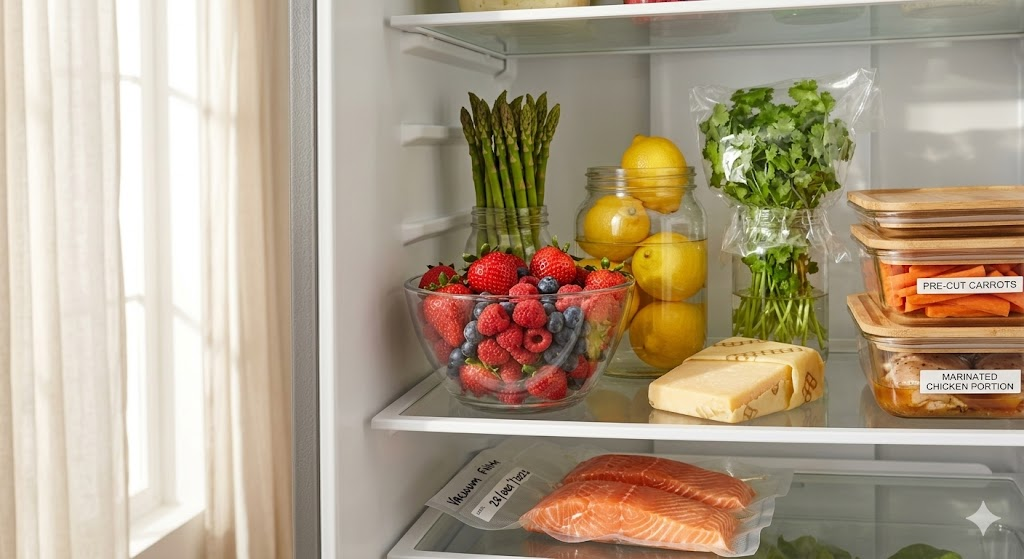
The Herb Bouquet: For parsley, cilantro, and mint, trim the stems at a 45-degree angle. Place them in a glass jar with an inch of fresh water.
The Greenhouse Effect: Cover the top loosely with a reusable silicone bag or a damp cloth.
The Basil Exception: This was a shocker—Basil is a tropical plant. Putting it in the fridge causes “chilling injury,” turning the leaves black. I keep my basil bouquet on the counter, and it stays fragrant and green for a full week.
4. The Berry Vinegar Bath: A Scientific Miracle
Berries are the “gold” of the produce world, and mold spores are the thieves.
My Routine:
As soon as I get home, I give my berries a “Sanity Soak.” 1. The Solution: 1 part white vinegar to 4 parts cold water.
2. The Bath: Soak for 5 minutes. The acetic acid in the vinegar kills the mold spores that are invisible to the naked eye.
3. The Spin Dry: This is the most critical step. I use a salad spinner lined with paper towels to get them bone-dry. Any remaining moisture will cause rot.
Since I started this, I’ve had raspberries—the most fragile of all berries—last for 9 days in the fridge.
5. Pantry Mastery: The “Dark & Breathable” Rule
Not everything belongs in the fridge. In fact, for some foods, the fridge is a torture chamber.
The Tomato Tragedy: Refrigerating tomatoes destroys their flavor compounds and turns their texture to mush. I keep mine in a wicker basket on the counter, stem-side down (to prevent air from entering the stem scar).
Honey and Garlic: Honey is immortal; it doesn’t need cold. Garlic, meanwhile, will actually start to sprout in the cold, humid environment of a fridge. Keep them in a cool, dark cupboard.
6. The “Eat Me First” Philosophy
Sometimes, the best preservation tool isn’t a gadget; it’s psychology.
I noticed that we often eat what is at eye level. To combat this, I created an “Eat Me First” bin—a bright orange container that sits right in the middle of the fridge. Anything that is a few days old or nearing its peak goes into this bin.
When my family looks for a snack, they go to the bin first. This simple visual cue has reduced our household food waste by nearly 60%.
7. Investing in Quality “Infrastructure”
Over time, I’ve moved away from single-use plastics. Not just for the environment, but because they are terrible at preserving food.
Glass Borosilicate Containers: They don’t absorb odors or bacteria.
Beeswax Wraps: Unlike plastic wrap, beeswax is slightly breathable, allowing gases to escape while keeping the food protected. It’s perfect for hard cheeses.
Vacuum Sealers: For my proteins (fish and chicken), this is non-negotiable. Removing oxygen prevents the “freezer burn” that makes meat taste like cardboard.
Conclusion: A Journey Towards a Zero-Waste Kitchen
Mastering food preservation hasn’t just saved me thousands of dollars; it has changed my relationship with food. I no longer feel the “guilt of the green” every Friday. I feel empowered.
Cooking is a joy when your ingredients are as fresh as the day you bought them. I encourage you to pick just one habit from this masterclass—perhaps the Berry Wash or the Herb Jar—and try it this week. Once you see the results, you won’t just be a consumer; you’ll be a preserver.
What is the one ingredient you’re tired of throwing away? Let’s talk in the comments, and I’ll help you build a custom preservation plan!