
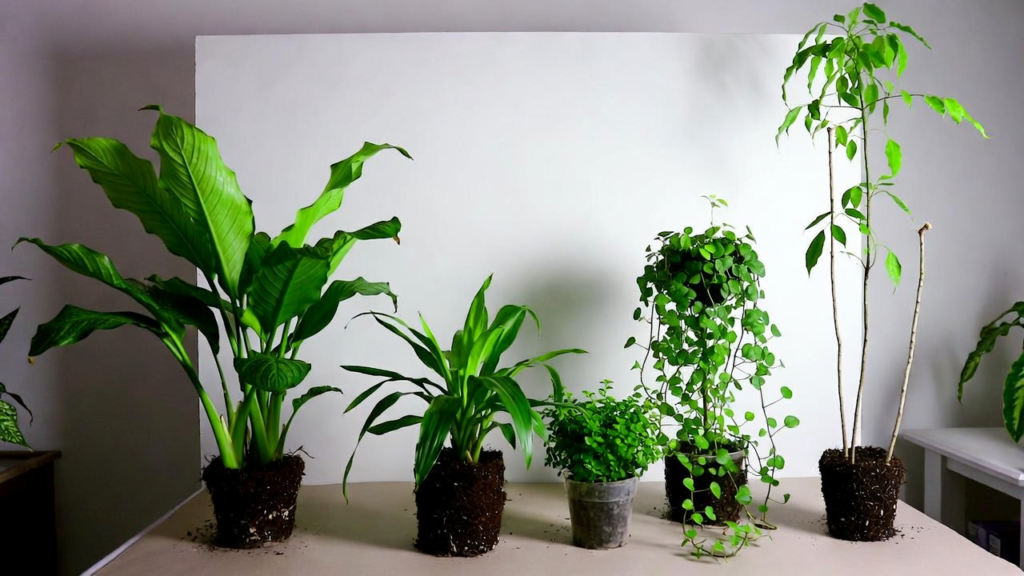
For years, I lived in a modern, tightly sealed apartment in the heart of the city. While it was cozy, I often struggled with afternoon fatigue, occasional headaches, and a sense that the air was “stale.” As someone who spends over 80% of my day indoors, I began researching ways to improve my environment without investing thousands in high-end HVAC systems.
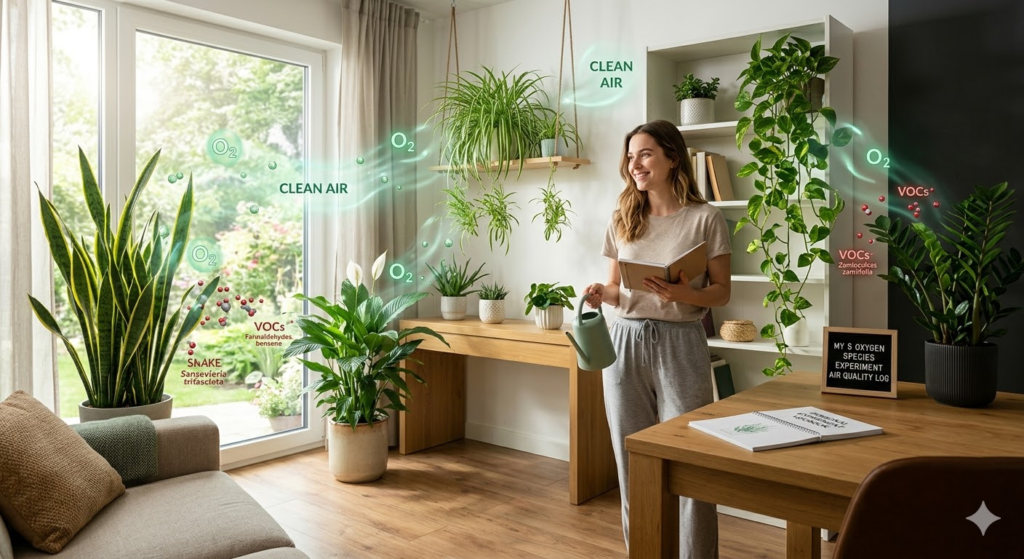
That was when I stumbled upon the famous NASA Clean Air Study. It suggested that certain common houseplants could neutralize indoor toxins like benzene and formaldehyde. Skeptical but hopeful, I decided to conduct a 6-month personal experiment. I transformed my living space into a “green lab” using five specific species.
Here is what I discovered about their “oxygen-boosting” and air-purifying capabilities.
1. Snake Plant (Sansevieria trifasciata): The Nighttime Oxygen Factory
The Snake Plant, also known as “Mother-in-Law’s Tongue,” was the cornerstone of my experiment. Most plants undergo photosynthesis during the day, but the Snake Plant is unique.
The Experiment: I placed two large Snake Plants in my bedroom, about three feet from my pillows.
The Science: It uses Crassulacean Acid Metabolism (CAM), meaning it absorbs Carbon Dioxide ($CO_2$) and releases Oxygen ($O_2$) specifically at night.
My Result: After just one week, I noticed a significant improvement in my sleep quality. The “heavy” feeling in the bedroom air vanished. It is the perfect companion for anyone prone to nighttime stuffiness.
2. Peace Lily (Spathiphyllum): The Chemical Scrubber
If you are looking for a plant that works as hard as a charcoal filter, the Peace Lily is it.
The Experiment: I positioned this plant in my living room, near a newly upholstered sofa and a synthetic rug—items known for “off-gassing” volatile organic compounds (VOCs).
The Science: Peace Lilies are champions at breaking down trichloroethylene and benzene, chemicals often found in paints and synthetic fibers.
My Result: Beyond the air quality, the Peace Lily acted as a natural humidifier. Its transpiration rate is high, which helped keep the room’s humidity at a comfortable level during the dry winter months. Note: Be careful if you have pets, as this plant is toxic if ingested.
3. Spider Plant (Chlorophytum comosum): The Carbon Monoxide Specialist
The Spider Plant is incredibly resilient and produces tiny “spiderettes” that hang down from the main plant, making it a beautiful hanging decoration.
The Experiment: I hung a Spider Plant in my kitchen, a high-traffic area where I use a gas stove.
The Science: NASA found that Spider Plants can remove up to 90% of the formaldehyde and carbon monoxide in the air within 24 hours.
My Result: It was the most “self-sufficient” plant in my lab. It thrived even with irregular watering and significantly reduced the lingering odors from cooking. It’s also completely non-toxic and safe for cats and dogs.
4. Golden Pothos (Epipremnum aureum): The Formaldehyde Fighter
Commonly known as Devil’s Ivy, this is perhaps the easiest plant to grow. It is nearly impossible to kill, making it ideal for beginners.
The Experiment: I trailed a Pothos along my bookshelf in my home office, an area filled with particle-board furniture and printer ink.
The Science: It is exceptionally efficient at removing formaldehyde, a chemical commonly found in wood glues and paper products.
My Result: My office felt fresher. Interestingly, I found that my focus improved. Whether this was due to the air quality or the “Biophilia effect” (the psychological benefit of seeing greenery), the impact was undeniable.
5. ZZ Plant (Zamioculcas zamiifolia): The Low-Light Purifier
The ZZ plant is a structural beauty with waxy, dark green leaves. It is a slow grower but a steady worker.
The Experiment: I placed the ZZ plant in a dim corner of my hallway that receives almost no natural sunlight.
The Science: It is adept at filtering out xylene and toluene, which are often present in cleaning supplies and household fragrances.
My Result: Even in the darkest corner of my home, the ZZ plant remained vibrant. It proved that you don’t need a sun-drenched sunroom to enjoy the air-purifying benefits of nature.
Lessons Learned: Science vs. Reality
After six months of living with these five species, here are my “Pro Tips” for anyone looking to replicate this experiment:
1. Density Matters
One small succulent won’t purify a 500-square-foot room. Based on my experience, you need roughly two medium-sized plants for every 100 square feet to feel a noticeable difference in air freshness.
2. Don’t Replace Your Air Purifier (Yet)
While plants are excellent at scrubbing chemicals ($VOCs$) and adding oxygen, they aren’t great at removing physical dust or $PM_{2.5}$ particles. For the best results, I use a high-quality HEPA air purifier for dust and my “plant squad” for chemical filtration and oxygenation.
3. The Psychological “Oxygen”
One of the most profound results wasn’t measurable by a sensor. Caring for these plants reduced my cortisol (stress) levels. There is a specific mental “oxygen” that comes from nurturing a living thing and seeing a new leaf unfurl.
Conclusion: A Greener Way to Breathe
My experiment proved that indoor plants are much more than just home decor. They are silent, hardworking allies in our quest for a healthier lifestyle. By strategically placing the right species—like the Snake Plant for sleep or the Spider Plant for the kitchen—you can significantly improve your home’s “breathability.”
If you are just starting, I recommend the Golden Pothos. It’s cheap, durable, and will give you the confidence to grow your own indoor forest.
What about you? Have you noticed a difference in your home’s air since adding plants? Leave a comment below and let’s discuss!