
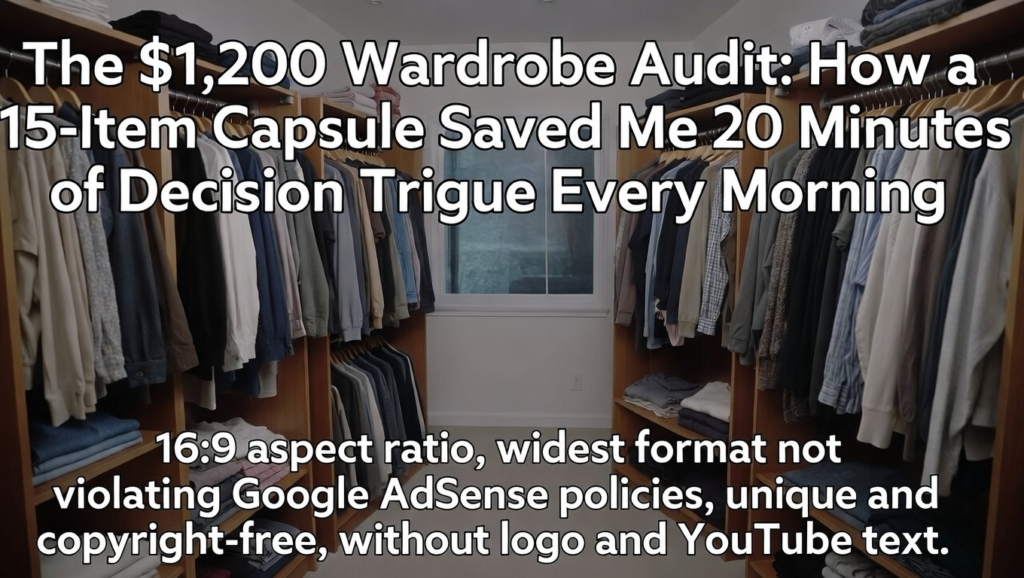
We often succumb to the illusion that a diverse, overflowing closet is the key to effortless style. But for a data analyst at FactsFigure, a chaotic wardrobe reveals a different truth: a massive leak in both personal finance and mental efficiency.
I decided to perform a comprehensive audit of my clothing consumption. The data was startling—I was only wearing 20% of my clothes 80% of the time. I was trapped in a cycle of “Fast Fashion” impulse buys that provided zero long-term value.
To combat this efficiency drain, I implemented a strict “Capsule Wardrobe” experiment, reducing my daily options to just 15 high-quality, interchangeable items. Here is the verified 12-month data on how this single lifestyle shift recovered $1,200 in annual savings and reclaimed 20 minutes of prime focus time every morning.
The Cognitive Figure: Quantifying “Decision Fatigue”
Every morning, our brain starts with a finite amount of mental energy for decision-making. The seemingly trivial question of “What should I wear?” consumes a measurable portion of this energy. In psychology, this is known as Decision Fatigue.
The Scientific Data: Research indicates that the average person makes about 35,000 decisions a day. Reducing low-stakes choices (like clothing) preserves mental clarity for critical high-stakes decisions later in the day.
The “FactsFigure” Observation: Before the experiment, my “selection process” involved trying on multiple combinations, checking the mirror, and inevitably feeling dissatisfied. My average “closet time” was 25 minutes.
The Post-Experiment Result: With a pre-coordinated 15-item system, my selection time dropped to a fixed 5 minutes.
The Time ROI (Return on Investment): This reclaimed 20 minutes per day. Over one year, that amounts to 121 hours—the equivalent of five full days of recovered life. I now utilize this time for a structured morning routine, which has a compound effect on my daily productivity metrics.
The Financial Audit: Slaying the “Fast Fashion” Debt
When I calculated the total cost of my clothing purchases over the previous 12 months, the figure was a true eye-opener.
The “Baseline” Figures: I had spent $1,500 on apparel. However, over 50% of those items were either impulse buys that I only wore once or low-quality goods that lost their shape within three wash cycles.
The Key Metric: Cost Per Wear (CPW)
To truly understand value, you must calculate CPW (Total Cost / Number of Times Worn).
Fast Fashion Item: A $20 shirt worn 2 times before fading => CPW of $10. This is a high-cost, low-yield item.
Investment Item: A high-quality $150 jacket worn consistently over three seasons (approx. 100 times) => CPW of $1.50.
The Financial Pivot: By investing in just 15 high-quality, durable basics, my annual clothing expenditure dropped to $300.
Total Annual Savings: $1,200. For a FactsFigure reader, that is a direct injection of capital that can be diverted to an index fund or a high-yield savings account.
The “15-Item Capsule” Formula: Mathematics in Style
To achieve this level of efficiency, I built my wardrobe around a strictly interchangeable system where every piece complements the others. This is “Functional Minimalism” in data form:
3 Bottoms: (1 Dark Denim, 1 Tailored Trouser, 1 Chino).
5 Tops: (2 Crisp White/Blue Button-down Shirts, 3 Premium Pima Cotton T-shirts).
2 Footwear: (1 Clean White Sneaker, 1 Versatile Loafer).
2 Outerwear: (1 Structured Blazer, 1 Light Transition Jacket).
3 Base Accessories: (Leather Belt, Classic Timepiece, Utility Tote/Briefcase).
The Mathematical Fact: These 15 items can be configured into over 50 unique outfits. This system provides a new outfit every single day for over a month, eliminating visual repetition while maximizing logistical simplicity.
How to Start Your Own “High-ROI Wardrobe”
If you are looking to recover that first $1,200, do not buy anything new yet. Start by auditing what you already own.
The 30-Day “Hanger Hack”: Turn all your hangers backward. When you wear an item, turn the hanger around. After 30 days, any item still on a backward hanger is a “financial leak” that you are paying to store.
Prioritize Fabric Integrity: Switch your focus from “Brand Name” to “Fabric Composition.” Invest in natural fibers like Cotton, Wool, or Linen. They have a significantly higher durability index than the plastic-based fibers (Polyester/Acrylic) prevalent in Fast Fashion.
Define Your Core Color Palette: Stick to three base colors (e.g., Navy, White, Gray) to ensure seamless interchangeability across your entire system.
Final Reflections: The ROI of the Simple Choice
At FactsFigure, we define wealth not just by capital but by Autonomy—control over your time and your money.
The $1,200 Wardrobe Audit proved that less is not just “more”; it is mathematically and mentally superior. By reducing my choices, I didn’t lose my style; I gained five days of my life back and redirected a significant portion of my income toward better investments.
The data is undeniable: Simplicity is the ultimate competitive advantage. Have you counted how many items you are paying to store but never wear?
⚠️ Disclaimer: Consumption Safety & Data Integrity
Market Variability: The savings figures ($1,200 annually) and decision-making time (20 minutes) are based on a personal audit of common Fast Fashion consumption patterns and may vary significantly based on individual income, location, and lifestyle requirements.
Fabric & Health: When prioritizing natural fibers, be aware of individual allergies (e.g., to wool or specific dyes). Always wash new garments before wearing them to remove residual manufacturing chemicals.
Sustainability & Disposal: When decluttering a wardrobe, prioritize donation or certified textile recycling over landfills. Improper disposal of clothing contributes significantly to global microplastic and chemical pollution.
Financial Advice: The CPW (Cost Per Wear) model is an analytical tool for consumption efficiency. It does not replace comprehensive financial planning. Always consult a certified financial advisor before making major changes to your long-term investment strategies.