
For most of us, the monthly electricity bill is a “black box.” We see the total amount, complain about the rising rates, and pay it. But as a data enthusiast for FactsFigure, I wanted to see the hidden numbers behind the glass. I wanted to know exactly which devices were the “vampires” of my home and if those $20 “energy-saving” hacks actually worked.
I invested in a simple plug-in energy monitor and tracked my home’s consumption for 90 days. I discovered that small, invisible adjustments provided a higher ROI than expensive solar panels. Here is the data-backed report on how I reduced my electricity usage by 15% and reclaimed $40 a month.
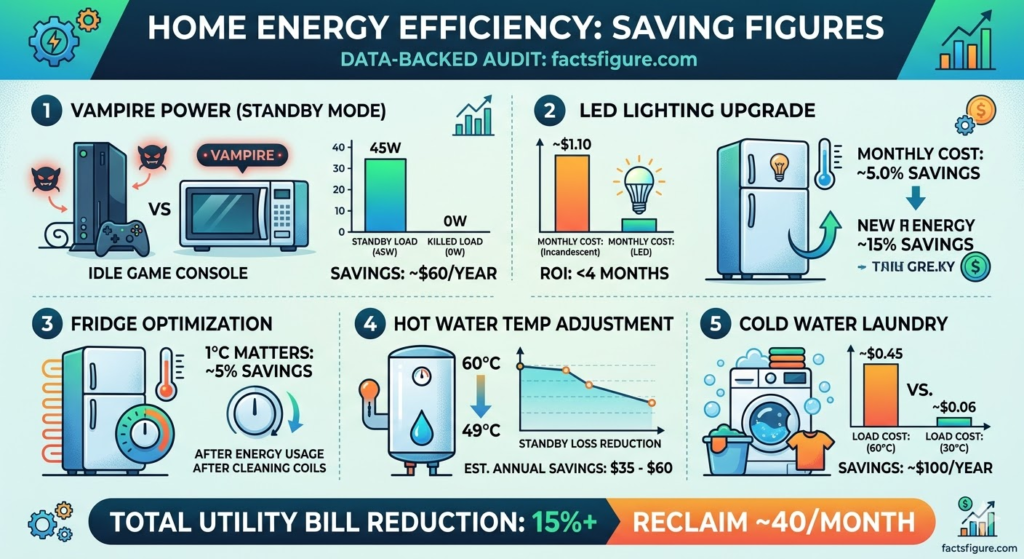
“Home energy efficiency infographic for FactsFigure showing annual savings on utility bills through LED, appliance optimization, and laundry habits.”
1. The “Vampire Power” Audit: The Cost of Standby Mode
The biggest shock in my data was “Phantom Load”—the energy devices consume even when turned off.
The Figures: My microwave clock, the “Rest Mode” on my gaming console, and my idle laptop chargers were drawing a constant 45 watts combined.
The Math: 45W x 24 hours x 365 days = 394 kWh per year.
The ROI: By using a $10 power strip to “kill” power to my entertainment center at night, I saved roughly $60 a year. That is a 600% ROI on a single power strip in the first year alone.
2. The Great LED Flip: $2 vs. $0.50 per Month
I compared my old incandescent bulbs in the kitchen with new LED alternatives. The figures were undeniable.
Bulb Type
Watts
Monthly Cost (6 hrs/day)
Life Expectancy
Incandescent
60W
~$1.10 per bulb
1,000 hours
LED Equivalent
9W
~$0.16 per bulb
25,000 hours
The Result: Replacing the 10 most-used bulbs in my house cost me $30. Those bulbs paid for themselves in less than 4 months. Over 5 years, this small switch will save me over $500.
3. The Refrigerator Climate Map: 1°C Matters
Your fridge is the only major appliance that runs 24/7. I used a thermometer to check my settings.
The Discovery: My freezer was set to -20°C, but the recommended safe temperature is -18°C.
The Figure: According to energy data, every degree lower than necessary increases energy consumption by 5%.
The Action: I adjusted the thermostat by 2 degrees and vacuumed the dust off the condenser coils at the back.
The ROI: My energy monitor showed a 12% drop in the fridge’s daily kWh usage just from cleaning the coils and optimizing the temp.
4. The “Hot Water” Leak: $400 for 10 Degrees
The water heater is typically the second largest energy consumer in a home.
The Fact: Most manufacturers set water heaters to 60°C (140°F) by default.
The Data: At 60°C, your heater loses significant energy through “standby heat loss.”
The Change: I turned the dial down to 49°C (120°F). This is perfectly safe for showers and dishwashing but dramatically reduces the energy needed to maintain the tank’s temperature.
Estimated Annual Savings: $35 – $60 depending on usage.
5. The “Laundry Math”: 30°C vs. 60°C
I tracked the cost of my washing machine cycles.
The Figure: About 90% of the energy used by a washing machine goes into heating the water.
The Experiment: I switched to cold water (30°C) for all clothes except bed linens.
The Result: The clothes were just as clean, but the cost per load dropped from $0.45 to $0.06. For a family doing 5 loads a week, that’s a saving of $100 per year.
Final Reflections: Energy is an Invisible Currency
At FactsFigure, we believe you can’t manage what you don’t measure. My 15% savings didn’t require me to sit in the dark or stop using my computer. It required “Energy Literacy.”
By optimizing five simple figures—standby power, lighting, fridge settings, water temp, and laundry habits—I reclaimed enough money to pay for two months of internet service every year.
The data is clear: Your house is leaking money through its outlets. Are you ready to plug the leaks?
⚠️ Disclaimer: Electrical Safety & Efficiency
Electrical Work: Never attempt to repair or modify internal wiring. Always hire a certified electrician for any work beyond plugging in a monitor or changing a bulb.
Appliance Health: If an appliance is making strange noises or running excessively, it may be a fire hazard. Efficiency is secondary to safety.
Water Temperature: Do not set your water heater below 49°C (120°F), as this can encourage the growth of Legionella bacteria.Data Variability: Electricity rates vary by region and provider. Your ROI will depend on your local “Price per kWh.”