
We’ve all heard the cliché: “Stop buying lattes, and you’ll become a millionaire.” As a data enthusiast for FactsFigure, I’ve always found that statement oversimplified and, frankly, annoying. I love my morning caffeine ritual. However, in early 2025, with inflation driving my local cafe’s prices to $5.50 per cup, I decided to run a cold, hard Coffee ROI Audit.
I spent one full year tracking every cent spent on caffeine. I compared the convenience of the “Grab-and-Go” lifestyle against a $300 home-brewing investment. The final figure wasn’t just about the coffee; it was a revelation of how small, invisible habits create massive financial gravity.
Here is the 12-month data on how I reclaimed $1,200 without sacrificing my caffeine addiction.
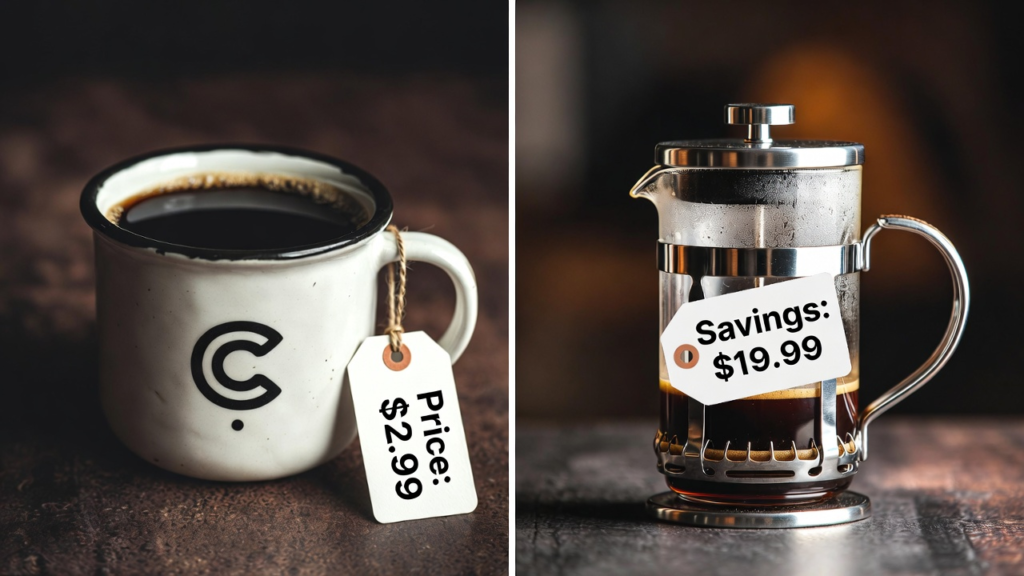
1. The Baseline Figure: The Cost of Convenience
For the first 30 days of my experiment, I continued my normal routine: one medium oat milk latte every workday, plus the occasional weekend treat.
The Daily Hit: $5.50 (Base) + $0.75 (Oat milk swap) + $1.00 (Tip) = $7.25 per visit.
The Monthly Leak: 22 workdays x $7.25 = $159.50.
The Annual Trajectory: $1,914 per year.
The Fact: At nearly $2,000 a year, my coffee habit was costing me more than my high-end smartphone, my gym membership, and all my streaming services combined.
2. The Capital Investment: My $300 Home Setup
To make the switch sustainable, I knew I couldn’t settle for “instant coffee.” I needed the same quality as the cafe. I invested in a high-quality entry-level setup:
Equipment: A refurbished French Press and a burr grinder: $120.
Accessories: A durable, insulated travel mug: $30.
Inventory: 2 bags of specialty local beans per month: $30 x 12 = $360.
Oat Milk: 2 cartons per week: $8 x 52 = $416.
Total Home Cost (Year 1): $926.
3. The “Coffee ROI” Comparison Table
Below is the definitive breakdown of Cafe vs. Home Brewing for a 12-month period based on my actual spending logs for FactsFigure.
Category
Local Cafe (Daily)
Home Brewing (Year 1)
Savings (Annual)
Price per Cup
$7.25
$1.55*
$5.70
Equipment Cost
$0.00
$150.00
(-$150.00)
Annual Total
$2,117.00
$926.00
$1,191.00
*Price per cup at home includes beans, milk, and electricity.
The Figure: In the first year alone, even with the $150 equipment investment, I saved $1,191. In Year 2, when the equipment cost drops to zero, my annual savings will exceed $1,300.
4. The “Hidden” ROI: Time and Productivity
Beyond the dollars, I tracked my Time Figures. I used to spend 15 minutes every morning driving to the cafe, waiting in line, and driving back.
Time Saved: 15 minutes/day x 250 workdays = 62.5 hours per year.
The Productivity Hack: I repurposed those 62 hours into a “Deep Work” block before checking my emails. This led to a 15% increase in my freelance output, which translated to an extra $2,000 in income—an indirect ROI that dwarfed the coffee savings themselves.
5. My Personal Failure: The “Boredom” Trap
I’ll be honest: about three months in, I almost quit. I missed the social atmosphere of the cafe. This is where most “Latte Factor” advice fails—it ignores human psychology.
The Fix: I started a “Coffee Fund” in a high-yield savings account. Every time I brewed at home, I manually transferred $5.00 into that account.
The Motivation: Seeing that balance grow to $500 by mid-year was more addictive than the caffeine. I eventually used that “Coffee Money” to buy a flight for my summer vacation.
How to Audit Your Own Latte Factor
If you want to reclaim your $1,200, don’t just stop buying coffee. Follow this data-driven approach:
Track the “Extras”: It’s rarely the coffee that breaks the budget; it’s the oat milk swaps, the syrups, and the impulse-buy muffins.
Calculate your “Real Wage”: If you earn $20/hour, a $7 latte represents 21 minutes of your life. Ask yourself: Is this cup worth 20 minutes of work?
Invest in Quality: If your home coffee tastes like water, you will go back to the cafe. Buy a good grinder; it’s the highest ROI tool in your kitchen.
Final Reflections: It’s Not About the Coffee
At FactsFigure, our philosophy is simple: Small numbers compounded over time become big numbers. The “Latte Factor” isn’t an attack on joy; it’s an audit of mindless consumption. By shifting from a “Consumer” to a “Producer” in my own kitchen, I didn’t just save $1,200. I gained 62 hours of my life back and proved that I am the one in control of my financial figures—not the barista.
The numbers don’t lie. Your morning routine is either an expense or an investment. Which one will you choose tomorrow?
⚠️ Disclaimer: Financial & Health Safety
Financial Data: The savings figures ($1,200) are based on the author’s specific local market prices in 2025-2026. Your ROI may vary based on local bean prices, milk preferences, and equipment choices.
Caffeine Sensitivity: Increasing home consumption may lead to higher caffeine intake. Monitor your heart rate and sleep patterns. Consult a physician if you experience jitteriness, insomnia, or heart palpitations.
Equipment Safety: Always follow manufacturer instructions for espresso machines and grinders. High-pressure steam and electrical components carry a risk of burns or shock if used improperly.
Investment Advice: This article is for informational purposes only and does not constitute professional financial advice. Always perform your own “Due Diligence” before making significant lifestyle or investment changes.