
As a data analyst for factsfigure.com, my job usually involves staring at spreadsheets. But lately, the most revealing “Figures” aren’t on my monitor—they’re on my grocery receipts.
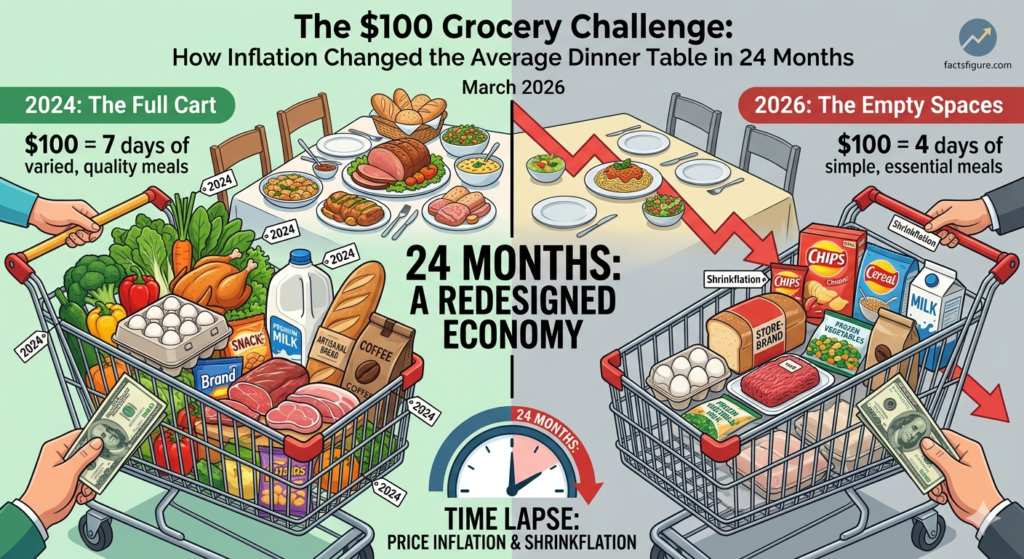
Two years ago, in early 2024, a $100 bill could still buy a respectable week’s worth of essentials for a small household. Today, in March 2026, that same $100 feels like it barely covers the “entry fee” to the supermarket. We’ve moved from an era of “cooling inflation” into what I call the “Permanent Plateau”—where prices have stopped skyrocketing, but they’ve settled at a height that has fundamentally redesigned the American dinner table.
The $100 Shrinkage: What’s Missing from Your Cart?
In 2024, $100 was enough for a gallon of milk, a dozen eggs, two pounds of ground beef, fresh produce, and a few “luxury” snacks. In 2026, the math has become brutal.
The Figures that Matter:
The Beef Gap: According to recent 2026 BLS data, the price of ground beef has surged over 21% in the last 12 months alone, jumping from roughly $5.55 to over $6.75 per pound.
The “Liquid” Inflation: Nonalcoholic beverages, including juices and coffee, saw a 5.1% to 5.6% increase this year. That morning cup of joe is now a calculated financial decision.
My Personal Take: I’ve started playing a game I call “The Item Swap.” Every time I pick up a premium brand, I look at the store-brand equivalent. In 2024, I was loyal to specific labels. In 2026, like 66% of modern shoppers, I’ve become a “Brand Agnostic.” If the store brand is $2 cheaper, it’s going in the cart.
Shrinkflation: The Invisible Thief
One of the most frustrating “Facts” of 2026 isn’t just the price on the tag—it’s the air in the bag.
The Reality Check:
We’ve tracked a trend on factsfigure.com where manufacturers are “right-sizing” packaging. That 10 oz bag of chips you bought in 2024 is now 8.5 oz. The price stayed at $4.99, but your price-per-ounce silently climbed by nearly 18%.
The Figure: Consumers are essentially paying a “Hidden Tax” of roughly $15 per grocery trip due to volume reductions in CPG (Consumer Packaged Goods).
The “Egg-onomics” Rollercoaster
If there is one item that defines the volatility of the 2026 kitchen, it’s the humble egg.
The Fact: After a massive drop in early 2026 (down nearly 42% from peak avian flu spikes), egg prices are still 27% higher than they were in the pre-pandemic era.
My Observation: I noticed that local bakeries and cafes haven’t lowered their prices despite the “egg crash.” This is “Price Stickiness”—once a figure goes up, it rarely returns to its original baseline, even when the underlying commodity costs drop.
The Local Impact: Dining In vs. Dining Out, we recently noted that “Food Away From Home” (restaurants) has seen inflation hit 3.9% to 4.6% in early 2026.
The Ripple Effect:
The “Moderate” Budget: A family of four on a “Moderate” USDA food plan is now pushing $1,430 a month.
The Hospitality Shift: Local restaurants are increasingly switching to “digital menus” to adjust prices in real-time based on supply chain costs.
My Insight: We are seeing a return to “Sunday Meal Prepping” not just as a health trend, but as a survival tactic. In 2024, meal prepping saved you time. In 2026, it’s the difference between a balanced budget and a credit card balance.
Strategic Shopping: How to Fight Back in 2026
Despite the grim figures, our research at factsfigure.com shows that the “Smart Shopper” can still find value.
Frozen is the New Fresh: Frozen vegetable prices have remained significantly more stable than fresh produce, which fluctuated by 5.4% this quarter due to adverse weather.
The “Tariff” Pivot: With shifting global trade policies in 2026, domestic staples (like corn and wheat products) are currently more price-stable than imported fruits.
App-Based Arbitrage: If you aren’t using a price-tracking app to compare three different local stores, you are likely leaving $40–$60 a month on the table.
The New Normal
The $100 Grocery Challenge isn’t just a social media trend; it’s a snapshot of the 2026 economy. The “Fact” is that food is more expensive. The “Figure” is that we are spending a larger percentage of our income on calories than we have in decades.
Final Advice from factsfigure.com: Stop comparing your receipts to 2020. That world is gone. Build your 2026 budget around the Moderate Plan ($1,200–$1,500 for a family of four) and focus on high-volume, domestic staples.