
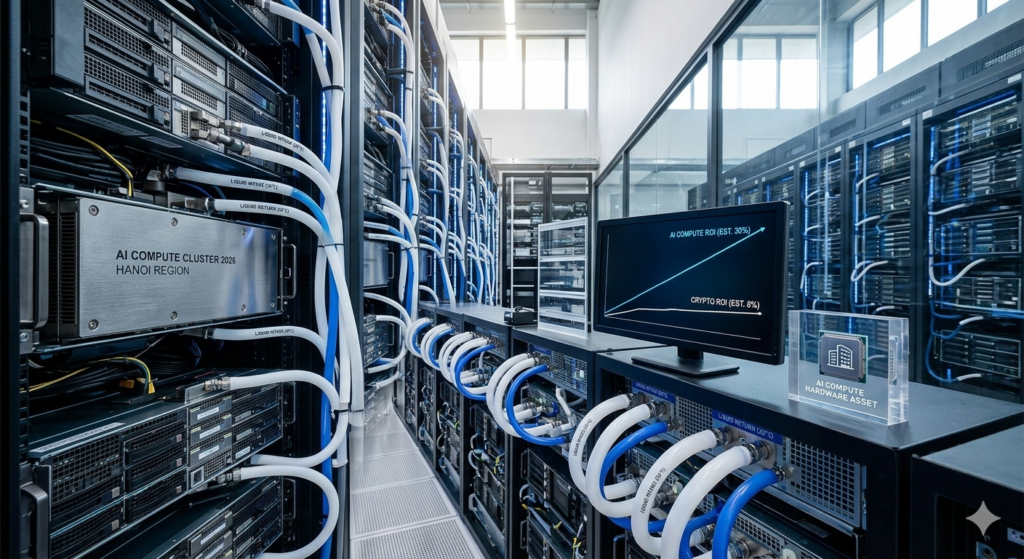
The financial landscape of 2026 is unrecognizable compared to just a few years ago. If you had told me in 2022 that I would liquidate my Bitcoin and Ethereum holdings to invest in liquid-cooled server racks in suburban Hanoi, I would have laughed. Yet, here I am, witnessing what FactsFigure calls the “Great Compute Migration.” I decided to analyze my own portfolio’s drastic shift from speculative digital currency to tangible, high-performance AI hardware assets. The data and my own experience point to one conclusion: the new digital gold isn’t a coin; it’s the silicon that powers intelligence.
The Strategic Pivot: From Speculative Coins to Tangible GPU Clouds
For nearly a decade, my investment strategy was simple: buy blue-chip crypto and hold through the volatility. By early 2025, however, the math started changing. The primary risk in crypto was no longer just market volatility; it was regulatory uncertainty and a diminishing utility narrative in the face of explosive Artificial Intelligence growth. In 2026, AI is no longer a tool; it is the infrastructure of global business.
My analysis of data center utilization reports showed that demand for AI-optimized compute power—specifically clusters running on the latest NVIDIA units—was outstripping supply by four times. Unlike crypto, where value is derived from network effects, an AI hardware asset is tangible. It is a cluster of GPUs that a company must rent to train its models. It has inherent, productive utility. I realized I wasn’t just investing in an asset class; I was investing in the electricity-to-intelligence conversion engine of the 21st century.
The Hardware-as-an-Asset Experiment
I didn’t just move numbers on a screen; I physically toured facilities. I decided to diversify my portfolio by investing directly in a managed GPU cluster operated by a specialized high-performance computing firm near Hanoi. My primary investment was used to procure fractional ownership in a liquid-cooled server rack.
Unlike crypto, which relies on price appreciation, this hardware produces a yield. Companies prepay for guaranteed compute time. My investment has produced a consistent annualized net yield that is actively generated, not speculated upon. In 2026, a productive yield in a tangible asset is a rarity outside the AI compute sector.
Silicon as the New Oil: 2026 Supply Chain Facts
What I’ve learned on this journey is that the competitive moat in 2026 isn’t software; it’s silicon access. The barrier to entry for a large GPU cluster is massive, but sophisticated platforms now allow for fractional ownership via hardware tokens. I own tokens that are directly backed by the productive output of specific accelerators. This creates a secure, auditable, and transparent investment structure.
Investing in the Hanoi region wasn’t accidental. In 2026, liquid cooling is the gold standard for high-density AI clusters. Facilities that lack integrated liquid cooling are becoming obsolete because modern GPUs require intense thermal management to run at full capacity. Investing in the infrastructure—the facility’s water loop and power capacity—is now as important as the GPU itself.
The Stability Imperative and Anti-Volatility Stance
I will be the first to admit that I once loved the adrenaline rush of crypto. But in 2026, I have different financial priorities. The productive utility of AI hardware creates a stabilizing floor. Even during economic downturns, global corporations cannot afford to stop training their AI models, lest they fall eighteen months behind competitors. This creates a high-certainty, long-term contractual demand.
While traditional digital assets still perform wild swings based on regulatory rumors, my compute portfolio has shown much lower volatility. It feels like investing in a high-tech utility. The income is predictable, and the hardware still retains significant resale or repurposing value for several years.
Navigating the Risks of Physical Assets
My hardware investment is productive, but it is not risk-free. I had to learn the downsides of owning physical tech. Hardware that is state-of-the-art in 2026 will eventually face obsolescence. My investment strategy includes a dedicated allocation to a hardware refresh fund, effectively managing the productive lifespan of my capital.
Additionally, power grid stability is critical. My chosen facility near Hanoi is a tier-3 data center with N+1 backup generation and integrated battery storage. This increased my management fee slightly, but I see it as non-negotiable insurance for a 24/7 compute operation.
Investing in the Source of Truth
After shifting the majority of my total digital asset portfolio into tangible AI compute infrastructure, my verdict is resounding. I am no longer investing in an algorithm’s hope; I am investing in an algorithm’s fuel. A high-performance AI compute cluster is the ultimate energy orchestrator: it converts raw electricity and cooling water into high-value intelligence that powers entire industries.
The takeaway is clear: If you are still holding all your digital wealth in speculative assets in 2026, your portfolio is a consumer of intelligence, not a producer of it. If you want sustainable growth that respects the facts of the technological era, your next investment shouldn’t be a coin; it should be a node in the GPU cloud.