
In the quiet corners of our homes, far from the chaotic tickers of the stock market or the complex jargon of central bank reports, a profound shift is taking place. We are currently living through an era where inflation is no longer just a headline; it has become a silent roommate, influencing every decision we make. As I observe the global response to rising costs, I’ve realized that we aren’t just “cutting back”—we are fundamentally rewriting the script of what a “normal” life looks like. This isn’t about deprivation; it’s about a radical, and perhaps necessary, recalibration of our values and our relationship with the things we consume.
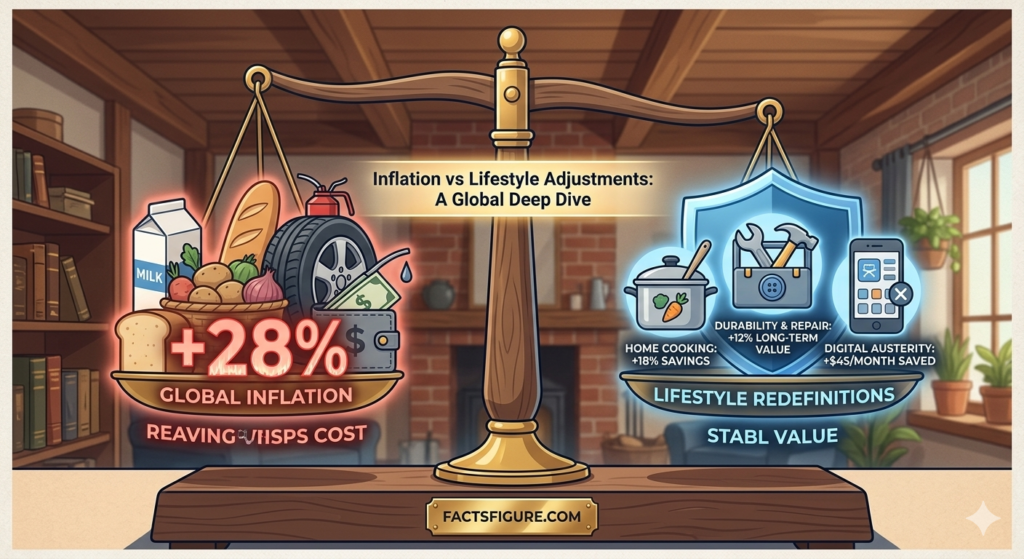
Inflation vs. Lifestyle Adjustments…
The Psychological Shift from Passive to Active Spending
For a long time, many of us lived in a state of “passive consumption.” We had our favorite brands, our automated subscriptions, and our habitual weekend outings. We didn’t really think about the “why” behind our spending because the economic environment was stable enough to allow for a bit of autopilot. But inflation has acted as a cold wake-up call. It has forced us to move from passive spenders to active auditors of our own lives.
I’ve noticed that people are now performing what I call a “Value Audit” on almost every dollar. We are starting to ask ourselves: “Does this item truly add value to my day, or am I just buying it out of habit?” This psychological shift is powerful. When we choose a store brand over a premium one, or when we decide that one streaming service is enough, we are exercising a level of intentionality that we haven’t seen in decades. This newfound awareness is, in my opinion, one of the few silver linings of this volatile economy.
Redefining the Dinner Table and the Lost Art of Domesticity
Food has always been the most visceral way we experience inflation. When the price of basic staples doubles, it hits us in the heart (and the stomach). But the response I’m seeing globally is incredibly resilient. Instead of just eating less, families are eating smarter. We are seeing a return to “purposeful cooking”—a style that prioritizes bulk grains, seasonal vegetables, and a “zero-waste” philosophy that our grandparents would have recognized instantly.
There is a certain beauty in this return to domesticity. We are rediscovering the joy of a slow-cooked meal and the satisfaction of using every part of an ingredient. Home gardening, once a niche hobby, is now being viewed as a strategic hedge against the grocery store. By taking back control of our food supply, even in small ways like a balcony herb garden, we are reclaiming a sense of agency. We are proving that our quality of life isn’t dictated by a price tag, but by our creativity and resourcefulness.
The Home as a Fortress of Efficiency
The way we view our living spaces is also undergoing a major transformation. As the cost of “external” entertainment—dining out, movies, gyms—continues to climb, our homes are becoming more than just a place to sleep. They are becoming our primary hubs for everything. I see more people investing in high-quality tools that bring the “outside world” in. Whether it’s a professional-grade coffee maker or a durable set of dumbbells, these aren’t just purchases; they are investments in “internalizing” our economy.
By shifting our social lives and hobbies back into the home, we are creating a more sustainable and intimate lifestyle. We are realizing that a dinner party with friends can be more meaningful than an expensive night at a loud restaurant. This “fortress of efficiency” mindset allows us to maintain a high standard of living while shielding ourselves from the inflationary spikes of the service industry. It’s a move toward a more grounded, family-centric existence.
The End of the Disposable Era and the Return to Durability
Perhaps the most significant change I’ve observed is our sudden distaste for the “disposable.” For years, we were trapped in a cycle of “fast everything”—fast fashion, cheap electronics, and furniture that barely survived a single move. Inflation has exposed the hidden cost of this cheapness. When money is tight, buying something that breaks in six months is no longer a “deal”; it’s a financial mistake.
We are seeing a profound resurgence in the “Buy It For Life” philosophy. I’m noticing that consumers are now willing to wait longer and save more to buy a single, high-quality, repairable item. We are looking for the “heft” in a product again. We want boots that can be resoled and tools that can be fixed. This shift back to durability is not just good for our wallets; it’s vital for the planet. We are learning that true value isn’t found in a low price, but in a long lifespan.
Conclusion: Finding Resilience in a Volatile World
As I look at how global families are navigating this inflationary period, I am filled with a sense of hope. Yes, the prices are high, and the challenges are real, but the human response has been one of incredible adaptability and wisdom. We are peeling back the layers of excess that defined the early 2000s and rediscovering a more intentional, durable, and resourceful way of being.
For a site like factsfigure.com, these aren’t just trends; they are the new metrics of a resilient life. We are learning that wealth isn’t just about what we earn, but about how efficiently and meaningfully we use what we have. As we continue to redefine our “essentials,” we are building a foundation that is much stronger than any economic cycle. We are proving that even in a world of rising prices, the most important things in life—creativity, connection, and character—remain entirely inflation-proof.