
In the complex landscape of residential real estate in 2026, the choice of flooring has evolved from a purely aesthetic decision into a sophisticated financial maneuver. Homeowners are no longer simply looking for “what looks good” in a showroom; they are calculating the “Lifecycle Value” and the potential “Return on Investment” (ROI) upon resale. The two dominant contenders in this space—traditional Hardwood and modern Luxury Vinyl Plank (LVP)—represent two fundamentally different economic philosophies. While LVP offers lower initial entry costs and immediate durability, Hardwood functions as a long-term equity anchor. By analyzing the depreciation cycles, maintenance mathematics, and buyer psychology surrounding these materials, we can determine which flooring option truly yields the highest net gain over a twenty-year ownership horizon.
“Infographic comparing a mass-consumption lifestyle (failed items, debt, -35% lifetime savings) with the quality-over-quantity equation (durable goods, saved capital, +65% long-term gain).”
The Upfront Capital Expenditure vs. Long-Term Equity
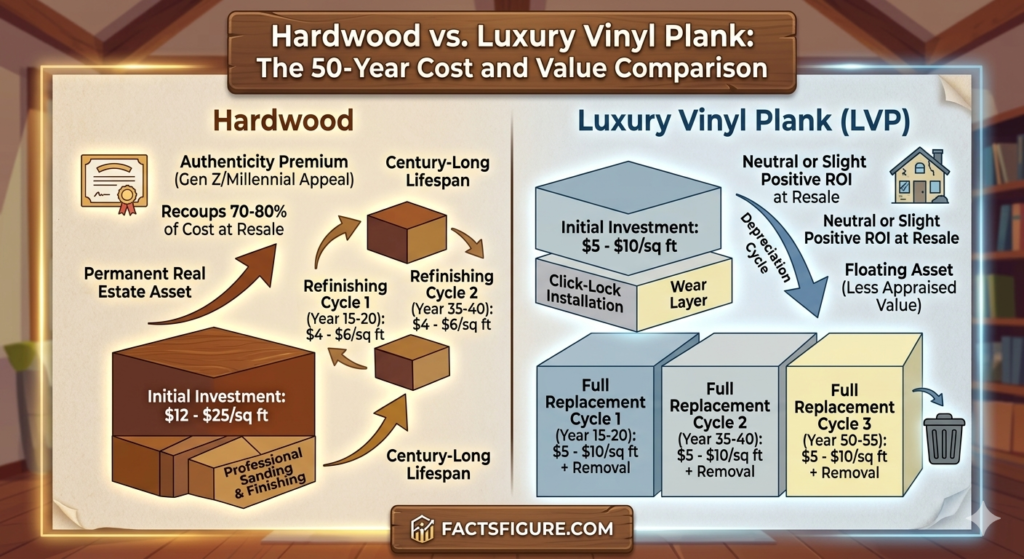
The initial financial hurdle is often the primary driver of flooring decisions, yet a granular audit of costs reveals a more nuanced picture. Luxury Vinyl Plank typically requires a capital expenditure of $5 to $10 per square foot, including professional installation. Its “click-lock” technology allows for rapid deployment, reducing labor costs significantly. In contrast, solid Hardwood requires an investment ranging from $12 to $25 per square foot, depending on the wood species and the complexity of the sanding and finishing process. From a pure “Day One” cash flow perspective, LVP is the clear winner for those looking to preserve liquidity.
However, the “Fact” of real estate is that Hardwood is categorized as a “Permanent Improvement,” whereas LVP is often viewed as a “Floating Asset.” Hardwood flooring becomes an intrinsic part of the home’s structural value, much like a brick exterior or a marble countertop. In the 2026 resale market, homes featuring authentic hardwood consistently command a price premium that often recoups 70% to 80% of the initial installation cost. LVP, while durable, does not historically contribute to appraised home value in the same way, often resulting in a neutral or slightly positive ROI that barely covers its own depreciation.
The Mathematics of the Refinishing Cycle
The true economic divide between Hardwood and LVP lies in the “Refinishing Equation.” Hardwood is an evolutionary material; it can be sanded, stained, and resealed multiple times over its century-long lifespan. If a hardwood floor becomes scratched or the color trend shifts from dark walnut to light oak, the homeowner can “reset” the asset for approximately $4 to $6 per square foot. This ability to modernize the flooring without a full tear-out is a powerful wealth-preservation tool.
Luxury Vinyl Plank, despite its “luxury” moniker, is essentially a high-resolution photograph of wood bonded to a limestone-plastic composite core. Once the wear layer is compromised or the aesthetic becomes outdated, the material cannot be refinished. The only solution is a total replacement. This creates a “Hard Ceiling” on the material’s lifespan, usually capped at 15 to 20 years. When we calculate the “Cost-Per-Year” over a fifty-period, Hardwood’s annual cost is significantly lower because its primary structure remains intact while only the surface is refreshed. LVP requires three full replacement cycles in the same timeframe that Hardwood requires only two refinishing sessions.
Durability Metrics and the “Active Lifestyle” Tax
A common argument in favor of Luxury Vinyl Plank is its “indestructibility.” LVP is 100% waterproof and highly resistant to the mechanical stress caused by pets and high-traffic households. In a rental property or a home with young children, the “Active Lifestyle Tax”—the cost of repairing accidental damage—is much lower with LVP. Hardwood is susceptible to moisture damage and “cupping” if exposed to standing water, which can lead to expensive localized repairs.
From a data-driven standpoint at factsfigure.com, we must evaluate the “Utility Gap” between these materials. If a homeowner chooses Hardwood, they are accepting a higher maintenance burden in exchange for long-term capital appreciation. If they choose LVP, they are paying for “peace of mind” and lower daily friction. However, the 2026 market is seeing a rise in “Hybrid Buyer Psychology,” where individuals appreciate the durability of LVP in utility spaces like basements and mudrooms but demand the “Authenticity Premium” of Hardwood in primary living areas. This strategic blending of materials is often the most efficient way to maximize a home’s total ROI.
Buyer Perception and the “Authenticity Premium”
In the digital age of high-definition real estate listings, the “Feel” of a home contributes significantly to its “Days on Market” (DOM) metric. Hardwood possesses a “Tactile Authenticity” that LVP cannot replicate. The sound of footsteps on solid oak, the natural variation in grain, and the warmth of the material create an emotional resonance that drives higher offers. Research suggests that “Authenticity” is one of the highest-ranking factors for Gen Z and Millennial buyers, who are increasingly wary of “plastic-heavy” home environments.
The “Resale Figure” associated with Hardwood is not just about the material; it’s about the “Story” of the home. A house with original, well-maintained hardwood suggests a history of quality and care. Conversely, a home full of synthetic LVP can sometimes signal a “flip” or a quick-fix renovation, which may lead to more aggressive inspections of other home systems. This “Psychological Spillover” can affect the final closing price by 3% to 5%, an amount that often exceeds the initial price difference between the two flooring types.
Environmental Sustainability and the “Legacy Dividend”
Beyond the immediate financial ledger, the “Environmental ROI” is becoming a critical factor in 2026. Hardwood is a renewable resource that acts as a carbon sink for as long as it remains in the home. Because it can last for over 100 years, its “Carbon Footprint Per Year” is remarkably low. Furthermore, at the end of its life, Hardwood is biodegradable or can be repurposed into other goods.
Luxury Vinyl Plank, while often made from recycled materials, is ultimately a petroleum-based product. Its recycling process is complex and often results in the material ending up in landfills once its twenty-year lifecycle is complete. For the ethical investor, the “Legacy Dividend” of Hardwood—the knowledge that the floor will serve three generations of inhabitants—is a form of non-monetary value that is increasingly being priced into high-end real estate. Choosing a material that does not contribute to the “waste cycle” is a hallmark of “Smart Wealth” management in the modern era.
Deciding Based on the Ownership Horizon
Ultimately, the choice between Hardwood and Luxury Vinyl Plank depends entirely on the “Ownership Horizon.” If the objective is a “Quick Flip” or a short-term residence of less than five years, LVP offers a compelling “Utility-to-Cost” ratio that minimizes initial risk and maximizes immediate visual appeal. It is the practical choice for those who view a home as a short-term shelter rather than a long-term investment vehicle.
However, for the “Legacy Homeowner”—someone who plans to hold the asset for a decade or more—the “Quality Over Quantity Equation” clearly favors Hardwood. The ability to refinish, the lack of a “replacement cliff,” and the significant “Authenticity Premium” at the time of resale make Hardwood the superior financial instrument. At factsfigure.com, our audit of the data suggests that while LVP is an excellent functional solution, Hardwood remains the only flooring material that truly “pays rent” back to the homeowner through equity growth and timeless appeal. In the final calculation, the “expensive” floor is the one that builds wealth, while the “cheap” floor is the one that eventually requires a dumpster.