
The heating, ventilation, and air conditioning (HVAC) system is the most expensive and complex mechanical asset in a modern home. Within this system, the compressor functions as the heart, responsible for circulating refrigerant and maintaining thermal comfort. However, a significant portion of premature compressor failures in 2026 can be traced back to a seemingly minor component: the air filter. While filters are often marketed based on their ability to improve indoor air quality (IAQ), their primary mechanical function is to protect the internal components of the HVAC unit. By analyzing the “Filtration Metrics” and understanding how high-efficiency filters impact the “Return on Investment” (ROI) of compressor longevity, homeowners can navigate the delicate balance between clean air and system health.
The Physics of Airflow Resistance and Static Pressure
To understand the ROI of filtration, one must first grasp the concept of “Static Pressure.” Every HVAC system is engineered to move a specific volume of air (measured in Cubic Feet per Minute or CFM) through a ductwork system designed for a certain level of resistance. The air filter is the primary point of resistance in this path. High-efficiency filters, specifically those with a high Minimum Efficiency Reporting Value (MERV), use denser media to trap smaller particles. While this is excellent for removing allergens, it inherently increases the “Pressure Drop” across the filter.
When a filter is too restrictive or becomes clogged with debris, the blower motor must work harder to pull air through the system. This creates a “Vacuum Effect” that strains the entire mechanical assembly. More importantly, reduced airflow leads to improper heat exchange at the evaporator coil. If the airflow is insufficient, the refrigerant does not fully evaporate, which can lead to “Liquid Slugging”—a catastrophic event where liquid refrigerant enters the compressor. Because compressors are designed to compress gas, not liquid, this event can lead to immediate mechanical failure. Thus, the ROI of a high-quality filter is not just about the filter itself, but about maintaining the engineered airflow necessary to keep the compressor within its safe operating parameters.
Calculating the “Compressor Stress Ratio”
At factsfigure.com, we use the “Compressor Stress Ratio” to quantify how filtration affects the lifespan of the unit. A system running with a clogged or overly restrictive filter experiences higher operating temperatures. For every 10-degree Fahrenheit increase in compressor operating temperature above its design limit, the chemical integrity of the internal oil and the insulation on the motor windings degrades exponentially. This is known as the “Arrhenius Rule” in electrical engineering.
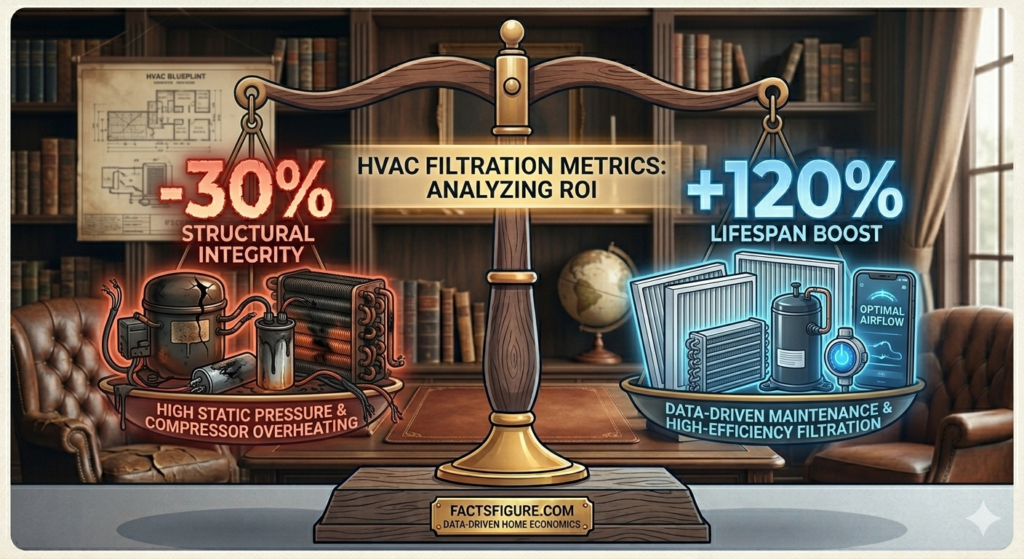
If a compressor is designed to last 15 years but is consistently operated under high static pressure due to poor filtration habits, its lifespan can be truncated by 30% to 50%. The financial “Figure” here is substantial. Replacing a central HVAC compressor in 2026 typically costs between $2,500 and $5,000. By investing in the “Right-Sized” filtration—filters that balance high particle capture with low airflow resistance—a homeowner is effectively spending $20 to $40 per quarter to protect a $5,000 asset. This represents an annual insurance premium of less than 3% to avoid a total system collapse.
The Myth of the “One-Size-Fits-All” MERV Rating
A common mistake in home economics is the belief that a higher MERV rating is always better. In reality, the ROI of filtration is highly dependent on the specific capacity of the HVAC blower. A MERV 13 filter in a system designed for MERV 8 can be more damaging than a cheap fiberglass filter. The “Filtration Metric” to watch is the “Dust Holding Capacity” (DHC). A high-quality pleated filter with more surface area (more pleats per inch) will have a lower initial pressure drop and a higher DHC, meaning it maintains safe airflow for a longer period than a standard flat filter.
For the modern homeowner, the goal is to find the “Efficiency Sweet Spot.” This is the point where the filter removes enough particulate matter to prevent “Fouling” of the evaporator coils—which also strains the compressor—without creating excessive backpressure. Data suggests that for most residential systems, a MERV 11 pleated filter provides the optimal balance. It captures 85% of fine particles while maintaining a “Static Pressure Profile” that allows the compressor to operate in its most efficient, low-heat state.
Energy Consumption and the Operational ROI
The ROI of high-efficiency filtration also manifests in the monthly utility bill. A strained HVAC system consumes significantly more electricity to achieve the same cooling effect. When airflow is restricted by an improper filter, the system must run for longer cycles to reach the thermostat’s set point. This “Extended Duty Cycle” not only increases energy costs by 10% to 15% but also accelerates the mechanical wear on the compressor’s internal valves and bearings.
By tracking the “Kilowatt-Hour (kWh) per Ton of Cooling,” homeowners can see the direct impact of their filtration choices. A clean, high-performance filter allows for “Short-Cycle Efficiency,” where the system reaches its target temperature quickly and then shuts down, allowing the compressor to cool off. This intermittent operation is vital for preventing the “Thermal Fatigue” that eventually leads to motor burnout. In the final calculation, the $10 difference between a bargain filter and a premium pleated filter is recouped within a single month of energy savings.
The Role of Smart Sensors in Predictive Maintenance
In 2026, the “Fact” of HVAC management is that we no longer need to guess when to change a filter. The rise of “Differential Pressure Sensors” allows homeowners to monitor the exact state of their filtration system via their smartphones. These sensors measure the pressure before and after the filter; when the “Delta-P” reaches a critical threshold, it signals that the compressor is beginning to experience stress.
Integrating these sensors into the home’s ecosystem provides a “Data-Driven ROI.” Instead of changing filters on a rigid 90-day schedule, which may be too late in a high-pollen season or too early in a clean environment, the owner can change the filter at the exact moment of “Peak Efficiency.” This precision prevents even a single hour of high-heat operation for the compressor, effectively “freezing” its mechanical age and ensuring the unit reaches or exceeds its 20-year design life.
Filtration as a Financial Lever
The HVAC filter is far more than a simple screen for dust; it is a critical governor of mechanical health and financial stability. The “Filtration Equation” proves that the most expensive filter is the one that causes the compressor to fail. By prioritizing airflow metrics over mere particle counts, homeowners can protect their largest mechanical investment while enjoying cleaner air and lower energy bills.For the readers of factsfigure.com, the takeaway is one of “Informed Stewardship.” Do not blindly chase the highest MERV rating. Instead, audit your system’s static pressure, invest in high-surface-area pleated filters, and use modern sensor technology to maintain the “Hydration” of your airflow. In the world of home economics, the smallest components often have the largest impact on the bottom line. A well-filtered system is a quiet, efficient, and long-lived asset that pays dividends in both comfort and capital preservation for decades to come.