
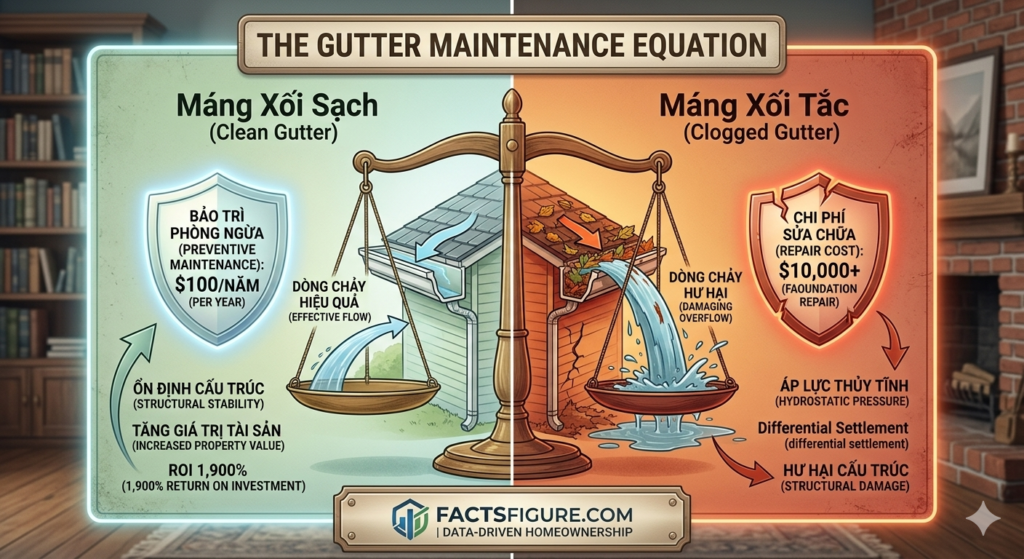
In the realm of homeownership, the most significant financial threats are often not the sudden natural disasters that grab headlines, but the slow, silent processes of structural erosion. Among these, the failure of a home’s water diversion system—specifically the gutters—represents one of the most lopsided risk-to-reward ratios in modern property management. While many homeowners view gutter cleaning as a seasonal nuisance, a data-driven analysis reveals it to be a critical “Financial Insurance Policy.” By examining the “Gutter Maintenance Equation,” we can see how a modest $100 annual investment effectively wards off a cascade of structural failures that frequently culminate in foundation repair bills exceeding $10,000. Understanding the mechanics of water displacement and the true cost of soil saturation is essential for any property owner looking to preserve their home’s equity in 2026.
The Hydrostatic Pressure Trap: Why Foundation Failures Begin at the Roof
The foundation of a house is engineered to support immense vertical weight, but it is remarkably vulnerable to lateral forces. The primary enemy of structural stability is “Hydrostatic Pressure”—the force exerted by water-saturated soil against the foundation walls. A standard home roof can collect thousands of gallons of water during a single heavy rainstorm. In a functioning system, gutters and downspouts move this massive volume of water safely away from the building’s perimeter. However, when gutters are clogged with organic debris, they overflow, dumping a concentrated curtain of water directly at the base of the home.
As water pools around the foundation, the soil expands, creating a “wedge” of pressure. Over time, this pressure leads to “Shear Failure,” causing foundation walls to bow inward or crack. From a factual standpoint, once a foundation’s structural integrity is compromised, the repair process involves hydraulic piering or wall anchors—services that start in the mid-four-figure range and quickly escalate. By maintaining clear gutters, a homeowner is essentially managing the moisture content of the soil, ensuring that hydrostatic pressure remains within safe, engineered limits.
The Mathematics of Soil Erosion and Settlement
Beyond the immediate pressure of water, clogged gutters lead to “Differential Settlement.” When water consistently saturates one area of the foundation while another remains dry, the soil’s load-bearing capacity becomes uneven. This causes the house to “sink” at different rates, leading to stuck doors, cracked drywall, and compromised rooflines. The cost of “Leveling” a home in 2026 involves specialized structural engineering and heavy machinery, a financial burden that can be entirely avoided through simple hydraulic management.
The “Figure” to keep in mind is the “Infiltration Rate” of your local soil. Clay-heavy soils, common in many residential areas, retain water for long periods, exacerbating the risks of settlement. A $100 professional gutter cleaning ensures that the “Exit Velocity” of rainwater through the downspouts is sufficient to move the water into drainage swales or dry wells, far enough from the foundation to prevent localized saturation. In this context, the $100 is not a “cost” but a “protection of asset value.”
The Secondary Cascade: Siding, Fascia, and Mold Remediation
The Gutter Maintenance Equation also includes a “Secondary Cascade” of costs. When gutters overflow, the water does not just hit the ground; it splashes back onto the siding and runs behind the fascia boards. This constant moisture exposure leads to “Rot and Delamination.” Replacing rotted fascia boards and soffits is a labor-intensive task that often requires the removal of the first row of roofing shingles, turning a simple maintenance task into a $2,000 construction project.
Furthermore, water that penetrates the building envelope creates the perfect environment for mold and mildew. Mold remediation is one of the most expensive “invisible” costs of homeownership. If water from a clogged gutter seeps into a basement or crawlspace, the resulting mold growth can trigger health issues and require professional abatement services that cost thousands of dollars. By auditing the “Water Path” of a home, it becomes clear that the gutter is the primary barrier preventing an external weather event from becoming an internal environmental crisis.
Quantifying the Return on Investment (ROI) of Preventive Care
To truly appreciate the value of gutter maintenance, we must look at the “Annualized Risk Cost.” If a homeowner skips gutter cleaning for five years to save $500, but results in a $10,000 foundation repair, the “Cost of Neglect” is $1,900 per year. Effectively, by spending $100, the homeowner is gaining a 1,900% return on their investment by avoiding the statistical probability of structural failure.
In the 2026 real estate market, “Deferred Maintenance” is a major red flag for buyers. A home inspection that reveals clogged gutters and water staining on the foundation can lead to aggressive price negotiations or the collapse of a sale. Prospective buyers view neglected gutters as a “Proxy Metric”—if the owner didn’t spend $100 on the gutters, what other critical systems did they ignore? Maintaining a clean gutter system preserves the “Resale Premium” of the home, ensuring that the property remains a competitive asset in a data-transparent market.
Strategic Maintenance: Frequency and Technology
The “Equation” requires a specific frequency based on the surrounding environment. Homes under heavy tree canopies may require three cleanings per year (the “High-Debris Ratio”), while those in open areas may only need one. In 2026, we are also seeing the rise of “Smart Gutter Sensors” that alert homeowners to blockages in real-time. While these technologies are useful, they do not replace the physical removal of debris.
Professional cleaning also provides an “Annual Structural Audit.” A technician on a ladder can spot loose shingles, pest infestations, or failing sealant that a homeowner would never see from the ground. This “Aerial Intelligence” allows for minor repairs that prevent larger, more expensive failures. The $100 fee covers not just the cleaning, but a professional assessment of the most vulnerable part of the home’s exterior.
The Wisdom of the $100 Shield
The Gutter Maintenance Equation is a masterclass in risk management. It highlights the fundamental truth that in homeownership, the smallest systems often protect the largest assets. A house is a machine for shedding water, and the gutter is the most vital component of that machine. Failing to spend $100 on a routine cleaning is not a frugal move; it is a high-stakes gamble with a $10,000 price tag.
For the readers of factsfigure.com, the message is clear: analyze your home as a series of interconnected financial risks. Protect your foundation by respecting the power of water. In the final calculation, the peace of mind that comes with a clear and functioning drainage system is worth far more than the modest fee of a cleaning service. Invest in your gutters today to ensure your foundation—and your financial future—remains rock solid for decades to come.