
During my years operating the analytical platforms at factsfigure.com, I have learned a profound lesson in domestic economics: the smallest figures are often the most silent financial thieves. We tend to worry about large-scale investments or the volatility of the stock market, yet we often ignore a literal “leak” right inside our own homes. Water leakage is not just a plumbing inconvenience; it is a cumulative economic erosion. This article combines my personal experience with home-based measurement and quantitative resource data to reveal the true devastation of “tiny drips” on both your wallet and the environment.
We often dismiss a slow-dripping faucet in the bathroom or a silent leak in the toilet tank as a minor auditory annoyance. However, when viewed through the lens of data (Figures), every drop of water that falls is a unit of currency disappearing. Water leakage is a cumulative waste that, if left unmeasured, will remain invisible until you see the final monthly bill or suffer severe structural damage.
Quantifying the Power of Individual Drops
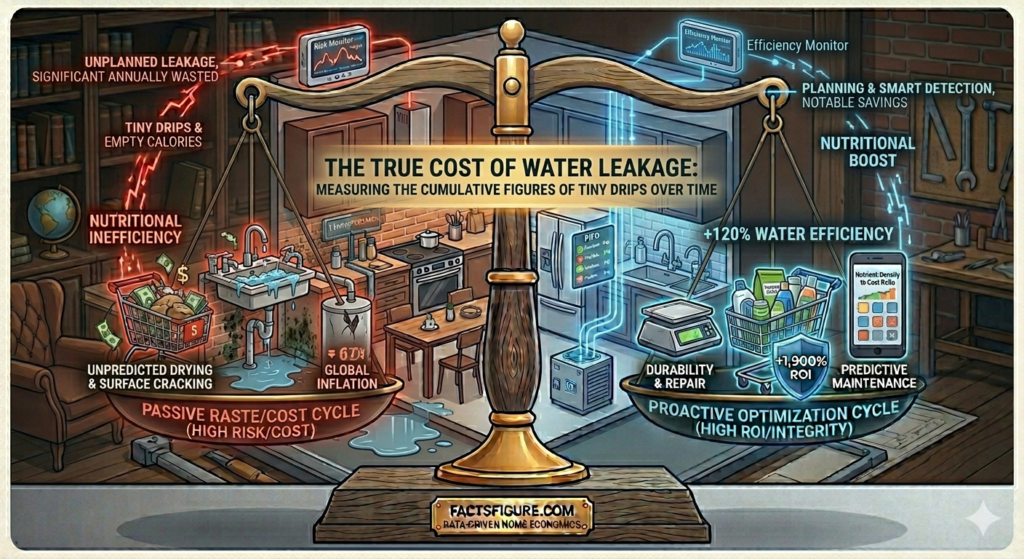
A single drip per second may sound insignificant. However, when I applied basic mathematical formulas to quantify it, the actual “Fact” was startling. A faucet dripping at the rate of one drop per second wastes approximately 3,000 gallons of water per year (over 11,000 liters). To put this in perspective, that amount of water is enough for more than 180 average-length showers.
When you multiply this figure by the urban water rates of 2026, we are discussing a direct financial loss with zero utility value. What is even more concerning is that water leaks tend to accelerate over time as flow pressure wears down rubber gaskets and valves. What starts as a waste of a few cents a day quickly evolves into dozens of dollars a month if not addressed promptly.
Analyzing the Chain Reaction on Infrastructure and Energy
The cost of a water leak extends far beyond the water bill itself. According to my observations in home maintenance reports, water leakage is the leading cause of moisture-related mold and the degradation of wooden or plasterboard structures. When water seeps into the cracks of walls or floors, it compromises the material’s integrity, leading to repair costs that are hundreds of times higher than simply replacing a valve.
Furthermore, if the leak occurs in the hot water system, you are paying a “double cost.” You are not only losing money on the wasted water but also on the electricity or gas consumed by the water heater to warm that water before it vanishes down the drain. Data from energy audits suggests that hot water leaks can increase household energy costs by approximately 5% to 10%—a significant figure in the context of today’s escalating energy prices.
Managing Leaks with a Home-Based Data Audit Mindset
I have always applied a simple yet effective method for controlling this: the “Overnight Meter Check.” Before going to bed, ensure all water-consuming devices are turned off and record the reading on your water meter. After 6 to 8 hours, check the meter again in the morning. If the number has changed even slightly, it is the empirical “Figure” proving that your home has a leak.
Locating the leak requires technical precision. A small tip I often share is using food coloring in the toilet tank. If the color appears in the bowl after 15 minutes without flushing, it confirms that your flush valve is leaking. These are small, easily fixable errors that represent the largest source of water loss in most households I have surveyed.
The ROI of Investing in Smart Monitoring Technology
In 2026, technology has provided us with highly sophisticated water monitoring solutions. I have tested smart flow sensors capable of sending notifications to a smartphone the moment they detect an unusual, prolonged flow. While the initial investment for these devices may seem high, the Return on Investment (ROI) is incredibly impressive when considering the ability to prevent major pipe bursts or long-term underground leaks.
A smart water monitoring system provides more than just financial savings; it offers “Peace of Mind.” When you have real-time data on your water usage, you can adjust the habits of the entire family, proactively optimizing your budget. This is how “Data-Driven Living” empowers us to master our personal finances starting from the smallest details.
Environmental Responsibility and Sustainable Resource Metrics
Looking beyond the financial aspect, every drop of water saved is a contribution to environmental sustainability. Global environmental data indicates that freshwater sources are becoming increasingly scarce. Wasted water through leakage is not just an individual problem; it is a waste of a shared community resource. When millions of households allow small drips to persist, the total loss equals the capacity of major reservoirs.
At factsfigure.com, we believe that understanding the numbers will change human behavior. When you know that one drop per second can waste thousands of liters per year, you will no longer hesitate to pick up a wrench and tighten a loose faucet. This small action, when multiplied, creates a massive positive change for both the planet and your bank account.
The Mindset of Managing Waste
Water leakage is a perfect illustration of the law of accumulation. Small errors, if left uncorrected, lead to massive failures. By paying attention to “Tiny Drips,” you are training yourself in a sharp financial management mindset: never allow resources to be wasted in vain.
I hope these data-driven personal insights help the readers of factsfigure.com take a more serious look at their home water systems. Do not let your money and precious resources wash away drop by drop. Measure, act, and optimize today to build a stronger and more sustainable financial future. Every drop you save is a positive figure in the balance sheet of your life’s plan.