
The modern bathroom is a technical marvel of convenience, but it is also a significant source of “Linear Economy” waste. Most personal care items are designed for a single-cycle life: they are purchased, used for a few months (or minutes), and then discarded into a waste stream where they remain for centuries. For the analytical homeowner at factsfigure.com, this represents a structural inefficiency in household management.
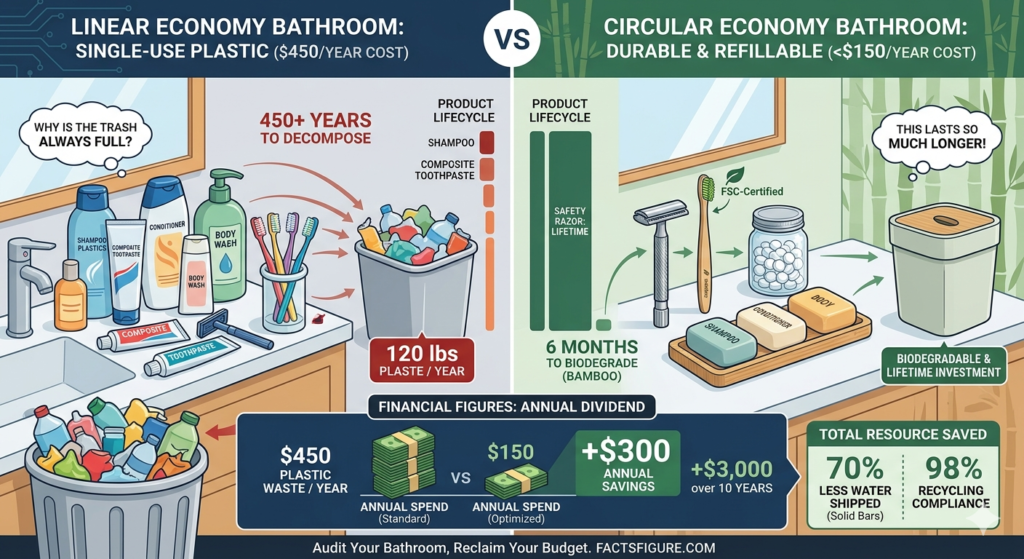
A Zero-Waste Bathroom Audit is not just about environmental ethics; it is a systematic replacement of high-entropy, single-use plastics with low-entropy, durable alternatives. By transitioning to sustainable hygiene, a household of four can eliminate approximately 120 pounds of plastic waste annually. Here is the data-driven guide to the most impactful swaps.
zero waste bathroom counter showing a bamboo toothbrush and safety razor factsfigure before after
The Problem: Quantifying the Plastic Footprint
To understand the audit, we must look at the volume of the waste. A typical individual uses:
4 Plastic Toothbrushes per year (Polypropylene and Nylon).
12 to 15 Plastic Tubes of toothpaste.
24 to 36 Plastic Bottles of shampoo, conditioner, and body wash.
Thousands of yards of plastic-coated dental floss.
Because these items are often made of mixed-material plastics or contaminated with organic residue, their recycling rate is statistically near zero. They are destined for landfills or ocean ecosystems.
High-Impact Swap 1: The Bamboo Toothbrush Transition
The manual plastic toothbrush is a design relic. While the bristles are often still nylon (a necessary trade-off for dental health), the handle—the largest mass of the object—does not need to be plastic.
The Technical Figures:
Plastic Handle: Takes 450+ years to decompose.
Bamboo Handle: Fully biodegradable in a home compost pile within 6 months.
Financial Parity: As of 2026, bulk bamboo toothbrushes have reached price parity with plastic counterparts (approximately $1.50 per unit when purchased in 10-packs).
Audit Tip: Look for “FSC-Certified” bamboo to ensure the wood is sourced from managed forests, preventing deforestation.
High-Impact Swap 2: Toothpaste Tablets vs. Composite Tubes
Toothpaste tubes are a recycling nightmare. They are composed of laminated layers of plastic and aluminum, making them impossible to process in standard facilities.
The Technical Shift:
Toothpaste Tablets are dehydrated, compressed spheres of active ingredients (Fluoride, Xylitol, and Calcium Carbonate) stored in glass or compostable paper.
Waste Reduction: 100% elimination of the composite tube.
Weight Efficiency: By removing water (the primary filler in paste), tablets are 30% lighter to ship, reducing the carbon footprint of the household supply chain.
The “Travel Factor”: Tablets are TSA-compliant and eliminate the “leaking tube” failure point in luggage.
High-Impact Swap 3: The Safety Razor (The “Buy Once” Model)
The “Razor and Blade” business model is the pinnacle of planned obsolescence. Plastic cartridge razors are expensive, provide an inferior shave due to “clogging” between multiple blades, and generate massive amounts of non-recyclable plastic and sharp-metal waste.
The Financial Audit:
Cartridge System: ~$20 for the handle + $3 to $5 per replacement head.
Safety Razor: ~$30 for a stainless steel handle (lifetime investment) + $0.10 to $0.25 per blade.
Annual ROI: After the initial investment, a safety razor saves the average user $80 to $120 per year. Over a decade, this is a $1,000 saving simply by switching to a more durable mechanical design.
High-Impact Swap 4: Solid Bar Formulations (The “Waterless” Move)
The most inefficient thing we move through our supply chains is water. Standard liquid shampoo is roughly 80% water. We pay for the weight of the water and the plastic bottle required to hold it.
The Performance Figures:
A single 3-ounce “Shampoo Bar” is the technical equivalent of 2 to 3 plastic bottles of liquid shampoo.
Volume Efficiency: Reclaims 85% of under-sink storage space.
Chemical Transparency: Solid bars often require fewer synthetic preservatives (Parabens) because they lack the water content that fosters bacterial growth.
Strategic Implementation: The Phase-In Approach
At factsfigure.com, we do not recommend throwing away your current plastic items immediately—that would be “Sunk Cost” waste. Instead, implement a “Deplete and Replace” policy:
Inventory Check: Identify all single-use items currently in the bathroom.
The Trigger Point: As an item hits 10% remaining volume, purchase the sustainable alternative.
The Feedback Loop: Track the reduction in your “Trash Volume.” Most households report a 50% reduction in bathroom waste bin frequency within the first three months.
Final Summary: The Optimized Bathroom
The “Fact” is that our current hygiene habits are a carryover from a period of cheap, ignored environmental costs. The “Figure” is that transitioning to a zero-waste bathroom can save a household over $200 a year while significantly lowering their ecological entropy.
By moving to bamboo, tablets, and bars, you aren’t just “saving the earth”—you are auditing a wasteful system and replacing it with a more efficient, durable, and cost-effective personal care infrastructure.