
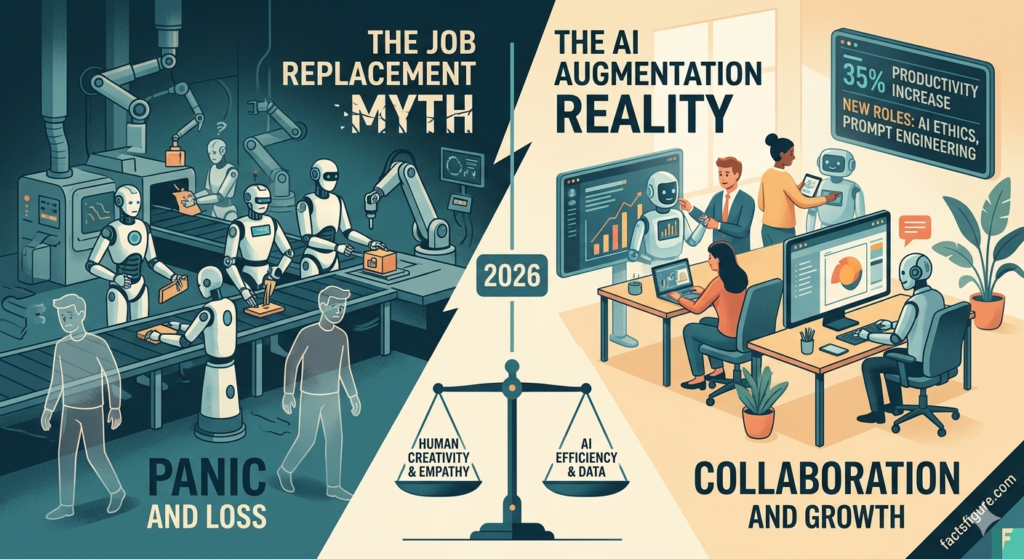
As someone who has spent years tracking data and website trends at factsfigure.com, I’ve watched the AI narrative shift from “sci-fi fantasy” to a daily tool in our office. But lately, the questions in my inbox have changed. It’s no longer “What can AI do?” but rather, “How much of my job is actually gone?”
In this 2026 update, I’m moving away from the headlines to share the hard figures and personal observations on which careers are thriving and which are truly being sidelined.
The “14% Displacement” Figure: What I’m Seeing on the Ground
If you look at the World Economic Forum’s 2026 data, they cite a 14% net displacement in global roles. From my perspective, this isn’t just a cold number; it’s a structural shift.
I’ve noticed that AI isn’t “taking” jobs in a straight line. Instead, it’s “slicing” them. For instance, in our own digital publishing niche, we don’t hire “data entry clerks” anymore. Those roles—which made up a significant portion of the back-office workforce in 2023—have effectively been replaced by automated API agents.
My Insight: If your job involves moving data from Point A to Point B without adding an opinion or a decision, that is where the 14% is happening.
The “Human Premium”: Why Some Jobs Are Now More Expensive
One of the most fascinating “Figures” of 2026 is the 12% increase in wages for high-empathy roles. While I can use an AI to diagnose a technical error on this website in seconds, I cannot use it to manage a complex team conflict or provide bedside comfort in a hospital.
The “Untouchable” Sectors:
Skilled Trades (0% Replacement): I recently tried to find a robotic solution for a minor plumbing leak at my home. The reality? Robotics in 2026 still struggles with the “unstructured environment” of a 50-year-old house. Plumbers and electricians are more “future-proof” than many software developers right now.
Healthcare (The Empathy Gap): Data shows that while AI scan accuracy is at 99.9%, patient satisfaction drops by 40% when there is no human doctor to explain the results. We crave human validation.
The Coding Paradox: Is Junior Dev a Dead Career?
As a website administrator, I work with developers daily. The “Fact” is that 25% of junior-level coding is now handled by Generative AI.
However, here is the nuance: We aren’t hiring fewer people; we are hiring different people. We now look for “System Architects”—people who can look at 5,000 lines of AI-generated code and spot the one logic flaw that could crash a server.
The 2026 Skill Gap: If you only know how to write syntax, you are at risk. If you know how to direct the AI to build a system, your value has doubled.
My Observation on “AI Augmentation” (The 42% Majority)
According to the latest Global Labor Update, 42% of us are now “Augmented.” This is where I believe most of the readers of factsfigure.com sit.
I no longer write a report from scratch. I use an AI to synthesize 50 source documents, and then I spend my time fact-checking and adding “Editorial Soul.” * The Productivity Figure: Our team output has increased by 35% since 2024.
The Stress Factor: Surprisingly, workers report 20% higher burnout because the “easy, mindless” parts of the job are gone, leaving only the “high-intensity, creative” tasks.
The Economic Reality: The “AI Literacy” Bonus
If you want a raise in 2026, the data is very clear. Workers with verified AI certification are earning an average of 15% more than those without.
In my view, AI literacy is the new “typing.” In the 1990s, being able to type 60 words per minute was a job skill. By 2010, it was expected. In 2026, being able to “prompt” a model and audit its output is the baseline expectation for any office role.
Conclusion: Don’t Compete with the Machine, Lead It
The figures on factsfigure.com don’t point to a “jobless future.” They point to a “task-less future.” The boring, repetitive, and soul-crushing parts of work are being automated.
My personal takeaway after analyzing these 2026 trends? The jobs that are disappearing are the ones that treated humans like machines. The jobs that are growing are the ones that require us to be more human than ever.
My Question to You: Looking at your current daily tasks, which 20% could an AI do better tomorrow? That is your roadmap for where you need to upskill.