
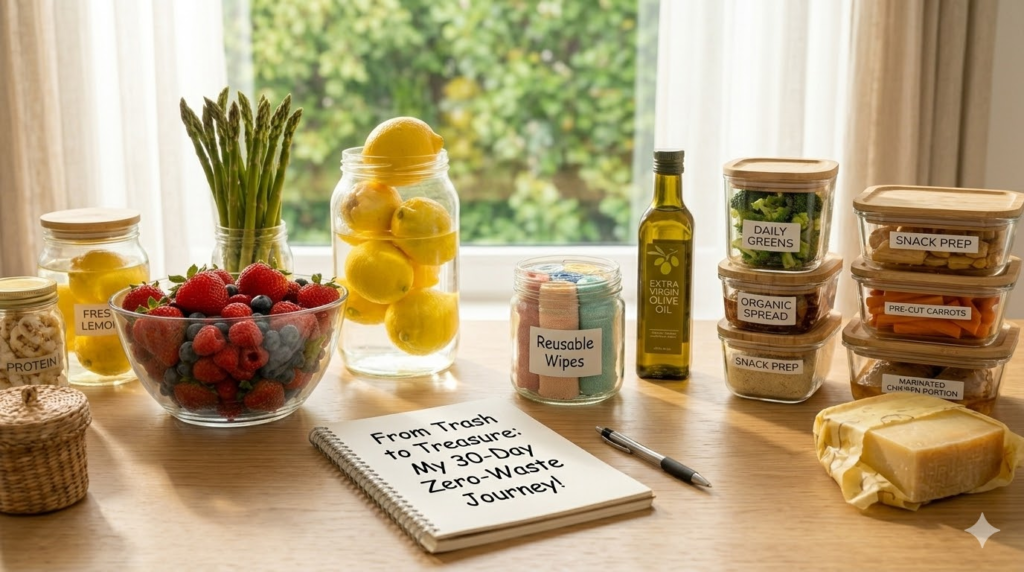
The “Garbage Avalanche” That Changed My Life
It was a humid Tuesday evening in my small apartment. As I tried to heave a leaking, overstuffed trash bag into the communal bin, the plastic gave way. A literal avalanche of coffee grounds, soggy takeout containers, and plastic mailers exploded across my shoes.
Standing there, I didn’t just see trash; I saw wasted money. I realized my “convenient” lifestyle was costing me nearly $50 a week in disposables. That night, I committed to a 30-day “Zero-Waste” experiment. I didn’t want to just be “eco-friendly”; I wanted to see if a regular, busy person could actually stop feeding the landfill.
Week 1: The “Paper Towel” Withdrawal
I’ll be honest: I was a paper towel addict. I used them for drying hands, wiping the stove, and even as makeshift plates.
The Personal Swap: I cut up three old, grey cotton T-shirts that were destined for the bin. I rolled them up and put them in a wooden basket on my counter.
The Struggle: For the first four days, my hand instinctively reached for the empty paper towel holder. It was a phantom limb sensation!
The “Eureka” Moment: By day 10, I realized these rags cleaned my glass stovetop better than any paper product ever did.
The Math: I saved $18 in Week 1 alone by not buying a bulk pack of towels.
Week 2: My Kitchen “Science Experiment” (Bokashi Composting)
Food scraps made up 40% of my trash weight. Living in an apartment with no yard, I tried the Bokashi Method—a Japanese fermentation system.
The Reality: Most blogs say it’s “odorless.” They lie. If you don’t drain the “Bokashi tea” every two days, it smells like a jar of old pickles.
The Fail: On day 14, I didn’t tighten the lid properly. My kitchen smelled like a cider factory for 24 hours.
The Success: I started giving the “tea” to my neighbor’s struggling lemon tree. Two weeks later, the leaves turned a deep, healthy green. My trash was literally regenerating the neighborhood.
Week 3: The “Waxy Hair” Phase (Bathroom Detox)
This was the week I almost quit. I swapped my liquid shampoo in a plastic bottle for a $12 handmade shampoo bar.
The Personal Disaster: For the first week, my hair felt heavy and waxy. I looked like I hadn’t showered in a month. I was embarrassed to go to work meetings.
The Pivot: I discovered my water was “hard.” I started using a simple apple cider vinegar rinse (1 part vinegar, 4 parts water).
The Result: My scalp stopped itching for the first time in years. I realized I had been paying for expensive chemicals to “fix” problems that those very chemicals were causing.
Week 4: The “Repair Over Replace” Mindset
In the final week, I stopped looking at stores and started looking at my local community.
The Boot Save: My favorite leather boots had a hole in the sole. Instead of buying a new $120 pair, I found a local cobbler. He fixed them for $15 while we chatted about the “old days.”
Bulk Shopping Reality: I brought my own glass jars to the bulk store. Pro Tip from my mistake: Always weigh your empty jar (tare weight) before you fill it, or you’ll end up paying for the weight of the glass!
Internal Link: I realized that keeping my dry goods in glass jars actually helped them stay fresh longer (check out my guide on Advanced Food Preservation for the specific science behind this).
The Final Tally: What 30 Days Taught Me
My trash didn’t fit into a tiny mason jar (that’s an Instagram myth). I still had some plastic medicine blister packs and fruit stickers. But I reduced my waste by roughly 80%.
The Financial Breakdown:
Savings on Disposables: $65 (Paper towels, plastic bags, bottled water).
Savings on DIY Cleaners: $30 (Using vinegar/baking soda instead of brand-name sprays).
Avoided Purchases: $120 (Repaired items instead of buying new).
Total Saved: $215 in just one month.
Conclusion: It’s Not About Perfection
The most valuable thing I found in my trash was perspective. Zero-waste isn’t a destination; it’s a series of small, intentional choices. My kitchen is quieter, my wallet is heavier, and I no longer dread the “Garbage Avalanche.”
What is the one item you throw away every single day? Tell me in the comments, and let’s find a way to “treasure” it together!
It was a humid Tuesday evening in my small apartment. As I tried to heave a leaking, overstuffed trash bag into the communal bin, the plastic gave way. A literal avalanche of coffee grounds, soggy takeout containers, and plastic mailers exploded across my shoes.
Standing there, I didn’t just see trash; I saw wasted money. I realized my “convenient” lifestyle was costing me nearly $50 a week in disposables. That night, I committed to a 30-day “Zero-Waste” experiment. I didn’t want to just be “eco-friendly”; I wanted to see if a regular, busy person could actually stop feeding the landfill.
Week 1: The “Paper Towel” Withdrawal
I’ll be honest: I was a paper towel addict. I used them for drying hands, wiping the stove, and even as makeshift plates.
The Personal Swap: I cut up three old, grey cotton T-shirts that were destined for the bin. I rolled them up and put them in a wooden basket on my counter.
The Struggle: For the first four days, my hand instinctively reached for the empty paper towel holder. It was a phantom limb sensation!
The “Eureka” Moment: By day 10, I realized these rags cleaned my glass stovetop better than any paper product ever did.
The Math: I saved $18 in Week 1 alone by not buying a bulk pack of towels.
Week 2: My Kitchen “Science Experiment” (Bokashi Composting)
Food scraps made up 40% of my trash weight. Living in an apartment with no yard, I tried the Bokashi Method—a Japanese fermentation system.
The Reality: Most blogs say it’s “odorless.” They lie. If you don’t drain the “Bokashi tea” every two days, it smells like a jar of old pickles.
The Fail: On day 14, I didn’t tighten the lid properly. My kitchen smelled like a cider factory for 24 hours.
The Success: I started giving the “tea” to my neighbor’s struggling lemon tree. Two weeks later, the leaves turned a deep, healthy green. My trash was literally regenerating the neighborhood.
Week 3: The “Waxy Hair” Phase (Bathroom Detox)
This was the week I almost quit. I swapped my liquid shampoo in a plastic bottle for a $12 handmade shampoo bar.
The Personal Disaster: For the first week, my hair felt heavy and waxy. I looked like I hadn’t showered in a month. I was embarrassed to go to work meetings.
The Pivot: I discovered my water was “hard.” I started using a simple apple cider vinegar rinse (1 part vinegar, 4 parts water).
The Result: My scalp stopped itching for the first time in years. I realized I had been paying for expensive chemicals to “fix” problems that those very chemicals were causing.
Week 4: The “Repair Over Replace” Mindset
In the final week, I stopped looking at stores and started looking at my local community.
The Boot Save: My favorite leather boots had a hole in the sole. Instead of buying a new $120 pair, I found a local cobbler. He fixed them for $15 while we chatted about the “old days.”
Bulk Shopping Reality: I brought my own glass jars to the bulk store. Pro Tip from my mistake: Always weigh your empty jar (tare weight) before you fill it, or you’ll end up paying for the weight of the glass!
Internal Link: I realized that keeping my dry goods in glass jars actually helped them stay fresh longer (check out my guide on Advanced Food Preservation for the specific science behind this).
The Final Tally: What 30 Days Taught Me
My trash didn’t fit into a tiny mason jar (that’s an Instagram myth). I still had some plastic medicine blister packs and fruit stickers. But I reduced my waste by roughly 80%.
The Financial Breakdown:
Savings on Disposables: $65 (Paper towels, plastic bags, bottled water).
Savings on DIY Cleaners: $30 (Using vinegar/baking soda instead of brand-name sprays).
Avoided Purchases: $120 (Repaired items instead of buying new).
Total Saved: $215 in just one month.
Conclusion: It’s Not About Perfection
The most valuable thing I found in my trash was perspective. Zero-waste isn’t a destination; it’s a series of small, intentional choices. My kitchen is quieter, my wallet is heavier, and I no longer dread the “Garbage Avalanche.”
What is the one item you throw away every single day? Tell me in the comments, and let’s find a way to “treasure” it together!