
Leather is often celebrated as the pinnacle of durable materials, a “buy it for life” asset that gains character with age. However, from a structural standpoint, leather is a complex biological matrix of collagen fibers that remains reactive to its environment long after the tanning process is complete. The longevity of leather goods—ranging from high-end equestrian gear to luxury interior upholstery—is dictated by a delicate equilibrium known as the “Hydration Ratio.” When this ratio is disrupted by fluctuating environmental humidity or improper conditioning cycles, the material undergoes irreversible structural failure, commonly manifested as surface cracking. By understanding the mathematics of moisture retention and the chemical requirements of fiber lubrication, owners can transition from reactive care to predictive maintenance, effectively doubling the lifespan of their leather investments.
The Microscopic Mechanics of Leather Dehydration
To predict when leather will crack, one must first understand its internal architecture. Leather consists of an intricate web of interwoven collagen fibers held together by natural tannins and oils. These oils act as internal lubricants, allowing the fibers to slide past one another when the material is flexed. In a healthy state, leather maintains a specific moisture content that supports this lubricity. However, leather is hygroscopic, meaning it constantly exchanges moisture with the surrounding air to reach an equilibrium.
When environmental humidity drops below a critical threshold—typically 40% Relative Humidity (RH)—the leather begins to give up its internal moisture to the atmosphere. As the water molecules evaporate, they often carry away a portion of the essential oils through a process of capillary migration. This leads to “fiber desiccation,” where the collagen strands become brittle and lose their ability to glide. When a desiccated piece of leather is flexed, the fibers, instead of sliding, grind against each other, creating microscopic fractures that eventually propagate to the surface as visible cracks. This is the “Dehydration Tax” paid by owners who fail to monitor their storage environments.
Calculating the Environmental Humidity Impact
The relationship between ambient air and leather health is not linear; it is exponential. Data collected from archival preservation studies suggests that for every 10% drop in relative humidity below the 50% “Goldilocks Zone,” the rate of oil oxidation and moisture loss increases significantly. In environments with chronic low humidity, such as heated homes during winter months, leather can lose up to 15% of its internal hydration within a single thirty-day cycle.
Owners of high-value leather assets must consider the “Saturation Deficit” of their local climate. In arid regions, the conditioning cycle must be accelerated to compensate for the atmospheric pull on the material’s moisture. Conversely, in ultra-high humidity environments (above 70% RH), the risk shifts from cracking to fungal degradation and fiber swelling, which can weaken the structural integrity of the hide. The “Figure” of merit for leather preservation is therefore a constant maintenance of 45% to 55% relative humidity, a baseline that ensures the collagen matrix remains supple without becoming a breeding ground for microbes.
The Mathematical Cycle of Conditioning and Lubrication
Conditioning leather is often viewed as a cosmetic task, but in reality, it is a chemical replenishment of the “Inter-Fiber Lubricant.” A conditioning cycle should not be based on a calendar date, but rather on the “Flex and Exposure Frequency” of the item. An upholstered sofa in a sunlit room requires a different hydration ratio than a briefcase stored in a climate-controlled closet. The goal of a professional-grade conditioner—typically a blend of lanolin, neatsfoot oil, or beeswax—is to penetrate the grain and coat the individual collagen fibers.
Over-conditioning is as dangerous as neglect. When the hydration ratio becomes too high through excessive oil application, the leather becomes “over-saturated,” causing the fibers to lose their tensile strength and the material to become “mushy.” This state leads to permanent stretching and deformation. The predictive equation for leather care suggests a light, semi-annual deep conditioning for low-traffic items, and a quarterly “moisture check” for high-traffic assets. By measuring the “Absorption Rate”—how quickly a drop of water or oil disappears into the surface—owners can determine if the leather is “thirsty” or if the internal barriers are still intact.
Surface Cracking as a Failure of the Grain Layer
The outermost layer of leather, known as the “grain,” is the most aesthetic and also the most vulnerable. It has the highest density of fibers and is the first line of defense against UV radiation and mechanical abrasion. Surface cracking occurs when the grain layer loses its elasticity while the underlying corium (the thicker, lower layer) remains relatively flexible. This “elasticity mismatch” creates shear stress.
Once a crack appears on the grain, the structural integrity of the piece is permanently compromised. These fissures act as entry points for dirt, salt, and acidic sweat, which further accelerate the breakdown of the internal collagen. From a “Lifecycle Value” perspective, preventing the first crack is worth ten times the cost of a high-quality conditioner. In the 2026 market, “Buy It For Life” enthusiasts are increasingly using digital sensors to monitor the surface temperature and humidity of their leather collections, ensuring that the hydration ratio never dips into the “Fracture Zone.”
The ROI of Preventive Preservation
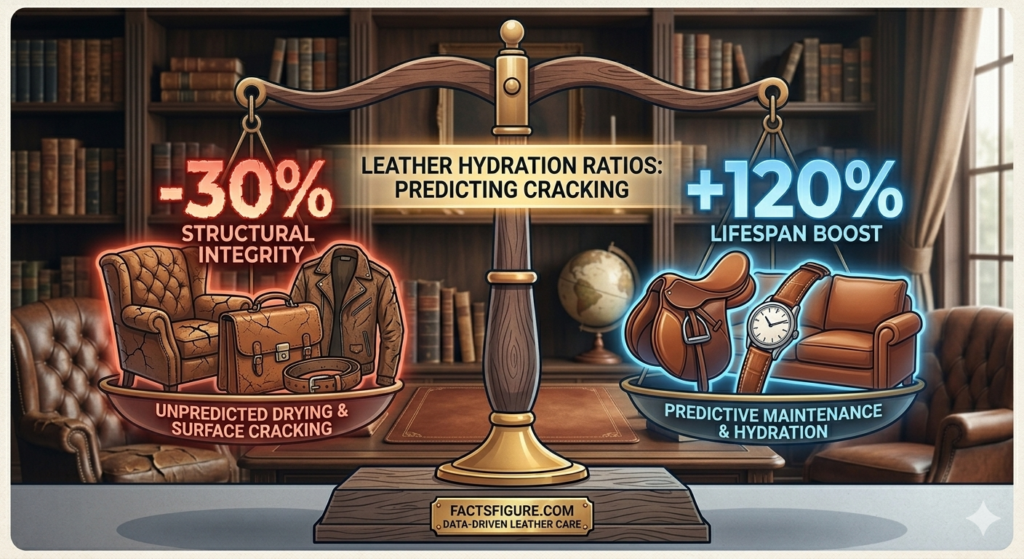
The financial logic of maintaining the correct leather hydration ratio is undeniable. A premium leather sectional or a pair of bespoke boots represents a significant capital outlay. If neglected, these items may require professional restoration or replacement within five to seven years. However, with a disciplined hydration strategy, the same items can easily surpass the twenty-year mark with minimal aesthetic decline.
This “Preservation Dividend” is calculated by comparing the annual cost of high-quality conditioners and humidity control (approximately $50–$100) against the replacement cost of the asset (thousands of dollars). Beyond the monetary savings, there is the “Patina Value”—the fact that well-maintained, aged leather is more desirable and valuable in the secondary market than new leather. A perfectly hydrated, twenty-year-old leather jacket possesses a character and softness that cannot be manufactured; it must be grown through years of careful environmental management.
Engineering the Longevity of Leather
Predicting the lifespan of leather is not a matter of luck, but a matter of physics and chemistry. By understanding the hydration ratios required to keep collagen fibers lubricated, we move from being passive consumers to active curators of our possessions. The “facts” of leather degradation are clear: humidity is the lifeblood of the hide, and oil is its shield.For the readers of factsfigure.com, the takeaway is a call for “Quantitative Stewardship.” Monitor your environment, audit your conditioning cycles, and respect the biological nature of the materials you own. In a world of disposable synthetics, a piece of perfectly maintained leather is a rare “Figure” of permanence. It is a testament to the idea that with the right care, the things we love can truly last a lifetime, growing more beautiful and more valuable with every passing year.