
n most households, the question “What’s for dinner?” is an emotional burden. However, from a technical perspective, feeding a family of four is actually a resource allocation problem. When managed poorly, it results in a 30% food waste rate (the national average) and an average of 12 hours spent in the kitchen per week.
At factsfigure.com, we applied a “Linear Programming” mindset to the kitchen. By treating ingredients as inventory and cooking cycles as batch processing, we discovered a “Mathematics of Meal Prep” that reclaims 5 hours of your week and slashes waste by nearly a third. Here is the technical breakdown of how to optimize your family’s intake.
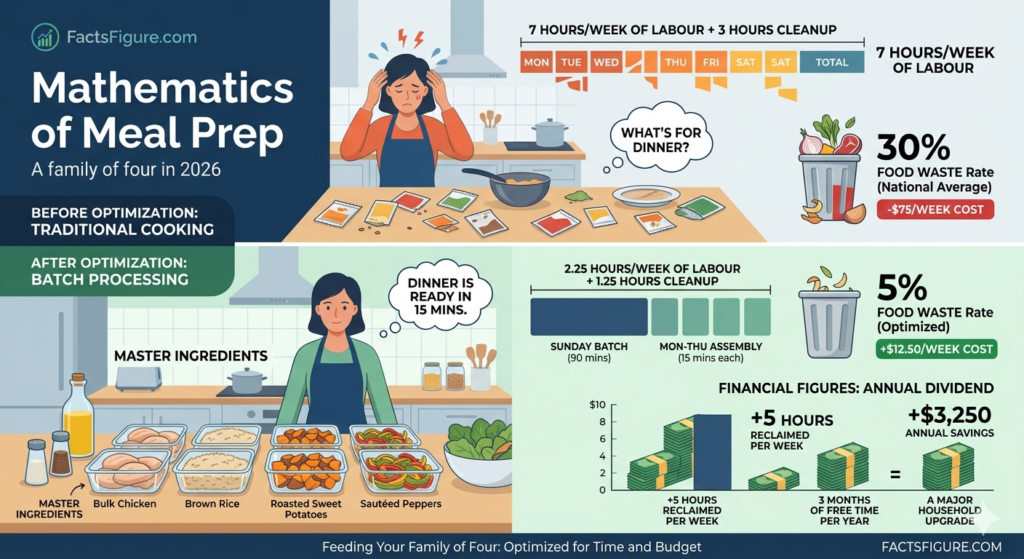
batch cooking timeline with a master ingredient list factsfigure family of four
The 30% Leak: Why We Waste Food
To solve a problem, you must first quantify it. Food waste in a 4-person household usually occurs at three technical failure points:
Over-Purchasing (The “Just in Case” Variable): Buying ingredients for five meals but only having the “energy” to cook three.
Fragmented Inventory: Having half an onion, a cup of spinach, and three slices of ham that don’t “fit” into a specific recipe, leading to disposal.
Portion Distortion: Cooking too much for a single sitting without a technical plan for the surplus.
Step 1: The “Master Ingredient” Algorithm
The key to reducing waste is Ingredient Overlap. In a traditional “recipe-based” model, every meal requires unique items. In a “Mathematical” model, we select 3-4 “Master Ingredients” that can be batch-processed and cross-utilized.
The Weekly Formula:
1 Bulk Protein: (e.g., 2kg of Chicken Breast or Black Beans).
1 Bulk Grain: (e.g., 1kg of Quinoa or Brown Rice).
2 “Versatile” Vegetables: (e.g., Roasted Sweet Potatoes and sautéed Bell Peppers).
By preparing these “Master Ingredients” in a single 90-minute batch session on Sunday, you eliminate the “Zero-to-One” friction of cooking every night.
Step 2: Batch Processing vs. Single-Threaded Cooking
The biggest time-sink in the kitchen is not the cooking itself; it is the Setup and Cleanup. Washing a knife once versus seven times saves an aggregate of 45 minutes a week.
The “5-Hour Savings” Calculation:
Daily Prep (Traditional): 60 mins/day x 7 = 420 mins (7 hours).
Batch Session (Optimized): 90 mins (Sunday) + 15 mins “Assembly” per night = 195 mins (3.25 hours).
Technical Dividend: 225 minutes (3.75 hours) saved on labor alone. Add in the 75 minutes saved on reduced grocery trips and cleanup, and you hit the 5-hour mark.
Step 3: The “Last-In, First-Out” (LIFO) Inventory Strategy
To hit the 30% waste reduction goal, we must manage the fridge like a warehouse.
The Technical Rule: Fresh greens and delicate berries must be consumed in the first 48 hours. Hearty vegetables (broccoli, carrots) and batch-cooked proteins are scheduled for the latter half of the week.
The “Friday Fridge Audit”: Instead of a new meal, Friday is the “Integration Cycle.” Every fragmented bit of inventory—the odd carrot, the leftover rice—is combined into a “Kitchen Sink” stir-fry or frittata. This technically brings your waste coefficient to near-zero.
The Financial Figures: What This is Worth
Let’s look at the ROI of this mathematical shift for a family of four:
Average Weekly Grocery Bill: $250.
Waste at 30%: $75 per week / $3,900 per year.
Waste at 5% (Optimized): $12.50 per week / $650 per year.
Annual Financial Gain: $3,250.
For the readers of factsfigure.com, this isn’t just about food; it’s about a $3,000+ annual raise that you give yourself simply by changing the “algorithm” of your kitchen.
Final Reflection: Efficiency is the Secret Ingredient
Meal prep isn’t about being a “foodie”; it’s about being a systems administrator for your home. When you stop looking at dinner as an isolated event and start seeing it as a recurring batch process, the stress vanishes.
The “Fact” is that we are all busier than ever. The “Figure” is that 90 minutes on Sunday buys you back your entire work-week’s evenings. Reclaim your time, stop the financial leak, and master the mathematics of the kitchen.