
I used to think that “farming” required a backyard and hours of back-breaking work. But in 2026, with grocery prices for organic greens hitting record highs, I decided to run an experiment: Could I actually grow a meaningful amount of food in just 5 square feet of my apartment? After six months of data tracking, the “Facts and Figures” blew me away.
1. The Realization: Space is a State of Mind
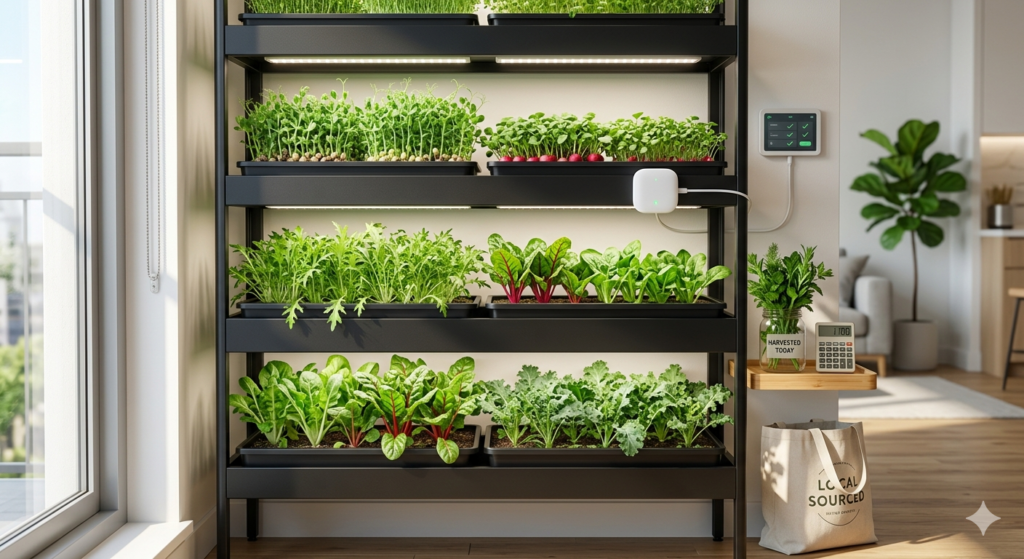
When I first looked at the empty corner of my balcony—roughly 0.5m2 (5 square feet)—it didn’t look like much. But in the world of 2026 urban farming, we don’t think horizontally anymore; we think vertically.
By using a modular vertical shelving system, I managed to triple my growing surface. It’s no longer about how much floor space you have, but how you optimize your “Yield-per-Inch.” I realized that even a small corner, if managed with the right tech, could outperform a traditional garden bed.
2. My Financial Audit: What I Actually Saved
The most common question I get is: “Is it actually cheaper than buying at the store?” To answer this, I kept a spreadsheet of every harvest versus the local market prices in 2026.
The Retail Reality: A simple bag of organic arugula or a bunch of fresh basil now costs me nearly $7.00 at the city market.
My Production Cost: Between seeds, organic nutrients, and the low-wattage LED lights, I’m producing that same amount for about $0.45.
The Bottom Line: Over the course of a year, my little 5-square-foot setup is on track to save me roughly $1,100.
The Fact: That’s not just “hobby money”—that’s a significant chunk of my annual food budget reclaimed through a bit of smart automation.
3. Selecting the “High-ROI” Crops
I learned quickly that you shouldn’t waste space on low-value crops like potatoes or carrots in a micro-farm. To make the numbers work, you have to focus on high-turnover “luxury” greens.
The 10-Day Microgreen Cycle
Microgreens are my “secret weapon.” They grow from seed to harvest in just 10 to 14 days. Not only are they packed with up to 40 times the nutrients of adult plants, but they also sell for a premium. Growing them at home felt like printing my own “health currency.”
“Cut-and-Come-Again” Harvesting
I’ve had great success with Mizuna and Swiss Chard. Instead of harvesting the whole plant, I just take the outer leaves. This keeps the “production line” running 24/7 without having to wait for new seeds to sprout every time.
4. The Hidden Value: Nutrient Density
One thing the data doesn’t always show is the Nutrient Degradation Rate. Did you know that spinach can lose nearly 90% of its Vitamin C within just 24 hours of being picked and shipped?
By harvesting my salad literally 30 seconds before I eat it, I’m getting a level of nutrition that money simply cannot buy at a grocery store. In 2026, where we all prioritize “Preventative Health,” this is the ultimate biohack. I feel sharper, more energized, and I haven’t had to buy expensive synthetic supplements in months.
5. The 2026 Tech: Making it “Lazy-Proof”
I’ll be honest: I don’t have a “green thumb.” But with 2026 technology, you don’t need one. My system is almost entirely automated:
Smart Sensors: My phone pings me when the water level is low.
AI Lighting: The LEDs automatically adjust their spectrum based on the time of day, mimicking a perfect Mediterranean spring.
Efficiency: The whole setup uses less electricity than a standard bedside lamp.
6. My Final Verdict: Should You Do It?
If you have 5 square feet and a power outlet, my answer is a resounding Yes.
Micro-farming in 2026 isn’t just about the food; it’s about Self-Sovereignty. It’s the feeling of knowing that no matter what happens with global supply chains or inflation, you have a reliable, high-yield source of nutrition right in your living room.
The takeaway: You don’t need a farm to be a farmer; you just need to start thinking in “Facts and Figures.”