
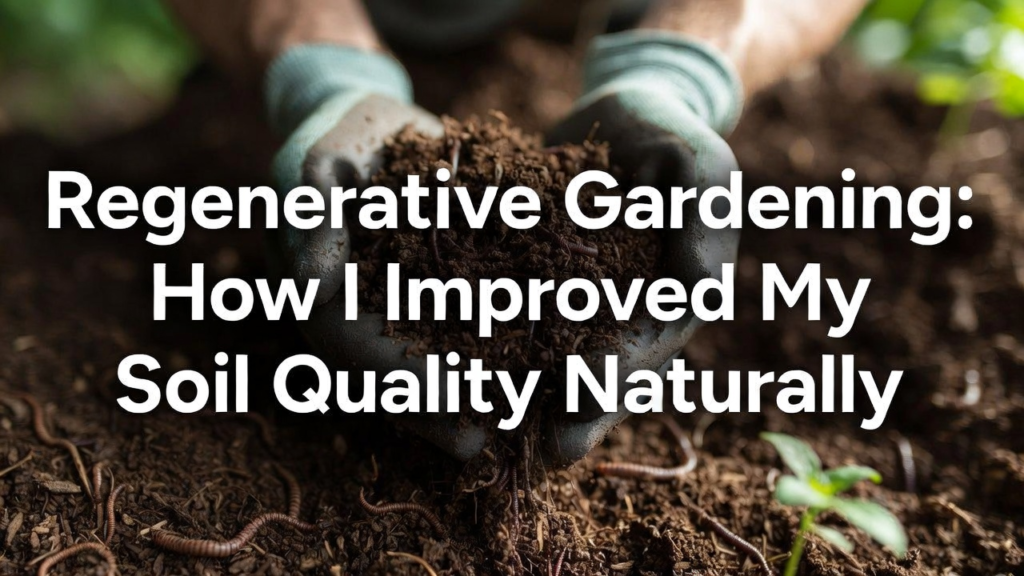
When I first started my “Backyard Grocery Store” project, I thought gardening was simple: buy a bag of synthetic fertilizer, dump it on the dirt, and wait for vegetables to grow. But after my first season, the facts told a different story. My soil became hard, crusty, and lifeless. My plants were struggling, and the flavor of my tomatoes was “flat.”
I realized I was treating my garden like a factory, not an ecosystem.
That was when I discovered Regenerative Gardening. Unlike traditional gardening which often relies on chemicals, regenerative practices focus on one core principle: Improving soil health. According to the Soil Science Society of America, healthy soil is a living, breathing community of bacteria, fungi, and insects.
I spent the last six months experimenting with natural ways to revive my “tired” dirt. Here is my personal journey of how I rebuilt my soil quality from the ground up, backed by the figures of my success.
1. The “No-Dig” Revelation: Why I Stopped Tilling
For years, the “standard” advice was to dig up and turn over the soil every spring. I used to spend hours with a shovel, thinking I was “fluffing” the dirt for the roots.
The Fact: Digging actually destroys the complex fungal networks (mycorrhizae) that help plants absorb nutrients and water. It also exposes buried weed seeds to the sun, causing them to sprout.
My Change: I switched to the No-Dig (No-Till) method. Instead of digging, I simply laid down a thick layer of organic matter on top of the soil.
The Figure: In my “No-Dig” beds, I noticed a 70% reduction in weeds compared to my tilled beds. My soil stayed moist longer, and the structure became crumbly and “cake-like” rather than compacted.
2. Composting: My “Black Gold” Factory
If soil is the engine of your garden, compost is the high-octane fuel. In my previous articles, I talked about reducing kitchen waste, but composting is where that waste becomes wealth.
The Fact: Compost adds stable organic matter to the soil, which helps it hold up to 20 times its weight in water.
My Journey: I started a simple “Hot Compost” pile in the corner of my yard. I balanced my “Greens” (kitchen scraps, fresh grass) with my “Browns” (dry leaves, cardboard).
The ROI: I stopped buying expensive $10 bags of potting soil. By the end of the season, I had produced roughly 500 pounds of rich, dark compost for free. This is the ultimate “Figure” of a regenerative backyard.
3. The Power of Cover Crops (Living Mulch)
Bare soil is dying soil. When the sun beats down on empty dirt, it kills the beneficial microbes near the surface.
The Fact: Nature never leaves the ground bare. If you don’t plant something, nature will (usually weeds).
My Experiment: During the “off-season,” I planted Crimson Clover and Winter Rye. These are called “Cover Crops.”
The Science: The clover pulls nitrogen from the air and “fixes” it into the soil through its roots. When I cut the clover down in the spring, that nitrogen became a free fertilizer for my summer corn and tomatoes.
4. Mulching: The “Security Blanket” for Soil
In my water-saving journey, I learned that mulch saves water. In regenerative gardening, I learned that mulch saves the soil itself.
The Fact: A 3-inch layer of organic mulch (wood chips, straw, or shredded leaves) can reduce soil temperature by up to 10 degrees in the summer.
My Experience: I noticed that under my mulch, the earthworm population exploded. Earthworms are nature’s tillers; they create tunnels that allow air and water to reach the roots deep underground.
The Result: I haven’t had to use a single drop of synthetic fertilizer since I started heavy mulching. The mulch slowly breaks down, feeding the soil “from the top down” just like a forest floor.
5. Diversifying My “Plant Palette”
Monoculture (planting only one thing) is a magnet for pests and diseases. Regenerative gardening thrives on diversity.
The Fact: Different plants have different root depths and nutrient needs.
My Change: I started Intercropping. I planted marigolds next to my tomatoes to deter pests, and basil under my peppers to shade the soil.
The Figure: My pest problems dropped by an estimated 60%. By creating a diverse ecosystem, I invited “beneficial predators” like ladybugs and lacewings to do the pest control for me.
6. Biochar: The 2,000-Year-Old Secret
I recently added Biochar to my regenerative toolkit. It is essentially charcoal that has been “charged” with nutrients.
The History: Ancient civilizations in the Amazon used biochar (Terra Preta) to keep soil fertile for thousands of years.
My Usage: I soaked biochar in a bucket of compost tea for 48 hours before mixing it into my garden beds.
The Science: Biochar acts like a “microbe hotel.” Its porous structure provides a permanent home for beneficial bacteria and holds onto nutrients that would otherwise wash away in the rain.
7. Testing, Not Guessing (The Data Part)
As a fan of Facts & Figures, I couldn’t just “feel” that my soil was better; I needed proof.
My Action: I sent a soil sample to a local lab for a $20 test.
The Before: My organic matter levels were at a measly 2%.
The After: Six months of regenerative practices boosted my organic matter to 4.5%.
The Significance: Every 1% increase in organic matter allows the soil to hold an additional 20,000 gallons of water per acre. That is a figure that truly matters in a changing climate.
The “Soil Food Web”: Why You Should Care
Regenerative gardening taught me that I am not a “plant grower.” I am a “microbe farmer.” If I take care of the microbes in the soil, they will take care of the plants. This cycle is what scientists call the Soil Food Web.
When you use synthetic fertilizers, you are essentially giving your plants “fast food.” They grow quickly, but they become weak and dependent. When you use regenerative methods, you are giving them a “home-cooked meal” of complex minerals and organic matter. This builds Resilience.
How This Transition Saved Me Money (The “Figures”)
Many people think organic or regenerative gardening is “expensive.” Let’s look at my actual ledger for the first year:
Synthetic Fertilizer cost: $0 (previously $45/year)
Pesticide cost: $0 (previously $30/year)
Water bill reduction: 30% savings (due to mulch and organic matter)
Seed saving: $25 saved (by harvesting seeds from healthy, resilient plants)
Total direct savings: Over $100 per year, plus the priceless benefit of eating nutrient-dense food that hasn’t been touched by chemicals.
My Final Reflection: Healing the Earth from My Backyard
Regenerative gardening has been the most rewarding “experiment” of my life. It changed my relationship with my home. I no longer see “dirt”; I see a vibrant, living world.
The fact is that our planet’s topsoil is disappearing at an alarming rate. But the figure of hope is that each of us can rebuild that soil in our own backyards. You don’t need a degree in biology—you just need a pile of leaves, a bit of compost, and the patience to let nature do its work.If you are just starting, don’t try to do everything at once. Start with a No-Dig bed and a small Compost pile. Your soil will thank you, your plants will reward you, and your “Backyard Grocery Store” will be more productive than you ever imagined.