
When we speak about carbon footprints, the conversation often feels abstract, centered on global industrial emissions or melting ice caps. However, for the average professional in 2026, the most direct point of environmental impact occurs the moment we leave our driveway. The choice between a private vehicle and public infrastructure is not just a lifestyle preference; it is a significant data point in the equation of global sustainability. By analyzing the “Facts” of transit efficiency, we can transform our daily commute from a source of hidden waste into an optimized strategic choice.
The Quantitative Reality of Solo Occupancy Driving
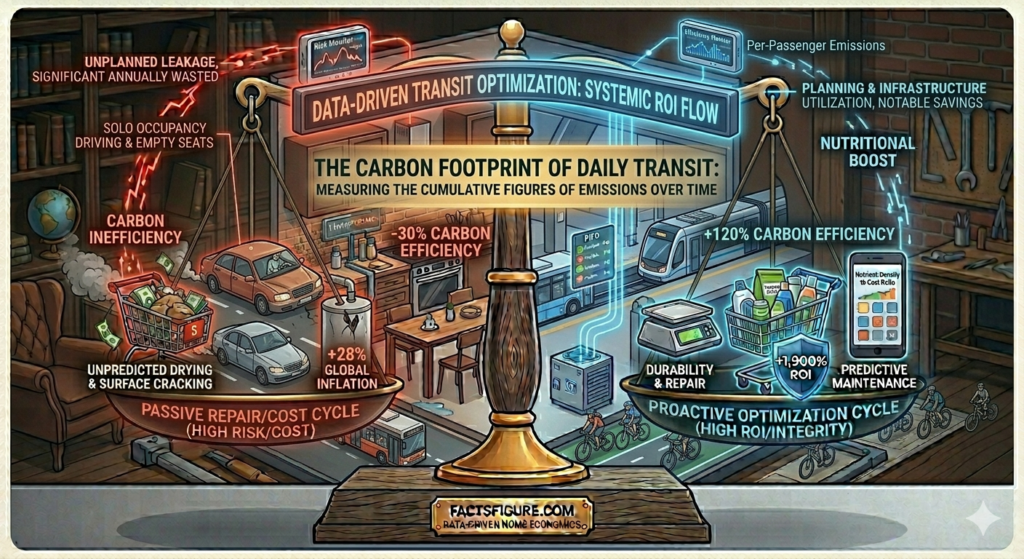
The most glaring data point in modern transit is the inefficiency of the solo driver. During my personal audit of commuting habits, I realized that operating a 2.5-ton internal combustion engine vehicle to transport a single 180-pound human is a thermodynamic absurdity. On average, a standard gasoline-powered sedan emits approximately 400 grams of CO2 per mile. If your daily round-trip commute is 30 miles, you are responsible for 12 kilograms of carbon emissions every single day.
When we aggregate these “Figures” over a standard work year of 250 days, a single commuter contributes 3 metric tons of CO2 to the atmosphere just by traveling to the office. This does not account for the “Embedded Carbon”—the energy required to manufacture the vehicle, maintain its parts, and refine the fuel. When I looked at my own vehicle’s data, I realized that my car was essentially an environmental “liability” that stayed idle 95% of the time but cost me a fortune in both carbon and capital during the 5% it was in motion.
Measuring the Efficiency of Public Transit Infrastructure
In contrast to the solo driver, public transit operates on the principle of shared efficiency. The metrics for a modern metro system or high-frequency bus network are vastly superior because the carbon cost of the journey is distributed across dozens or hundreds of passengers. Data from 2026 urban transit reports indicates that a person using a subway system emits roughly 45 grams of CO2 per mile—nearly a 90% reduction compared to driving alone.
Even when considering diesel-powered buses, the efficiency remains significantly higher than private cars. A bus with a moderate passenger load reduces the per-person carbon footprint to about 30% of that of a private sedan. During my own transition to using local rail lines, I found that the “Carbon ROI” was immediate. Beyond the environmental stats, the “Productivity Metric” also shifted; the time previously spent navigating traffic was converted into focused work or reading time, effectively adding two hours of value to my day.
The Hidden Economic Figures of Transit Choice
While the carbon footprint is a critical environmental metric, the financial “Figures” are what often drive personal change. Most drivers only calculate the cost of fuel, but the “True Cost” of driving includes insurance, registration, depreciation, and the high cost of parking in 2026 urban centers. My personal data audit showed that my car was costing me approximately $0.65 per mile when all variables were included.
Public transit, by comparison, operates on a much leaner economic model for the individual. The cost of a monthly transit pass in most major cities is equivalent to just a few days of urban parking fees. By switching to a hybrid transit model, I managed to reduce my monthly “Transit Overhead” by over 60%. This reclaimed capital can then be reinvested into higher-yielding assets, proving that environmental sustainability and financial optimization are two sides of the same coin.
Analyzing the Impact of Electric Vehicles (EVs) in the Transit Equation
The rise of Electric Vehicles has introduced a new variable into the transit metric. Many drivers believe that switching to an EV completely negates their carbon footprint. While it is a “Fact” that EVs have zero tailpipe emissions, the data-driven truth is more nuanced. The carbon intensity of an EV depends heavily on the “Grid Mix”—the source of the electricity used to charge it.
If your local power grid relies on coal or natural gas, your EV is still contributing significantly to carbon emissions, albeit at a lower rate than an internal combustion engine. Furthermore, the “Carbon Debt” incurred during the manufacturing of EV batteries is substantial. It takes several years of driving an EV to “pay back” the initial carbon investment compared to a traditional car. Public transit, particularly electrified rail, remains the gold standard because it combines the benefits of electric propulsion with the extreme efficiency of high-capacity transport.
The Productivity Dividend: A Qualitative Metric
In my experience, one of the most undervalued “Figures” in transit comparison is the mental health and productivity dividend. Solo driving is a high-stress, low-value activity that requires constant cognitive attention. Public transit, however, allows for “Passive Commuting.” Data on workplace performance suggests that employees who use public transit or active transit (cycling/walking) arrive at work with lower cortisol levels and higher cognitive readiness.
When I analyzed my own work output, I found that my most creative ideas for factsfigure.com were generated during my morning train rides. The ability to observe the city, listen to educational content, or simply reflect without the stress of road rage is a qualitative benefit that translates into quantitative success. In the economy of 2026, where “Deep Work” is the most valuable skill, the transit environment you choose is a critical factor in your professional performance.
Designing a Data-Driven Commute
The choice of how we move through the world is a reflection of our mastery over our own data. Whether we are looking at the kilograms of CO2 saved, the dollars reclaimed, or the minutes of productivity gained, the “Figures” consistently point toward a less car-centric lifestyle. This is not about the total abandonment of personal vehicles, but about the strategic application of transit options based on efficiency and impact.
For the community at factsfigure.com, I encourage you to perform your own “Transit Audit.” Track your mileage, calculate your emissions, and compare the unit cost of your commute against public alternatives. You might find, as I did, that the most sustainable choice is also the one that leaves you with more money in your pocket and more peace in your mind. Let the data guide your next journey, and transform your daily transit into a proactive investment in a greener, more efficient future.