
There is a familiar nostalgia that many of us feel when visiting an older relative’s home and seeing a refrigerator or a washing machine from the early 1990s still humming away in the corner. It feels like a relic from a different era of manufacturing—an era where things were built to outlast the house itself. In contrast, many of the sleek, high-tech appliances we purchase in 2024 seem to have a pre-determined expiration date, often beginning to fail just as the warranty expires. This shift in the lifespan of our household tools is not just a coincidence; it is a fascinating reflection of how our values as consumers and engineers have evolved over the last thirty years.
The Mechanical Soul of the Nineties
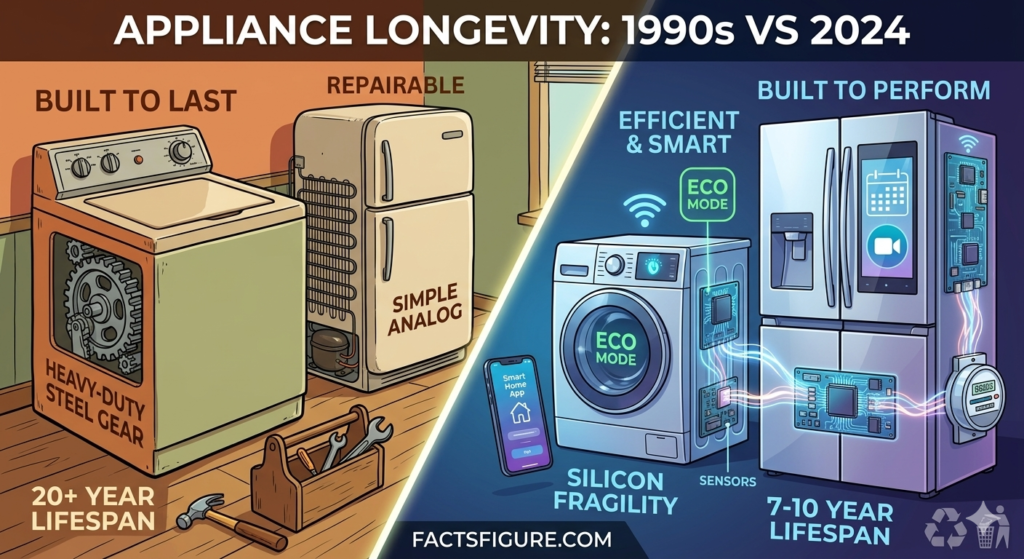
Looking back at the engineering of the 1990s, there was a clear focus on mechanical integrity. Back then, an appliance was essentially a collection of heavy-duty metal parts. If you opened up a washing machine from that decade, you would find a robust steel transmission and a motor built with enough copper to last a lifetime. The design philosophy was simple: over-engineer the moving parts so they could handle years of heavy use without breaking a sweat.
There was also a beautiful simplicity to those machines. They didn’t have complicated sensors or Wi-Fi connectivity. They relied on analog dials and physical switches that were incredibly resilient. Because they lacked a “brain” in the form of a delicate circuit board, they weren’t bothered by small power surges or the humid environment of a laundry room. From my perspective, the durability of that era came from a focus on the physical rather than the digital. These machines were built for a world where we expected a product to be a permanent fixture in our lives.
The Fragility of Modern Complexity
In 2024, the landscape has changed dramatically. We are now living in the age of the “smart” appliance. Today’s refrigerators can manage our grocery lists, and our washing machines can be started from an app on our phones. While these features offer undeniable convenience, they introduce a level of fragility that simply didn’t exist thirty years ago. We have traded mechanical gears for sensitive microprocessors.
The reality of modern appliances is that they are often held hostage by their own electronics. A tiny sensor or a single glitched circuit board can render a thousand-dollar machine completely useless. Unlike the mechanical repairs of the past, these digital components are rarely fixable; they usually require a total replacement of the part, which often costs as much as a new unit. It is a frustrating shift where the “innovation” we pay for becomes the very reason the machine fails prematurely. It feels as though we have sacrificed long-term reliability on the altar of short-term convenience.
The Paradox of Efficiency and Environmental Impact
One cannot discuss modern technology without mentioning the massive strides we have made in energy efficiency. A 2024 dishwasher uses a fraction of the water and electricity that a 1990s model would have consumed. There is a genuine sense of responsibility in modern manufacturing to reduce our carbon footprint, and that is something to be celebrated.
However, there is a hidden paradox here. To meet these strict energy-saving standards, manufacturers must often use lighter materials. Thinner insulation and smaller, more efficient motors mean that the machine has less structural “heft” to absorb the vibrations and heat generated during use. We save money on our monthly utility bills, but we end up spending that saved money—and more—on replacing the entire appliance every seven to ten years. From a broader environmental perspective, one has to wonder if the energy saved during operation outweighs the waste created when a machine is hauled to a landfill long before its time.
A Globalized Manufacturing Reality
Another personal observation regarding this shift involves the change in how these products are made. In the 1990s, many brands were vertically integrated, meaning they made most of their own parts in their own factories. Today, an appliance is a global jigsaw puzzle. The compressor might come from one country, the circuit board from another, and the assembly happens somewhere else entirely.
This globalization has made appliances more affordable than ever when adjusted for inflation, but it has also made quality control more difficult. We have entered a “throwaway economy” where it is often cheaper for a company to build a new machine than to design one that can be easily repaired by a local technician. This economic reality has fundamentally changed our relationship with the objects in our homes. We no longer view an appliance as an investment; we view it as a subscription to a service that needs to be renewed every decade.
Finding the Middle Ground in a High-Tech World
As we navigate this new era, I believe there is a way to find a middle ground. We don’t have to give up on modern technology, but we should be more mindful of what we choose to bring into our homes. Opting for “simpler” modern models—those without unnecessary touchscreens or complex connectivity—can often lead to a longer-lasting product. We can also support the “Right to Repair” movement, which pushes manufacturers to make their products more accessible to fix.
Ultimately, comparing the durability of the 1990s to the technology of 2024 is a lesson in trade-offs. We have gained incredible efficiency, silence, and smart features, but we have lost that “built-to-last” peace of mind. As consumers, our greatest power is our awareness. By understanding that modern machines are more fragile, we can take better care of them, invest in surge protection, and make more informed decisions that balance our desire for the latest tech with our need for a reliable home.