
My 3 AM Wake-Up Call
For nearly two years, I lived in a state of permanent “brain fog.” I would fall asleep at midnight, wake up at 3 AM with my heart racing, and then stare at the ceiling until my alarm went off at 6:30 AM. I tried expensive pillows, over-the-counter sleep aids, and even “exhausting” myself with late-night gym sessions. Nothing worked.
I realized I was treating my sleep like a chore rather than a biological process. I was asking my brain to “switch off” instantly after a day of high-stress work and blue-light exposure. That’s when I discovered the concept of Sleep Hygiene.
Sleep hygiene isn’t about “sleeping more”; it’s about creating the optimal environment and ritual that allow your body’s natural circadian rhythm to take over. Since implementing this 5-step sanctuary protocol, I’ve reclaimed 8 hours of deep, restorative sleep. Here is the science-backed system that saved my sanity.
Part 1: The Biology of the Dark
Our ancestors didn’t have to worry about sleep hygiene because their environment dictated it. When the sun went down, the world turned dark and cool—the two primary triggers for Melatonin production.
The Blue Light Saboteur
In our modern world, we carry a “miniature sun” in our pockets. The blue light emitted by smartphones and laptops mimics daylight, tricking the pineal gland into thinking it’s mid-afternoon.
My Personal Pivot: I implemented a “Digital Sunset” 60 minutes before bed. I swapped my scrolling habit for a physical book.
The Result: Within four nights, the time it took me to fall asleep dropped from 45 minutes to less than 15. Your brain needs a transition zone; don’t rob it of that.
Part 2: The Thermal Factor (The 18°C Rule)
One of the biggest mistakes I made was keeping my bedroom too warm. Science tells us that our core body temperature needs to drop by about 1 to 2 degrees Celsius to initiate sleep.
The Experiment: I lowered my thermostat to 18°C (65°F) and invested in breathable cotton sheets.
The “Warm Feet” Paradox: While the room should be cool, your extremities should be warm to facilitate vasodilation (which helps the core cool down). I started wearing loose wool socks to bed. It sounds counterintuitive, but it was a game-changer for staying asleep through the night.
Part 3: Creating the “Sensory Vacuum”
Your brain continues to process sensory information even while you are unconscious. If your bedroom is full of blinking LEDs or street noise, you might stay in “Light Sleep” all night without ever hitting the deep, regenerative REM cycles.
Step 1: Total Darkness
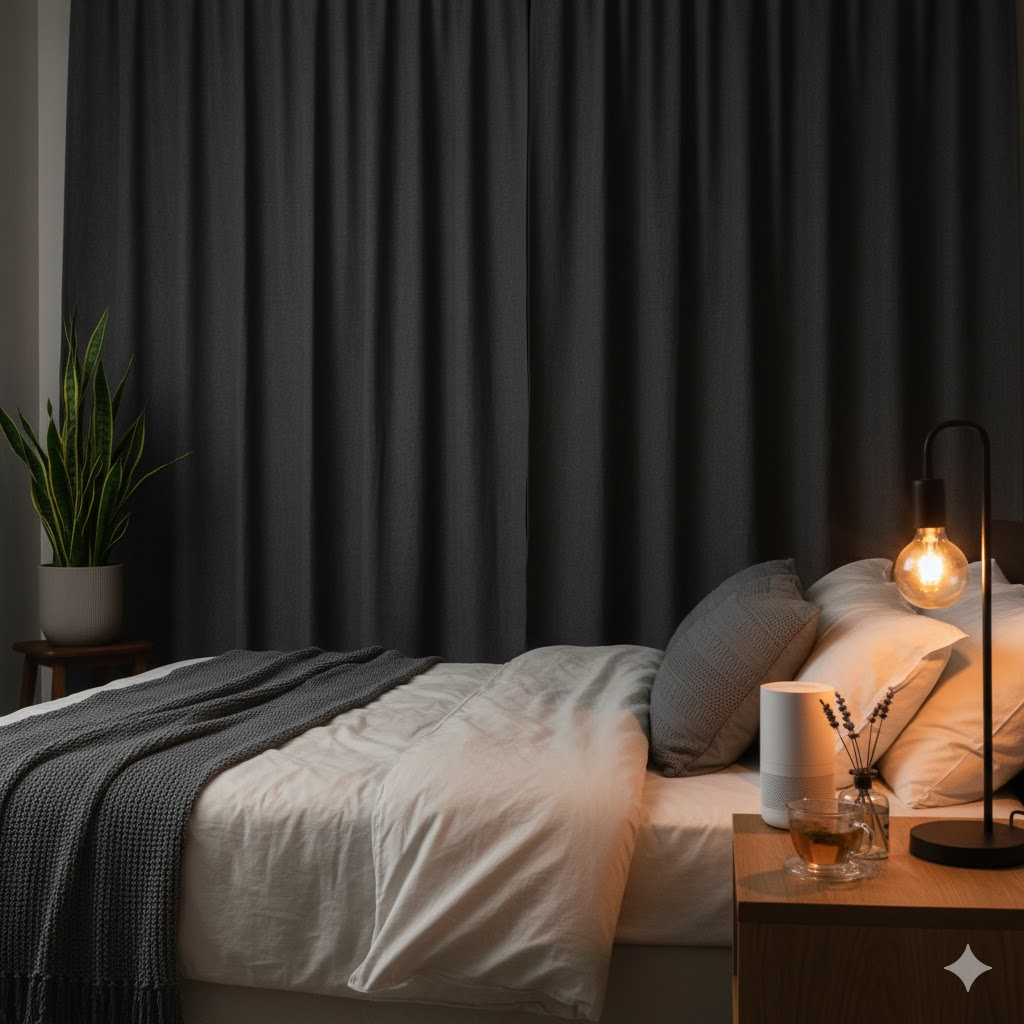
I replaced my thin curtains with Blackout Liners.
The Test: If you can see your hand in front of your face once the lights are out, it’s too bright. Even the tiny red light on a TV or power strip can disrupt your sleep cycle. I used black electrical tape to cover every single LED in my room.
Step 2: White Noise vs. Silence
I live near a busy road, and the sudden sound of a car horn used to jerk me out of sleep. I started using a dedicated white noise machine (or a simple fan).
The Logic: White noise creates a “sound blanket” that masks sudden spikes in volume. It provides a consistent acoustic environment that tells your brain it is safe to stay under.
Part 4: The “Bed is for Sleep” Psychology
Psychologists talk about Stimulus Control Therapy. My bed used to be my office, my cinema, and my dining table. Because of this, my brain associated the mattress with alertness and activity, not rest.
The Radical Change: I banned all electronics from the bedroom. No charging phones, no iPads, no TVs.
The 20-Minute Rule: If I am not asleep within 20 minutes, I get out of bed. I go to another room, sit in dim light, and do something boring (like reading a manual) until I feel sleepy.
Why this works: You must break the mental link between “Bed” and “Frustrated Wakefulness.” The bed must remain a sanctuary for sleep and intimacy only.
Part 5: The ROI of Rest (Health and Wealth)
Is a $50 blackout curtain or a $20 white noise machine worth it? Let’s look at the “Return on Investment” of a perfected sleep hygiene routine.
The Productivity Dividend
When I was sleep-deprived, I spent roughly 2 hours a day “procrastinating” simply because my brain didn’t have the energy to focus. With 8 hours of sleep, my focus is laser-sharp. I finish my work 25% faster.
Financial Impact: That extra time allowed me to start this blog (FactsFigure) and manage my investments more effectively. Good sleep is literally a wealth-building tool.
The Long-Term Health Shield
Deep sleep is when your brain’s Glymphatic System flushes out toxins (like beta-amyloid) associated with Alzheimer’s. By investing in sleep now, I am avoiding thousands of dollars in potential medical costs and long-term care in the future.
Part 6: FAQ – Common Sleep Hygiene Hurdles
Q: “I work night shifts. Can I still have good sleep hygiene?” A: Yes, but it’s even more critical. You must use blackout curtains and high-quality earplugs to convince your body it is night. Consistency is your best friend—keep the same sleep schedule even on your days off.
Q: “What about caffeine? I only drink it in the morning.” A: Caffeine has a half-life of about 5-6 hours. If you have a cup at 4 PM, half of it is still in your system at 10 PM. I moved my “Caffeine Cutoff” to 11 AM, and it significantly reduced my 3 AM wake-up calls.
Q: “Can I use my phone if I use a Blue Light Filter?” A: The filter helps, but the “mental stimulation” of social media or news is just as bad as the light. Your brain needs to be bored to fall asleep.
Conclusion: Reclaiming Your Sanctuary
Turning your bedroom into a sanctuary is an act of self-respect. It’s a recognition that you cannot perform at your best—financially, mentally, or emotionally—if you are running on empty.
Start tonight. Turn off your phone an hour early. Lower the temperature. Mask the noise. Your future self will wake up tomorrow feeling like a completely different person.
What is the biggest “thief” of your sleep right now? Is it a screen, a sound, or a stress? Let’s brainstorm a fix in the comments below!
References & Sources:
Walker, M. (2017). “Why We Sleep: Unlocking the Power of Sleep and Dreams.”
National Sleep Foundation – Guidelines for Optimal Sleep Environment.
Harvard Medical School – Division of Sleep Medicine: Stimulus Control Instructions.