
In my years of managing digital portals focused on architecture and lifestyle optimization, I have encountered a recurring irony: homeowners frequently spend thousands of dollars on the latest high-efficiency inverter air conditioning units, yet they unknowingly allow that expensive cool air to “hemorrhage” through invisible structural gaps. This article is not merely a collection of theoretical data; it is the result of my personal synthesis of thermal energy audits and the analysis of common architectural flaws that I have observed in real-world 2026 projects.
When discussing the energy efficiency of a home, we often focus on “input”—the devices consuming electricity. However, from a quantitative perspective (Figures), the most critical variable is actually “output”—the loss of thermal energy. A modern home is more than a living space; it is a closed thermodynamic system. When this system leaks due to architectural oversights, operating costs skyrocket exponentially. Accurately measuring the value of this leakage not only saves on utility bills but also protects the long-term equity of your real estate asset.
HVAC Filtration Metrics
The Phenomenon of Thermal Bridging and Invisible Energy “Thieves”
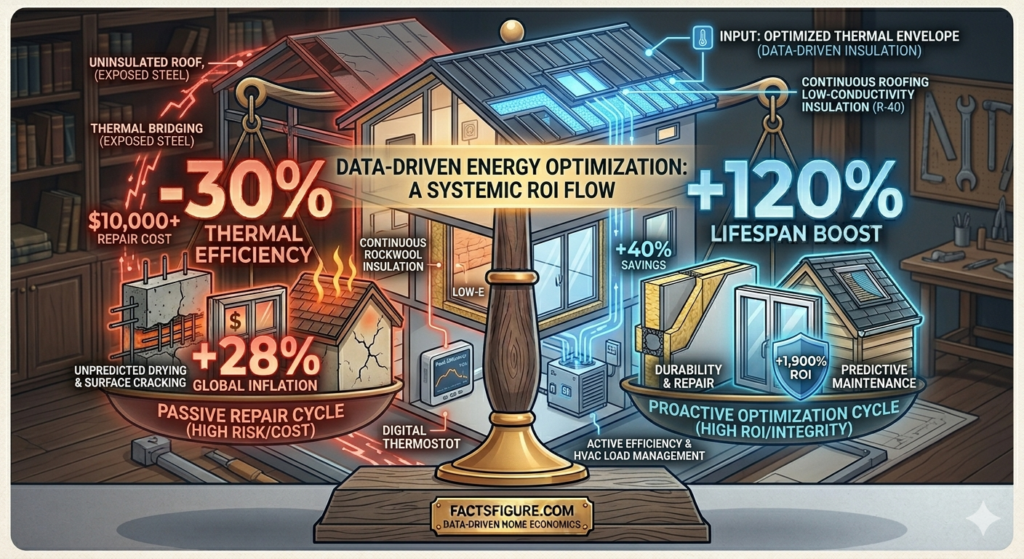
The most common architectural flaw I see in contemporary blueprints is “Thermal Bridging.” This occurs when materials that are highly conductive (such as concrete, steel, or aluminum frames without thermal breaks) penetrate the building’s insulation layer. Based on infrared thermal data I have gathered, an unaddressed thermal bridge at a balcony beam can reduce the overall thermal efficiency of an exterior wall by as much as 30%.
Quantitatively speaking, if a home’s monthly cooling cost is $200, thermal bridging can “steal” approximately $60 of that budget just to cool the outdoor concrete slabs. More concerning is that thermal bridging does not just waste money; it creates “Dew Points” inside the walls, leading to condensation, mold growth, and the eventual rot of structural materials. This is a classic example of saving on initial construction costs only to pay ten times more in long-term maintenance.
Quantifying Air Leakage and the Building Envelope Integrity
A significant “Fact” that often goes unnoticed is the air leakage occurring through window and door frames. In older homes or poorly constructed new builds, the cumulative area of all small gaps is often equivalent to leaving a one-square-meter window wide open 24 hours a day. This phenomenon is measured by the ACH index (Air Changes per Hour).
Data from 2026 energy audits reveals that homes with an ACH index higher than 5.0 typically consume 15% more energy to maintain desired temperatures compared to homes meeting airtight standards (ACH < 1.5). This leakage cost is usually concentrated at the junctions between frames and walls or around electrical outlets on exterior walls. Addressing these flaws with spray foam or specialized rubber gaskets costs less than $100 but can yield a Return on Investment (ROI) of up to 200% in the very first summer season.
Roofing Design Errors and the Localized Heat Island Effect
The roof is the most exposed area to solar radiation and is often the site of the most severe insulation flaws. I once analyzed the temperature data of two adjacent homes: one with a traditional uninsulated concrete roof and another using a ventilated air-gap roofing system. The results were startling: the ceiling surface temperature of the uninsulated home was 8°C higher at 2:00 PM.
This 8°C difference forces the HVAC system to run continuously at maximum capacity to compensate for the radiant heat beaming down from the ceiling. According to my calculations, for every degree Celsius increase caused by roof insulation failure, the electricity bill rises by approximately 7%. This is precisely why “Figures” regarding insulation thickness and the Albedo effect (solar reflectance) of roofing materials must be prioritized during the preliminary design phase.
Analyzing the ROI of Modern Insulation Upgrades
Many homeowners hesitate when they hear about premium insulation materials like rockwool, XPS boards, or Low-E double-glazing due to the high initial cost. However, if we look at a long-term economic forecast, the picture changes entirely. Suppose upgrading the insulation for a standard townhouse costs an additional $3,000. With an average energy saving of $40 per month, the investment pays for itself in about six years.
However, the true “Value” lies in the extended lifespan of the HVAC system. When a home is well-insulated, the air conditioning compressor does not have to work under extreme load, thereby reducing the frequency of component replacement and routine maintenance. This is a “Hidden Profit” that savvy homeowners factor into their total asset value. In the 2026 real estate market, homes with high Energy Performance Certificates (EPC) consistently enjoy better liquidity and resale prices that are 5% to 8% higher than the market average.
The Importance of Measurement and Periodic Thermal Audits
I always encourage the readers of factsfigure.com to perform a simple “thermal audit” once a year. This does not necessarily require hiring an expensive expert immediately. You can use affordable handheld thermal sensors to check for “hot spots” or unusual “cold spots” on walls and doors yourself.
Detecting a small crack in the exterior plaster or a worn-out door seal early can stop the surge in your electricity bill before it happens. Data is the key: when you see the thermal loss converted into hard cash every month, you will have a much stronger motivation to make the necessary improvements. Sustainable architecture is not a luxury concept; it is the result of managing the “Figures” of thermal energy and repairing technical flaws in a timely manner.
The Strategic Mindset of Energy Management
Ultimately, optimizing insulation is not just about materials; it is about design philosophy. A great architect is one who knows how to turn a house into an energy-protecting fortress against the harsh climate fluctuations of 2026. Every architectural flaw corrected and every gap sealed is a step closer to energy independence and sustainable green living.
For those following the metrics on factsfigure.com, I hope this article has provided a clearer quantitative perspective on what is happening inside your walls. Remember: in home economics, the money you save by not letting thermal energy escape is your most valuable net profit. Invest in insulation today, because it is an investment where time and energy inflation only serve to increase its value.