
As global food supply chains in 2026 continue to face volatility, the concept of “Micro-Factories” has moved from industrial parks into our own homes. At FactsFigure, I’ve always been obsessed with maximizing every square inch of underutilized space. Last month, I looked at a damp, dark corner of my garage and saw more than just a storage spot for old boxes; I saw a high-yield protein production center. By implementing a vertical mushroom farming system, I’ve managed to turn a forgotten two-square-meter space into a consistent source of gourmet nutrition.
The Efficiency of Fungi: Why Mushrooms are the Ultimate Urban Crop
Mushrooms are the masters of conversion. Unlike traditional vegetables that require intense sunlight and vast amounts of water, fungi thrive in the exact conditions most homeowners try to avoid: cool, dark, and humid environments. In the context of 2026 urban living, where space is at a premium, mushrooms offer a calorie-to-space ratio that is hard to beat.
What fascinated me during my initial research was the low energy footprint. While my outdoor hydroponic towers require pumps and LED grow lights for 14 hours a day, my garage mushroom racks operate on a fraction of that power. They are essentially recycling organic waste—like coffee grounds and shredded cardboard—into high-value Oyster and Lion’s Mane mushrooms. For anyone looking at the “Facts and Figures” of self-sufficiency, mushrooms are the most logical starting point for an indoor farm.
Building the Vertical Rack: A Case Study in Space Optimization
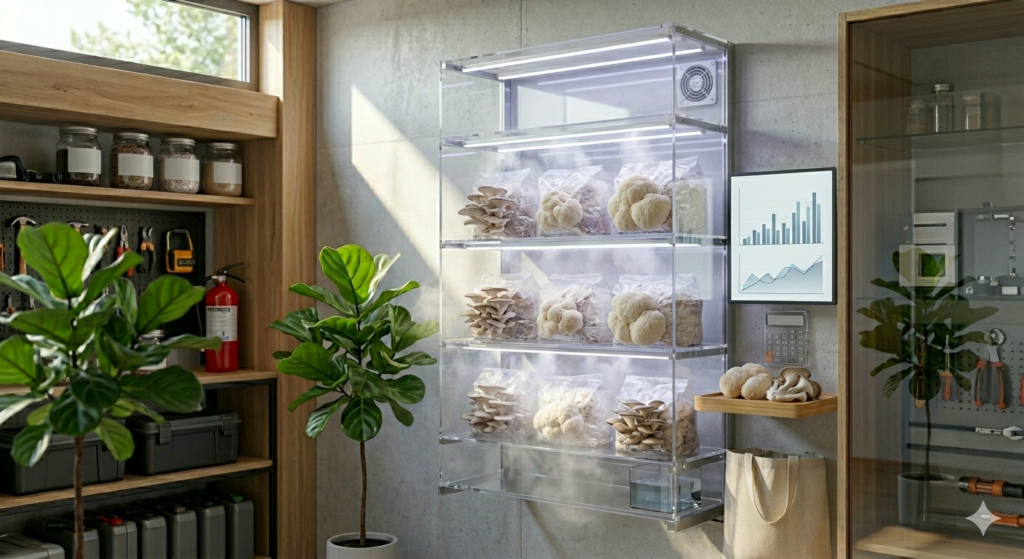
I didn’t want a messy DIY project; I wanted a “Micro-Factory.” I installed a modular, four-tier vertical shelving unit equipped with an automated misting system. By going vertical, I multiplied my production area by four without increasing the footprint on my garage floor.
The climate control was surprisingly simple to automate using a basic 2026 smart home sensor. I set a humidity trigger that activates a small ultrasonic mister whenever the air drops below 85% humidity. This automation ensures that the mushroom “fruiting bodies” develop perfectly, even when I’m busy working. The initial setup cost was under $150, and within just three weeks, I was harvesting my first batch of Pearl Oysters.
The ROI of Home-Grown Protein: Analyzing the Harvest
Let’s look at the actual figures. In 2026, gourmet mushrooms like Lion’s Mane or King Trumpets can retail for significant prices at specialty markets. By growing them in my garage, I’m not just eating better; I’m effectively printing a “food currency.”
Over a 30-day cycle, my two-square-meter corner produced approximately 8 kilograms of fresh mushrooms. If I were to buy this same quantity and quality at a high-end grocer, the cost would be nearly double my total monthly investment in substrate and electricity. Furthermore, the nutritional density is a major factor. These aren’t just garnishes; they are high-protein, vitamin-D-rich meat substitutes that have drastically reduced my household’s reliance on expensive, industrially-produced proteins.
Sustainability and the Circular Economy at Home
The most rewarding aspect of this vertical farm is how it fits into a circular lifestyle. In my household, nothing goes to waste. My morning coffee grounds and the shipping boxes from my online orders now serve as the primary “fuel” for my mushroom blocks.
Once a mushroom block is spent and can no longer produce a harvest, it doesn’t go into the trash. It becomes an incredibly rich compost for my outdoor garden. This creates a closed-loop system where waste is transformed into protein, and the byproduct of that protein enhances the soil for my summer vegetables. It is a perfect example of the bio-efficiency that FactsFigure champions—maximum output with minimum external input.
Scaling Up: Lessons Learned in Micro-Farming
If you are considering transforming your own garage corner, the biggest lesson I learned is the importance of airflow. While mushrooms love humidity, they also need to “breathe.” I installed a small, low-wattage exhaust fan that triggers every few hours to flush out CO2. This small adjustment increased my yield by nearly 15% and prevented the growth of unwanted mold.
As we look toward the rest of 2026, the trend of “Productive Homes” is only going to grow. We are moving away from homes that are purely consumers of resources and toward spaces that contribute to our survival and health. My garage mushroom corner is proof that you don’t need an acre of land to be a farmer; you just need a dark corner, a vertical mindset, and a commitment to understanding the biology of your food.