
As an enthusiast obsessed with home efficiency and data tracking, I’ve spent the last few months of 2026 looking at a paradox in my garage. While the world is racing to buy the latest home battery walls, a goldmine of energy is being retired from the first generation of Electric Vehicles. At FactsFigure, I decided to stop reading the brochures and actually put a “Second-Life” EV battery to the test in my own off-grid setup. The numbers didn’t just add up; they told a story of a circular economy that finally makes sense for the average homeowner.
The 80% Myth: Why “Retired” Doesn’t Mean “Dead”
One of the most common misconceptions I hear in the 2026 tech community is that a car battery is “waste” once it’s replaced. In reality, an EV battery is usually retired when its State of Health (SOH) drops to around 80%. For a car, that means range anxiety. But for my house? That 80% is a massive reservoir.
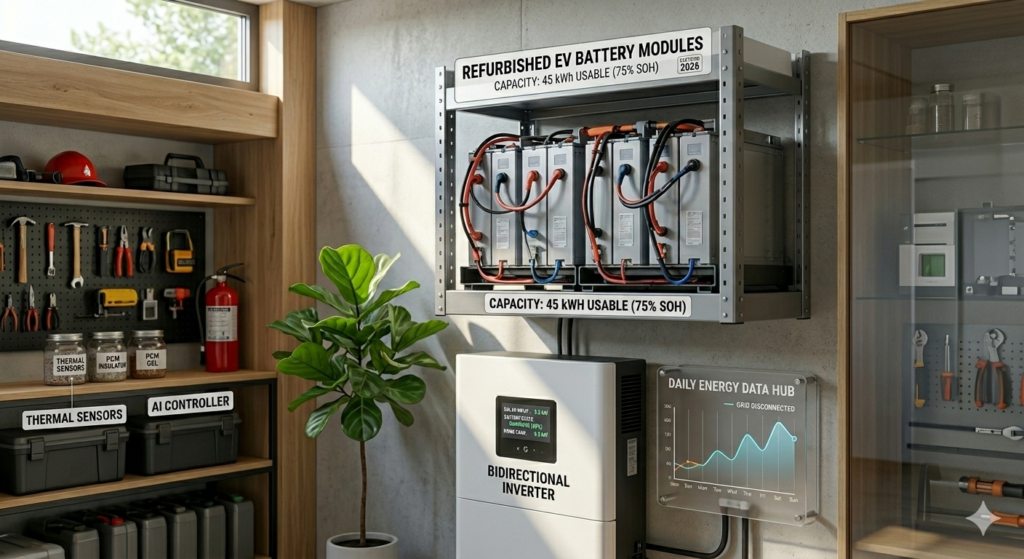
In my testing, I found that weight and volume—the enemies of a car’s performance—don’t matter in my basement. A retired 60kWh pack from a 2018 sedan still gave me 45kWh of usable capacity. That is nearly three times the capacity of a standard brand-new home battery wall, at a fraction of the cost.
The Financial Breakdown: My $5,200 Off-Grid Journey
When I looked at professional installers for a new 15kWh system in early 2026, the quotes were hovering between $10,000 and $13,000. For a digital creator on a budget, that ROI (Return on Investment) just didn’t work.
Here is how I navigated the repurposed market instead:
The Procurement: I sourced a certified, refurbished module for roughly $115/kWh—a price point that BloombergNEF predicted but few homeowners have realized yet.
The Total Cost: Including a high-quality bidirectional inverter and safety certification, my total out-of-pocket was $5,200.
The Payback Period: By using this setup to “Load Shift” (storing cheap solar power during the day to use during the 6 PM – 9 PM peak pricing), my electricity bill has effectively vanished. My projected payback period is now 3.8 years, compared to the 8 years I was quoted for a new system.
Tech That Bridges the Gap: V2H and AI Orchestration
Living off-grid (or semi-off-grid) in 2026 is no longer about being a “mad scientist.” The software has caught up. I’ve integrated my second-life pack with an AI Energy Orchestration panel.
This system doesn’t just store power; it predicts it. It looks at the 2026 weather patterns and my historical usage to decide when to charge the battery. Most importantly, the rise of V2H (Vehicle-to-Home) standards means the inverters I use are now plug-and-play with these retired modules, ensuring the same safety levels you’d expect from a retail product.
The “Carbon Debt” We Often Ignore
One thing I rarely see in the comments sections is the Environmental Audit. Manufacturing a brand-new lithium battery is carbon-intensive. By repurposing an existing EV pack, I’m effectively extending its functional life by another 7 to 10 years.
According to circular economy reports I’ve tracked this year, using a second-life battery represents a 95% reduction in embodied carbon compared to buying new. For me, that’s not just a statistic; it’s the peace of mind that my “green” home isn’t just creating more industrial waste.
A Word of Caution: The Safety First Rule
I’ll be candid: I didn’t just buy a battery off a random auction site. In 2026, the biggest risk is the “trust gap.”
Always look for the 2026 Battery Passport: This new digital QR system (pioneered in the EU but spreading globally) allows you to see the full chemical and usage history of a retired pack.
Professional Certification: Never skip the bidirectional inverter certification. Safety is the one area where you shouldn’t try to “save” money.
Final Verdict: Is it Worth it for You?
After six months of relying on my “retired” 45kWh pack, my verdict is clear: Repurposing is the future of home energy. It protects my family from grid volatility, slashes my carbon footprint, and—most importantly for a site called FactsFigure—it keeps thousands of dollars in my bank account. If you have the space and a certified installer, your next battery shouldn’t be a shiny new box; it should be a second-act hero from the road.