
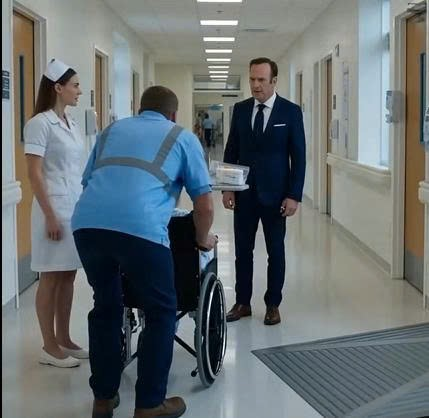
Just as the hospital administrator lunged forward, the elderly janitor pulled the medical bag safely out of reach.
The hallway fell into complete silence.
Only the steady rhythm of a heart monitor echoed from a nearby room.
Across the corridor, the young nurse stood frozen.
Tears streamed down her face—not because she was frightened anymore, but because the truth she had suspected was finally impossible to hide.
The janitor slowly removed one of the pharmacy labels.
Beneath it appeared another sticker.
Blue.
Official.
Clearly printed.
“Charity Pediatric Fund.”
He reached for another package.
The same stamp.
Then another.
Again.
Every single box carried identical markings.
These medications had never been purchased by the hospital.
They had been donated for children whose families couldn’t afford treatment.
The administrator forced out a nervous laugh.
“That doesn’t prove anything.”
Before anyone else could answer, a quiet voice interrupted.
“I watched you.”
Everyone turned toward the little boy sitting in the wheelchair.
His eyes were wet with tears.
His small hands gripped the wheels tightly.
“I saw you put different names on the medicine.”
His voice trembled.
“You covered ours… and gave it to people with money.”
The nurse closed her eyes.
Her heart broke.
The janitor carefully peeled another label away.
Underneath…
Another child’s name.
Then another.
Each package revealed the same heartbreaking pattern.
The donated medicine had been relabeled and redirected to wealthy patients willing to pay, while children who depended on those donations continued waiting… growing sicker with every passing day.
The nurse noticed something lying on the floor.
She bent down and picked it up.
A tiny hospital identification bracelet.
It belonged to the boy in the wheelchair.
Someone had even covered his name.
She held it in trembling hands.
The janitor slowly stepped toward the administrator.
In his fingers was one of the counterfeit labels.
His voice remained calm.
“You didn’t steal medication.”
He paused.
“You stole hope.”
Another step.
“You stole days…”
His eyes locked onto hers.
“…from children who didn’t have many left.”
The administrator instinctively backed away.
But it was already too late.
At the far end of the hallway, hospital security officers appeared.
They were walking directly toward her.
The nurse knelt beside the little boy.
Carefully, she placed the medicine into his lap.
He stared at it as though he were afraid it might disappear again.
With trembling fingers, he gently touched the box.
Then he looked up at her.
“…Does this mean I finally get my medicine?”
His voice was barely louder than a whisper.
The nurse smiled through tears.
She gently brushed his hair back from his forehead.
“Yes.”
Her voice cracked with emotion.
“This time…”
She squeezed his tiny hand.
“…it belongs to the child it was always meant for.”
For the first time in what felt like forever, the little boy smiled.
And in the quiet hallway where greed had hidden behind paperwork and false labels, justice finally arrived—carrying not punishment first, but hope.