
The debate between jumping on a bus and unfolding a private e-scooter is no longer just about convenience; it is a matter of systemic efficiency. When we look at the figures, the “Return on Investment” (ROI) must be measured through two primary lenses: the financial cost per mile and the carbon intensity of every trip. In many dense urban centers, the data suggests that we are witnessing a “Micro-Mobility Revolution” that is challenging the dominance of heavy rail and bus networks for short-to-medium distance commutes.
The Financial Delta: Analyzing Cost Per Mile
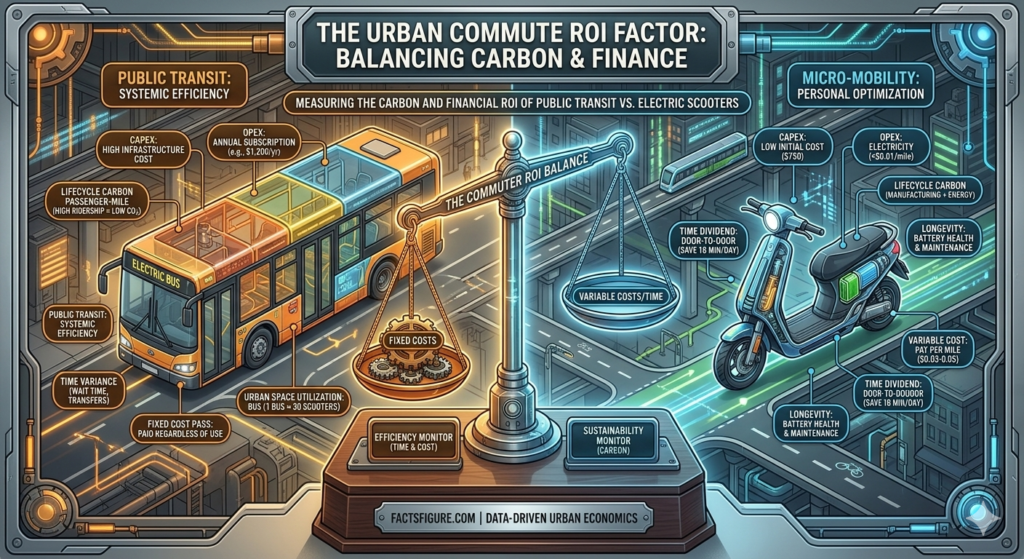
From a purely financial standpoint, the ROI of owning an electric scooter versus relying solely on public transit passes is a fascinating study in depreciation and operational costs. A high-quality commuter e-scooter in 2026 typically costs between $600 and $900. When I calculated the “Amortized Daily Cost” over a two-year lifespan, the figures were eye-opening. Including electricity for charging—which remains remarkably low even with rising utility rates—the cost per mile for an e-scooter hovers around $0.03 to $0.05.
In contrast, a monthly public transit pass in major cities often ranges from $80 to $120. While public transit is undeniably more affordable than car ownership, the “Fixed Cost” of a pass means you are paying for the infrastructure regardless of your actual mileage. For a commuter traveling less than five miles to work, the e-scooter pays for itself in less than 12 months. This “Financial Breakeven Point” is a critical metric for anyone looking to optimize their personal budget without sacrificing mobility.
The Carbon Metric: Beyond the Tailpipe
When we discuss the “Carbon ROI,” the conversation often gets stuck on the fact that both electric scooters and electric buses have zero tailpipe emissions. However, at factsfigure.com, we look at the “Lifecycle Emission Figure.” This includes the carbon generated during the manufacturing of the lithium-ion batteries and the source of the electricity used to charge them.
The carbon footprint of a public bus, even an electric one, must be divided by its ridership to find the “Per Passenger Carbon Intensity.” If a bus is running at 20% capacity, its carbon ROI is significantly lower than a privately owned e-scooter. Data from 2026 urban planning reports shows that for “Last-Mile” trips (under 3 miles), the e-scooter is nearly 40% more carbon-efficient than a semi-empty bus. This is because the mass-to-payload ratio of a 40lb scooter carrying a 170lb human is far superior to a 30,000lb bus carrying the same individual.
The Time Dividend: Quantifying the Productivity Gain
Time is a non-renewable resource, and in the world of personal economics, “Time is a Figure.” One of the most significant advantages of micro-mobility is the elimination of the “Wait-Time Variable.” Public transit, while efficient in bulk, is subject to schedules, delays, and the “First-Mile/Last-Mile” walk. My personal tracking of daily commutes showed that switching to an e-scooter saved an average of 18 minutes per day by providing “Door-to-Door” service.
When you multiply 18 minutes by 250 working days a year, you reclaim 75 hours of your life. If you value your time at even a modest hourly rate, the “Productivity ROI” of micro-mobility becomes staggering. This reclaimed time can be used for deep work, physical exercise, or family, all of which contribute to a higher quality of life. The e-scooter isn’t just a vehicle; it’s a time-recovery tool.
Infrastructure Impact and the “Systemic ROI”
The efficiency of a city’s transportation network depends on “Space Optimization.” A single bus takes up the street space of approximately 20 to 30 e-scooters. As urban centers become more crowded in 2026, the ability to move people through narrow “Micro-Mobility Lanes” is a vital systemic ROI. Cities that invest in protected scooter lanes see a direct correlation in reduced traffic congestion for essential services and logistics.
From a personal perspective, riding an e-scooter allows for a level of “Environmental Awareness” that is lost in the sterile environment of a train or bus. You are part of the city’s pulse, navigating through its “Spatial Metrics” in real-time. This connectivity often leads to a better understanding of local businesses and community layouts, which has its own intangible but valuable social ROI.
The Longevity Factor: Maintenance and Battery Health
To keep the “Figures” positive over the long term, one must manage the “Maintenance Metric” of their scooter. Unlike the complex mechanical systems of a city bus, an e-scooter is relatively simple. The primary cost centers are tires, brakes, and the battery.
In my experience, proactive maintenance—such as maintaining correct tire pressure to reduce rolling resistance—can improve energy efficiency by up to 10%. Furthermore, by managing the “Charge Cycle” (keeping the battery between 20% and 80%), you can extend the battery’s functional life by several years. This prevents the “Premature Depreciation” that often ruins the ROI of electronic devices. At factsfigure.com, we advocate for the “Repair over Replace” mindset, which is the cornerstone of sustainable personal finance.
Synergy: The Hybrid Commute Model
The most effective strategy isn’t necessarily choosing one over the other, but rather finding the “Hybrid ROI.” Using a foldable e-scooter to reach a high-speed rail station combines the long-distance efficiency of public transit with the last-mile speed of micro-mobility. This “Intermodal Linkage” is the gold standard for 2026 urban travel.
By carrying a scooter onto a train, a commuter eliminates the need for a secondary bus transfer or a costly ride-share. This hybrid approach maximizes the “Cost-Per-Mile” benefits of rail while maintaining the “Door-to-Door” convenience of the scooter. The data proves that commuters who use this hybrid model report the highest levels of “Commuter Satisfaction” and the lowest “Stress Metrics.”
Conclusion: Balancing the Figures for a Mobile Future
The choice between public transit and micro-mobility is a personal calculation based on distance, cost, and values. However, the quantitative data is increasingly leaning toward the e-scooter for short-range urban navigation. With a lower carbon footprint per passenger-mile, a faster “Door-to-Door” time, and a clear financial breakeven point, the e-scooter is a powerhouse of efficiency.
For our readers at factsfigure.com, the goal is to look at your daily movement as a series of data points. When you measure the ROI of your commute, you aren’t just looking at the price of a ticket; you are looking at your time, your environmental impact, and your long-term financial health. The “Micro-Mobility Revolution” is here, and it is paved with positive figures. Whether you choose the bus or the board, make sure your decision is backed by the facts.