
By factsfigure.com Staff
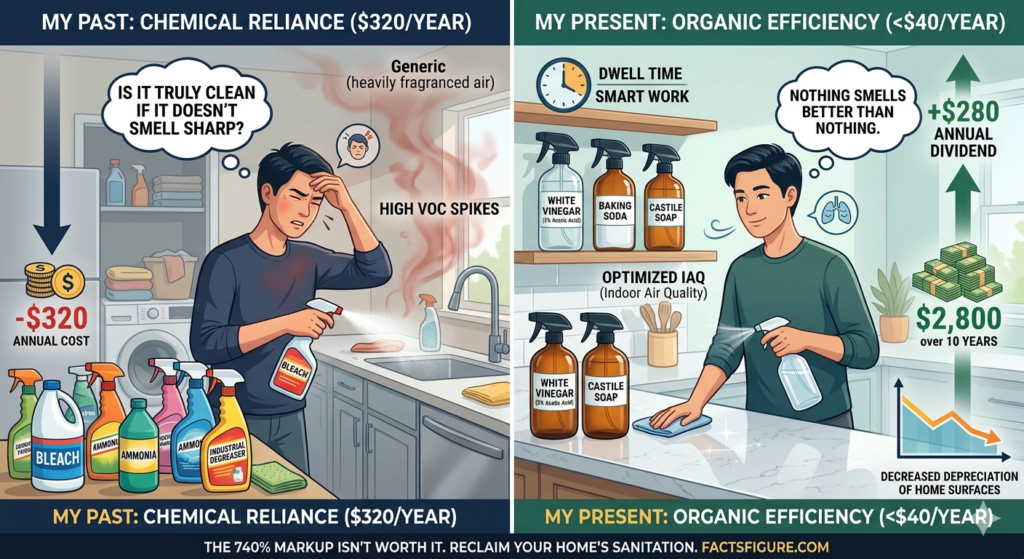
For a long time, I was the “perfect consumer.” My laundry room shelves were a colorful gallery of specialized bottles: one for the glass, another for the stainless steel, a heavy-duty degreaser for the stovetop, and that distinctively blue liquid for the bathroom tiles. I equated the sharp, stinging scent of bleach with a job well done. To me, if it didn’t smell like a hospital, it wasn’t truly clean.
But a little over a year ago, while managing the technical audits for my sites at factsfigure.com, I decided to run a different kind of audit—one on my own household expenses. What I discovered wasn’t just a financial leak; it was a realization that I had been paying a massive “convenience tax” for products that were actually degrading my home’s surfaces and my family’s air quality.
The Wake-Up Call: More Than Just a Price Tag
The shift didn’t happen because of a sudden “green” epiphany. It happened because I started looking at the ingredients. I realized that 90% of my “specialized” cleaners were composed of the same two things: water and a tiny fraction of surfactants, hidden behind synthetic dyes and perfumes.
When I calculated my annual spend, I was shocked to find I was pouring nearly $320 a year down the drain—literally. By switching to bulk organic ingredients like white vinegar, baking soda, and castile soap, that figure plummeted to less than $40. That’s a $280 annual dividend I reclaimed simply by mixing my own solutions. But the real “hidden cost” wasn’t just the money; it was the “Thermal and Chemical Stress” I was putting on my home.
Learning the “Formula of Clean” the Hard Way
One of the biggest hurdles I faced was the “Efficiency Myth.” I initially thought organic cleaners didn’t work because my stovetop didn’t sparkle immediately after a spray. I had been trained by commercials to “spray and wipe” in three seconds.
I had to learn a technical truth I now call the Formula of Clean: Chemical Strength + Time + Temperature + Mechanical Action = Result.
When you use a “harsh” chemical, you are using a high-octane shortcut. When I switched to a diluted acetic acid (vinegar) solution, I realized I just needed to give it “Dwell Time.” By spraying my counters and letting them sit for five minutes while I loaded the dishwasher, the organic solution performed exactly like the industrial one. I wasn’t working harder; I was just working smarter with the clock.
The “Silent” Benefit: Breathing Better
About three months into my organic experiment, I noticed something I didn’t expect. The chronic “post-cleaning headache” I used to get disappeared. I started researching Indoor Air Quality (IAQ) and found that my previous chemical habit was creating “VOC spikes” in my living room that were five times higher than outdoor pollution levels.
By removing synthetic fragrances—which are technically just complex chemical chains designed to trick our noses—the air in my home felt lighter. My “figures” improved too: I noticed I was buying fewer air fresheners because the house didn’t need to hide a chemical scent; it just smelled like… nothing. And in the world of clean, “nothing” is the ultimate goal.
The Technical Kit: My Three Pillars of Sanitation
If you’re looking to replicate my results at home, you don’t need a lab. My “Technical Audit” narrowed it down to three pillars that handle 95% of my home:
The Acid Pillar (Vinegar): My go-to for windows, mirrors, and descaling the coffee maker. It’s a natural disinfectant that costs pennies when bought in the 5-gallon jug.
The Abrasive Pillar (Baking Soda): This is my “magic eraser” for the bathtub and the inside of the oven. It provides the mechanical friction needed without scratching the finish.
The Surfactant Pillar (Castile Soap): For anything greasy. A few drops of plant-based soap in a spray bottle of water creates enough surface tension to lift the toughest kitchen grime.
Final Reflection: Reclaiming the Narrative
Transitioning to an organic, DIY cleaning framework has been one of the most rewarding technical shifts I’ve made for my family. We’ve saved thousands of dollars over the long term, our surfaces—from the quartz counters to the hardwood floors—look better because they aren’t being “burned” by high-pH chemicals, and our lungs are clearer.
At factsfigure.com, we often talk about optimizing systems. Your home is the most important system you manage. Don’t let the 740% markup of the cleaning industry dictate your household budget. The most effective “clean” isn’t found in a bright plastic bottle; it’s found in the simple chemistry of your pantry.