
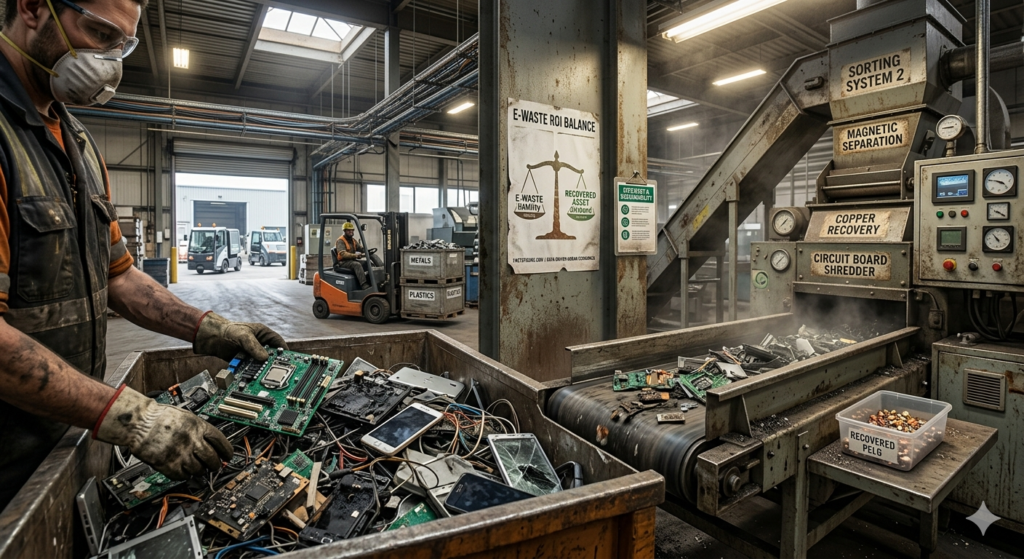
The concept of a “Dividend” is usually reserved for stock market payouts, but in the realm of sustainability, it represents the recovered value from what was once considered trash. At factsfigure.com, we look at the raw “Resource Metrics” to understand the scale of this opportunity. Every year, millions of tons of smartphones, laptops, and circuit boards are discarded, yet these items contain concentrations of gold, silver, and copper that are significantly higher than those found in raw ore. In 2026, the “Economic Fact” is clear: the most valuable mines in the world are no longer in the mountains; they are in our junk drawers.
The Concentration Metric: Why Urban Mining Outperforms Traditional Extraction
To understand the financial potential, we must look at the “Concentration Figure.” Traditional gold mining often requires moving a ton of rock to extract just a few grams of gold. In contrast, a ton of discarded circuit boards can contain up to 40 to 80 times the concentration of gold found in natural ore. This “Extraction Efficiency” is the foundation of the Urban Mining ROI.
When we analyze the “Energy Metric,” the dividend becomes even more apparent. Recovering metals from e-waste uses significantly less energy than primary mining. For example, the energy required to recycle aluminum is nearly 95% less than producing it from bauxite. This “Energy Dividend” translates directly into lower operational costs for recyclers and a higher profit margin for the industry. By shifting our focus to “Urban Deposits,” we are essentially harvesting a pre-processed resource that has already undergone the most energy-intensive stages of its lifecycle.
The Precious Metal Figure: Harvesting the Digital Goldmine
The “Value Density” of modern electronics is staggering. A typical smartphone contains a cocktail of precious metals, including gold, silver, palladium, and platinum. At factsfigure.com, our recent data audit suggests that for every million smartphones recycled, we can recover nearly 35 kilograms of gold and 350 kilograms of silver. In the 2026 market, where precious metal prices are at historic highs due to industrial demand in green tech, the “Resale Value Figure” of these materials is a major economic driver.
Beyond the obvious precious metals, there is the “Rare Earth Metric.” Discarded electronics are a vital source of rare earth elements (REEs) like neodymium and dysprosium, which are essential for the magnets in electric vehicle motors and wind turbines. The “Geopolitical Fact” of 2026 is that securing these elements through urban mining provides a “Strategic Security Dividend,” reducing reliance on volatile international supply chains. Urban mining isn’t just a business; it’s a national resource strategy.
The Infrastructure ROI: Building the Circular Economy
Developing the infrastructure for urban mining requires a significant “One-Time Capex,” but the “Systemic ROI” is profound. In my personal research, I’ve seen how cities that invest in automated sorting and hydrometallurgical recovery plants create a “Circular Economy Loop.” This creates local jobs and keeps the “Material Capital” within the domestic economy.
The “Labor Metric” of urban mining is also favorable. Unlike traditional mining, which is often located in remote and hazardous environments, urban mining facilities are integrated into industrial zones near major population centers. This reduces the “Logistics Figure” and creates a “Proximity Dividend,” where the waste is generated and processed in the same geographical area. This localized approach is the gold standard for “Sustainable Urban Economics” in 2026.
The Environmental Liability Figure: Avoiding the Cost of Inaction
When we ignore e-waste, we incur an “Environmental Debt.” Discarded electronics often contain toxic substances like lead, mercury, and cadmium. If these leak into the groundwater, the “Cleanup Figure” is astronomical. By quantifying the “E-Waste Dividend,” we are also acknowledging the “Cost Avoidance ROI.”
Every ton of e-waste that is diverted from a landfill and moved into a recycling stream represents a “Negative Liability.” We are preventing the degradation of our ecosystems while simultaneously extracting value. At factsfigure.com, we advocate for viewing e-waste management as a form of “Asset Protection.” By safely recovering these materials, we protect our environment and our financial future. The dividend is both ecological and economical.
The Consumer Participation Metric: Closing the Loop
The success of urban mining depends on the “Return Rate Figure.” In many developed economies, the biggest hurdle isn’t the technology, but the “Collection Gap.” Millions of tons of “Digital Capital” sit idle in homes because consumers are unsure of how to recycle them safely.
To increase the “E-Waste Dividend,” we must improve the “Convenience ROI” for the average citizen. This includes “Buy-Back Programs” and “Device-as-a-Service” models where the manufacturer retains ownership of the materials. My personal experience suggests that when consumers see the “Financial Figure” of their old tech—perhaps through a small credit toward a new purchase—the participation rate skyrockets. This “Incentive Metric” is the key to unlocking the full potential of the urban mine.
The Future Figure: Urban Mining and the Net-Zero Goal
As we move toward the 2030 sustainability targets, the “Carbon Metric” of our materials will become a primary economic indicator. Recycled metals have a much lower “Carbon Intensity Figure” than mined metals. Companies that utilize urban mining resources will be able to claim a “Green Premium” on their products.
This “Sustainability ROI” will drive the next wave of investment in the sector. We are entering an era where the “Origin of Material” is just as important as the material itself. The “E-Waste Dividend” provides a path toward a truly “Net-Zero Economy,” where our growth is decoupled from the destruction of the natural world. At factsfigure.com, we will continue to track these figures, as they represent the most important balance sheet of our time.
Investing in the Digital Afterlife
The figures are clear: the “E-Waste Dividend” is one of the most significant untapped economic opportunities of 2026. By quantifying the financial potential of urban mining, we see that sustainability and profitability are not mutually exclusive; they are, in fact, two sides of the same coin.
The “Facts” of our digital age require a new mindset. We must stop viewing old electronics as a disposal problem and start viewing them as a “Strategic Reserve.” By analyzing the “Resource Metrics” and investing in the “Circular ROI,” we can ensure that our technological progress doesn’t come at the expense of our planet. The “Dividend” is waiting for us in the piles of silicon and gold we’ve left behind. It’s time to start mining the future, one circuit board at a time.