
At factsfigure.com, I’ve always viewed natural wood furniture not as static objects, but as living entities that “breathe” and react sensitively to their environment. During the last extreme humidity season, I conducted a real-time audit within my own home to decode what I call the “Humidity Impact Figure.” This data point became the ultimate key to saving my expensive solid oak collection from irreversible warping.
The Reality of Indoor “Moisture Shock”
I used to believe that once wood was treated and finished, it remained stable forever. I was wrong. Wood is fundamentally hygroscopic. When the air is damp, the fibers “drink” water and swell; when the AC runs too dry, they “exhale” moisture and shrink.
During my monitoring process using precision sensors, I discovered a sobering “Physical Fact”: the dimensional change in wood is silent but violent. If you find a drawer suddenly sticking on a rainy morning, it isn’t a design flaw—it is the mechanical result of wood fibers expanding beyond their structural limits due to a spike in the local humidity figure.
The “Golden” 40-60% Zone: My Preservation Baseline
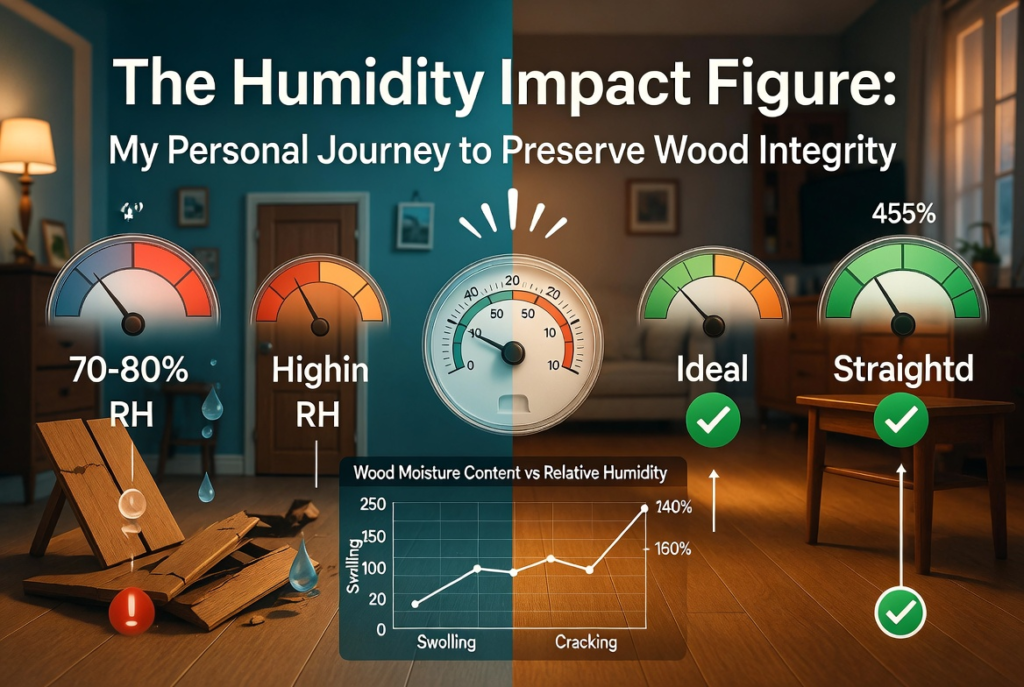
After twelve months of logging data, I established a “Preservation Zone” for my household assets. To maintain the highest “Material ROI,” the Relative Humidity (RH) must stay within the 40% to 60% range.
When the figure drops below 40%: I began to see micro-cracks appearing on the grain surfaces. This is an immediate signal to activate humidifiers to restore the material’s health.
When the figure exceeds 60%: This is a “Red Alert.” Cabinet doors start showing the first signs of cupping. On these days, my dehumidifiers run at maximum capacity to stabilize the environment.
My Personal Audit Tip: I keep a digital hygrometer directly on my most valuable wooden tabletop. It acts like a “Financial Thermometer,” telling me exactly when my assets are at risk of devaluation.
Defensive Strategies: Lessons from My Household Audit
To keep the Humidity Impact Figure within the safe zone, I’ve refined three “Material Engineering” tactics that you won’t find in standard DIY manuals:
The “Six-Side Sealing” Rule: My audits revealed that furniture finished only on the visible exterior surfaces warps 80% faster. My secret? I ensure the underside and back are also sealed. This creates a uniform “vapor brake,” allowing the wood to adapt slowly to weather changes without structural stress.
The 3cm Airflow Gap: I never place solid wood flush against an exterior wall. Leaving a small 3cm gap prevents “Moisture Micro-climates” from forming between the wall and the furniture, ensuring the back of the piece stays as dry as the front.
Avoiding Direct Airflow: I once placed a solid wood chair directly under an AC vent, and it cracked within a single summer. The sudden localized drop in humidity is the number one enemy of timber. Stability is the foundation of longevity.
The Economic Fact: Energy Costs vs. Restoration ROI
Let’s look at the financial logic. Running a dehumidifier costs a few dollars in electricity each month. However, when compared to the $1,000+ cost of professional restoration for a cracked live-edge table, this is the smartest “Asset Insurance” I’ve ever purchased.
At factsfigure.com, I define humidity control as an “Unspoken Asset Dividend.” You invest a small amount in monitoring and energy, and in return, you preserve the structural and aesthetic value of your furniture for decades.
Understanding the Grain to Protect the Value
The Humidity Impact Figure taught me that we cannot fight nature, but we can manage it. Maintaining the 40-60% zone is the most practical way to say “no” to warping and “yes” to longevity.Natural wood furniture is the soul of a home. Listen to it, monitor the figures, and provide it with a stable environment. Visit factsfigure.com to join me in exploring more secrets of data-driven home management.