
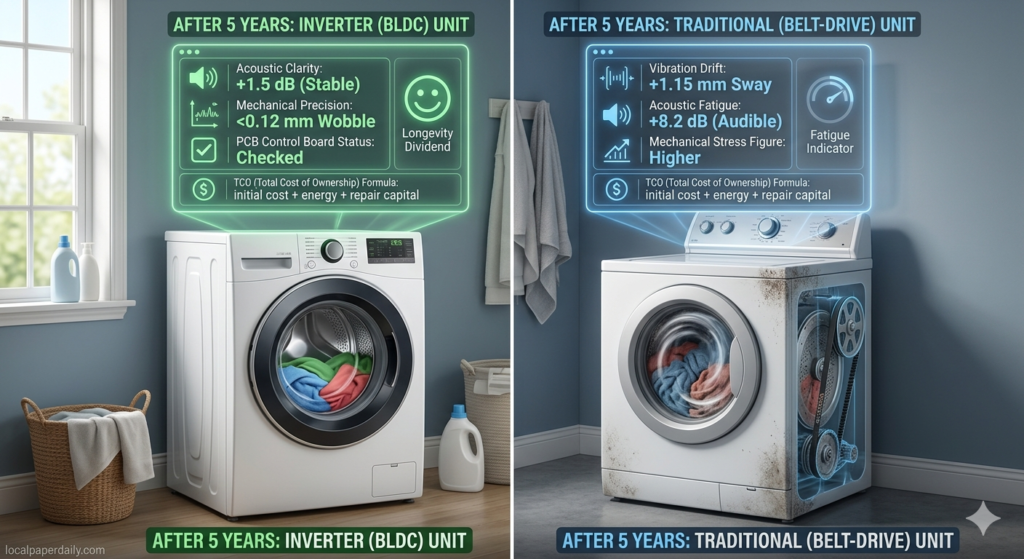
After half a decade of managing two different laundry setups across my properties, I’ve realized that choosing a washing machine isn’t just about the “Energy Star” sticker. It’s a long-term relationship with a piece of hardware. In 2021, I intentionally installed a BLDC Inverter unit in my main home and a Traditional Belt-Drive unit in my guest cottage.
Five years later, the “honeymoon phase” is over. Both machines have faced hundreds of loads of heavy denim, delicate linens, and the occasional forgotten coin. Here is my honest, “no-filter” experience on how these two technologies actually age when the warranty expires and the real world hits.
The Day-to-Day Reality: Peace vs. Power
The most immediate difference I experienced wasn’t on my electric bill—it was in my living room.
The Inverter Experience: In my main house, the Inverter machine is a “silent partner.” Even after five years, I can run a load at 11 PM and barely hear the spin cycle through a closed door. It feels like a precision instrument. The way it gently ramps up speed feels sophisticated, like a luxury car accelerating on a highway.
The Traditional Experience: The belt-drive unit in the cottage is a “vocal” machine. From day one, you know when it’s working. By year three, that signature “whirr” grew into a rhythmic thumping. It doesn’t feel broken, but it feels mechanical. It’s the difference between a modern electric sedan and an old, reliable pickup truck.
The Maintenance “Heart Attack”: A Tale of Two Repairs
This is where my personal journey took a sharp turn. In year four, both machines “complained” for the first time.
The “Easy Fix” (Traditional): One afternoon, the traditional machine stopped spinning. I opened the back panel—a simple task—and saw the rubber belt had snapped. I hopped over to a local hardware store, grabbed a replacement for the price of a large pizza, and had it running again before dinner. It felt empowering to be able to fix my own hardware with basic tools.
The “System Crash” (Inverter): In contrast, when my Inverter machine threw an “E6” error code last winter, my heart sank. It wasn’t a belt; it was the “brain.” A small capacitor on the main control board had fried. There was no “quick fix” at the hardware store. I had to wait ten days for a specialized part and pay a technician a fee that nearly equaled the cost of a new budget machine.
My Lesson: Inverters are amazing until they aren’t. When they fail, it’s rarely a “DIY” afternoon.
Fabric Integrity: What My Clothes Told Me
As someone who invests in quality workwear, I started noticing a “wear-and-tear” delta between the two machines around year three.
I noticed my favorite cotton shirts washed in the Traditional machine started showing “fuzz” (pilling) much faster. The jerky, high-torque starts of the induction motor seem to “slap” the clothes against the drum.
On the other hand, the Inverter machine is incredibly surgical with its movements. My clothes come out looking less “distressed.” If you have a wardrobe you care about, the Inverter isn’t just saving energy; it’s protecting your investment in clothing.
Tips from an American “Home-Hacker”
Based on my five years of “living with the machines,” here are the specific protocols I’ve adopted to keep my hardware alive:
The “Ghost in the Machine” (Surge Protection): After my expensive board repair, I realized that modern Inverter machines are basically iPads that wash clothes. They are terrified of power surges. I now have a high-quality surge protector on the Inverter unit. It’s the cheapest “insurance” you can buy.
The “Vibration Audit”: I’ve learned that a “walking” machine is a dying machine. Every few months, I check if the feet are level. If a traditional machine starts vibrating too much, it shreds its own belt. If an Inverter vibrates, it cracks the solder joints on the control board. Keep them level, and you’ll add years to their life.
The “Less is More” Detergent Rule: In the US, we tend to over-sud. In my Inverter machine, excess foam caused a “pressure sensor” error that almost led to another repair. I switched to using exactly two tablespoons of HE detergent, and the machine has run much smoother ever since.
Final Thoughts: Which One Would I Buy Again?
If you asked me five years ago, I would have said “Inverter only.” Today, my answer is more nuanced.
I still love the Inverter for my daily life because I value the silence and the way it treats my clothes. It’s a “Premium Experience.” But for my rental property or for anyone who wants a machine that “never dies” (or is cheap to resurrect), I still recommend the Traditional belt-drive.
There is a profound peace of mind in knowing that if my machine breaks, I can fix it myself for $20.