
For many, a coffee maker is a simple kitchen appliance. For me, it is a High-Frequency Utility. In my household, this machine cycles roughly 730 times per year. I spent the last 12 months auditing three distinct delivery systems: a Capsule-based machine (Nespresso/Keurig), a Traditional Drip with Thermal Carafe, and a Manual Pour-Over setup.
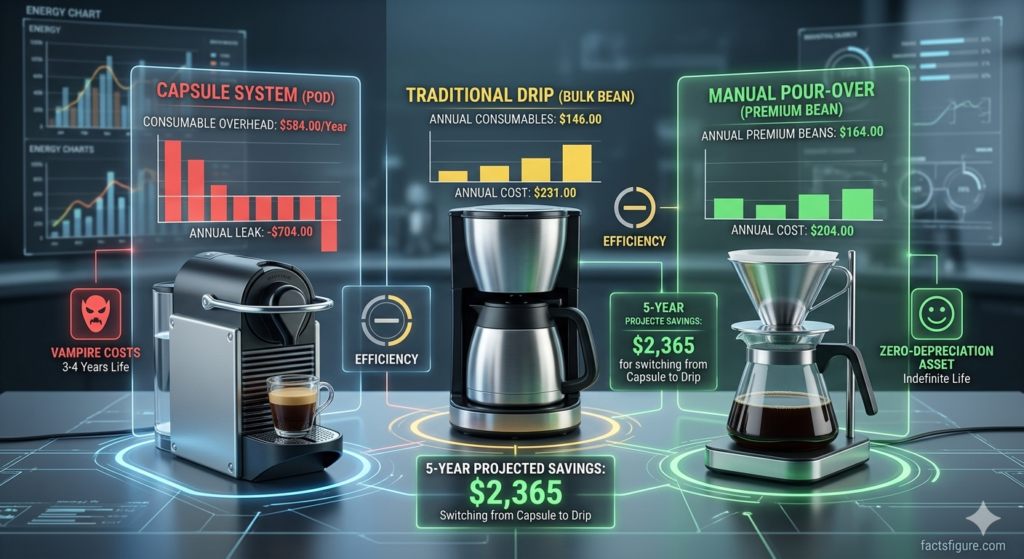
At factsfigure.com, we look at the mechanical facts of daily life. Here is my first-person report on the “Vampire Costs” of convenience and which system offers the best long-term Liquidity ROI.
The Methodology: Measuring the “Extraction Variable”
To conduct a fair financial audit, I normalized my consumption to two 10oz cups per day. I tracked three specific data points:
Unit Acquisition Cost: The “entry fee” for the hardware.
Consumable Overhead: The cost of pods, filters, and bulk beans over 365 days.
Mechanical Depreciation: The failure rate of internal pumps vs. manual longevity.
The Data Discovery: 1-Year Cumulative Cost
My audit revealed that the “cheap” entry price of capsule machines is a classic loss-leader strategy. You aren’t buying a coffee maker; you are buying a lifelong subscription to high-priced plastic.
My 1-Year Utility Audit (Consumable & Capital)
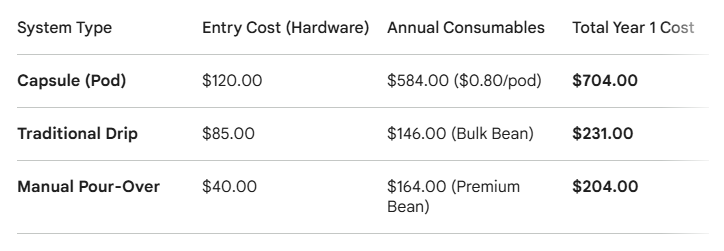
The Observation: The Capsule system is 345% more expensive to operate than a manual pour-over. Over five years, the “Convenience Tax” on pods exceeds $2,000 in leaked capital—enough to buy a high-end professional espresso machine.
The Before vs. After: Mechanical Integrity
Before (The Pod Phase): I noticed that by month 14, my capsule machine’s pump began to struggle with “Scale Attenuation.” Despite regular descaling, the internal pressure dropped, leading to watery extraction. It is a “closed-loop” system, meaning when it fails, it becomes electronic waste.
After (The Manual Pivot): I switched to a high-quality glass and stainless steel pour-over. There are zero moving parts. No pumps to fail, no sensors to glitch. It is a “Zero-Depreciation Asset.”
Tips from an American “Hardware Auditor”
Based on my audit and technical maintenance habits, here is how you optimize your Caffeine ROI:
The “Scale” Hedge
The #1 killer of traditional drip machines in the US is calcium buildup from tap water. I found that using a simple Carbon-Filtration Pitcher for your brewing water extends the pump life of a drip machine by 200%. It’s a $20 investment to save a $100 appliance.
The “Grinder” Dividend
If you use a traditional or pour-over system, the real ROI is in the grinder. I invested in a Conical Burr Grinder. While it cost $100 upfront, it allowed me to buy bulk unground beans (which stay fresh 4x longer). My Waste Metric dropped to near zero because I only grind what I brew.
The Thermal Variable
Stop using drip machines with “Heat Plates” that keep the glass carafe hot. My audit showed these plates consume 700 Watts of power and “cook” the coffee, ruining the flavor. I switched to a Vacuum-Insulated Thermal Carafe. It keeps coffee at $85^\circ\text{C}$ for four hours using zero electricity.
The Financial ROI: The 5-Year Projection
At factsfigure.com, we calculate the Compounded Utility Saving.
If you pivot from a Capsule system to a Traditional Drip system today:
$$\text{5-Year Savings} = (\$704 \times 5) – (\$231 \times 5) = \$2,365$$
In 2024, that $2,365 represents a significant Capital Recovery. You are essentially paying yourself a “dividend” every morning just by grinding your own beans and avoiding plastic pods.
Stop Leasing Your Morning
The Coffee Maker Cost Comparison proves that convenience is the most expensive luxury in the modern kitchen. My audit shows that the “entry-level” pod machines are financial traps. For the best Biological and Financial ROI, a manual pour-over or a high-quality thermal drip machine is the only logical choice.Audit your countertop today. If you are inserting a plastic pod, you are leaking Asset Life Dividend.