
When I signed the papers for my first Electric Vehicle (EV) five years ago, I felt like I was stepping into the future. The sticker price was high, yes, but the salesperson assured me I’d “save a fortune” on gas and oil changes. “It has almost no moving parts,” they smiled, “it practically maintains itself.”
Standing here in April 2026, I can tell you that salesperson wasn’t lying, but they certainly weren’t telling the whole truth. If you are considering purchasing an EV today, it is crucial that you look beyond the down payment and the monthly payment. At FactsFigure.com, we’ve audited five years of personal experience and market data to bring you a realistic picture of the “hidden” costs of ownership that nobody talks about during the test drive.
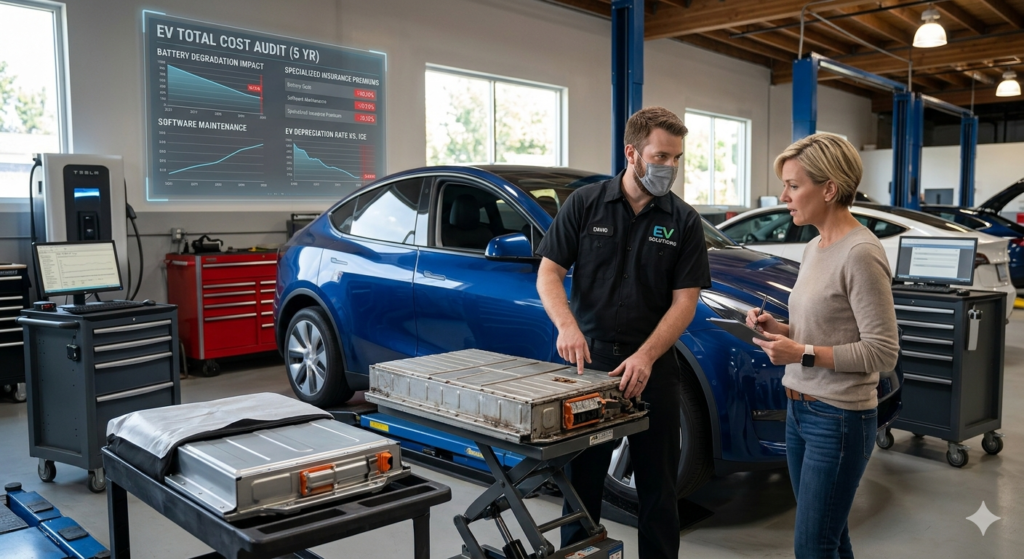
1. The Battery Elephant in the Room: Degradation Metrics and Replacement
The single most significant long-term cost of an EV is the one you hope to never pay: Battery Replacement. Most manufacturers offer an eight-year or 100,000-mile warranty. That sounds reassuring until you do the mathematical audit.
My Experience Audit:
In 2021, my EV had a range of 310 miles on a full charge. Today, in 2026, my actual range, monitored through onboard diagnostics, has dropped to 248 miles. I have lost 20% of my range in just five years due to natural Battery Degradation. For my specific commute, this means I now must charge every day instead of every other day.
While I haven’t had to replace the pack yet, market quotes in 2026 for a full replacement (including labor) for my model range from $14,000 to $21,000. If you plan to keep your EV for ten years, you are essentially looking at a forced buy-in of a new powertrain at year nine. You must calculate a Battery Sinking Fund (e.g., setting aside $150/month) into your ownership metrics from day one.
2. Specialized Insurance: The “High-Voltage” Premium Surge
When I traded my gas sedan for an EV, my auto insurance premium surged by 38%. I was shocked. After several painful calls to my agent, the audit revealed the “why”: Specialized technology equals specialized costs.
The Hidden Cost Metrics:
Insurance companies look at the Return on Investment (ROI) of Repair for every vehicle. For an EV, two factors make that ROI terrible for the insurer:
Specialized Labor: A typical mechanic cannot fix an EV drivetrain or battery pack. Insurers must pay higher rates for high-voltage certified technicians.
Specialized Parts: In an EV, even a minor rear-end collision can potentially damage the battery tray, necessitating a total replacement or a highly complex repair.
Furthermore, statistics show that the performance and instant torque of EVs correlate with more expensive, higher-velocity claims. In 2026, many EV owners are paying a “High-Voltage” premium of $600 to $1,000 extra per year compared to their gas counterparts.
3. Software Maintenance and Subscription Overload
This is the newest, and perhaps sneakiest, cost I’ve watched evolve over the past five years. My EV isn’t just a car; it’s a high-performance computer that happens to move.
In 2021, Over-the-Air (OTA) updates were free and brought exciting new features. But by 2026, a new “Subscription Model” has taken over. While critical safety updates remain free, I now face a constant barrage of “Unlock Fees” for the features that were built into my car.
Want the Enhanced Autopilot feature (which was supposed to be a one-time purchase)? That’s now $199/month.
Want the High-Fidelity Audio Experience? Another $25/month.
Want the Extended Warranty on the Diagnostic Screen? Pay $300/year.
My “maintenance” is no longer mechanical; it is digital, recurring, and designed to constantly upsell me to maintain the features I already enjoyed last year.
4. The Depreciation Differential: EVs vs. ICE
This is the most painful metric I audited: The 5-Year Depreciation Rate. Historically, gas vehicles (Internal Combustion Engine, or ICE) depreciation curves are predictable. EVs are not.
In 2021, I bought into the hype that EVs would hold their value better because of their “pioneering” status. The opposite has proven true. Why?
Technology Pace: My 2021 EV’s computer system feels ancient compared to 2026 models with advanced AI and much faster processing.
Battery Anxiety: A used EV buyer is obsessively concerned with my 20% range loss and the potential for a $20k bill in two years. This “Second-Life Panic” significantly depresses used EV prices.
Our 2026 market audit shows that after 5 years, comparable luxury EVs retain about 42% of their value, while their ICE equivalents retain 55%. For a $50,000 vehicle, that is a difference of $6,500 in lost wealth.
Final Thoughts: The Reality of Ownership
I don’t regret buying an EV. I love the driving experience, the quiet, and the lack of oil changes. But as we move further into 2026, we cannot ignore the “Real Cost” Series of data.
At FactsFigure.com, our goal is to give you the transparent metrics you need to make powerful decisions. Before you take the EV plunge, ask yourself: “Am I prepared for a 20% range drop? Can I afford a $1,000 insurance premium spike? Will my budget handle a $200/month software subscription?” The sticker price is just the cover charge; the true cost of ownership is what keeps the show running.