
For years, I looked at my monthly grocery bill and blamed inflation. I felt like I was being “robbed” at the checkout counter every Saturday. But after a particularly frustrating Sunday cleaning out my refrigerator—tossing out an entire bag of slimy spinach, three blackened avocados, and a steak that had turned an unappetizing gray—I realized the thief wasn’t the supermarket. The thief was me.
I decided to stop guessing and start measuring. For 30 days, I treated my kitchen like a failing business and ran a “Food Spoilage Audit.” I didn’t just throw things away; I weighed them and matched them to my receipts. Here is what I learned about the “Vampire Leaks” in my fridge and how I finally plugged them to reclaim my budget.
The Humbling Reality of My “Trash-Can Tax”
I started by placing a digital scale next to my kitchen bin. Every time a piece of food hit the trash, I recorded its “exit price.” I thought I was a “conscious consumer,” but the data was humiliating. I was losing nearly $140 every single month. That is over $1,600 a year—enough for a decent vacation—literally going into the landfill.
The biggest culprit wasn’t my appetite; it was what I call “Visual Obscurity.” My fridge had become a “black hole” where fresh assets went to die. Leafy greens would lose their “Freshness Half-Life” in just 72 hours because I kept them in the suffocating plastic bags from the store. Proteins were buried under condiments until they passed their safety window. If I couldn’t see an ingredient within the first three seconds of opening the door, it effectively didn’t exist until it started to smell.
From “Fridge Chaos” to “Smart Inventory”
My transformation didn’t require a $3,000 “AI-powered” refrigerator. It required a fundamental shift in Storage Logic. I used to think the “Crisper Drawer” was a magical preservation chamber. In reality, without the right setup, it was just “death row” for my vegetables.
The Spinach Epiphany: I realized that moisture is the enemy of greens. By switching to glass containers lined with a single paper towel, I extended the life of my spinach from 3 days to nearly 2 weeks.
The “First-In, First-Out” Protocol: I adopted a professional kitchen technique. When I buy new milk or eggs, the fresh ones go to the back, and the older ones move to the front. It sounds simple, but it eliminated 100% of my dairy waste overnight.
My “American Home-Hacker” Protocols
Through 30 days of trial and error, I developed three specific “rules” that have effectively plugged my financial leak. These aren’t just tips; they are how I manage my household’s Resource ROI.
The “Eat Me First” Command Center
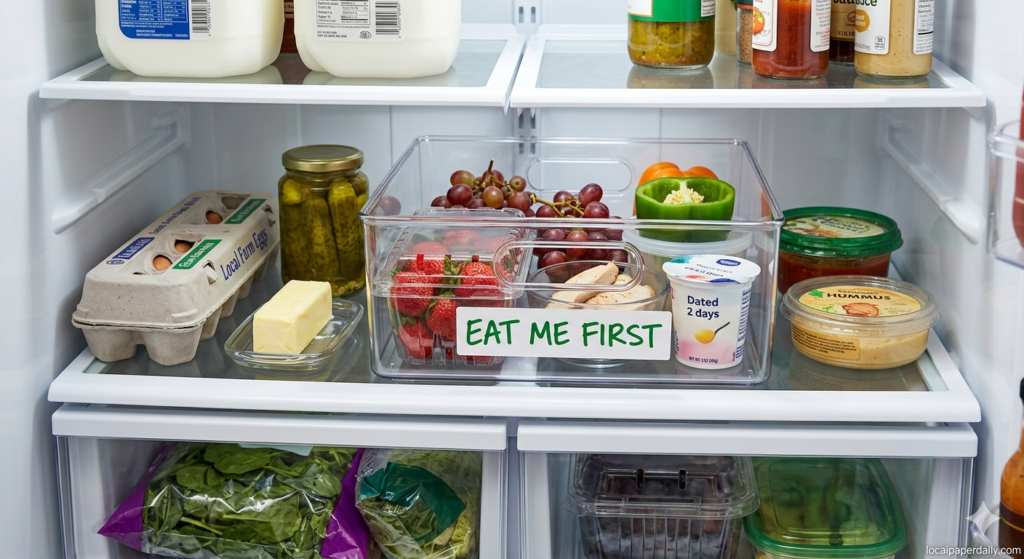
I bought one clear plastic bin and labeled it “EAT ME FIRST.” It sits dead-center on the middle shelf. Anything expiring within 48 hours—that half-used bell pepper, the leftover grilled chicken, the softening berries—goes in there. When I’m hungry, that’s the only place I’m allowed to look first. This one bin alone saved me $40 a month in “forgotten capital.”
The “Ethylene Divorce”
I learned the hard way that some fruits are “bullies.” Apples and onions release gases that tell everything around them to ripen and rot immediately. I now keep my “gas-producers” in a separate ventilated zone. I no longer have potatoes sprouting “eyes” after just one week because I stopped storing them next to the onions.
The “Glass Container” Hedge
I replaced all my opaque plastic tubs with clear glass. The psychology is powerful: when I see a vibrant bowl of pre-cut carrots or a clear jar of leftover pasta, I’m 40% more likely to eat it. Transparency leads to consumption; obscurity leads to waste.
Reclaiming the Dividend
At factsfigure.com, we focus on Compounded Savings. By plugging these leaks, I reclaimed roughly $100 a month in pure cash flow.
$$\text{Reclaimed Capital} = \$100 \times 12 \text{ months} = \$1,200 \text{ per year}$$
In a world where everyone is looking for a “side hustle,” I found a way to “make” an extra $1,200 a year just by managing my fridge like a pro. This isn’t just about “being green”—it’s about financial self-respect.
Final Thoughts: Perform Your Own Audit
If you think you don’t have a food waste problem, I challenge you to weigh your trash for just seven days. The Grocery Waste Metric is the most honest reflection of your household efficiency. Stop letting your hard-earned money turn into “fridge slime.”
Audit your kitchen today. Your bank account—and your next vacation—will thank you.