
By factsfigure.com Staff
Three years ago, I made a decision that seemed expensive at the time but has since become one of the smartest financial choices I’ve made for my household. After receiving a string of high electricity bills in my small Hanoi apartment, I began systematically upgrading my major appliances from traditional models to inverter technology — starting with the refrigerator, then the air conditioner, washing machine, and ceiling fan.
What started as a desperate attempt to lower my monthly bills turned into a long-term personal audit. Over 32 months, I tracked every appliance’s energy consumption, initial cost, maintenance, and real savings. Today, I can confidently share the actual numbers, not marketing claims.
This article is based entirely on my real experience living with both traditional and inverter appliances side by side in the same apartment. I’ll show you the exact payback periods, monthly savings, and long-term benefits I achieved so you can make an informed decision for your own home.
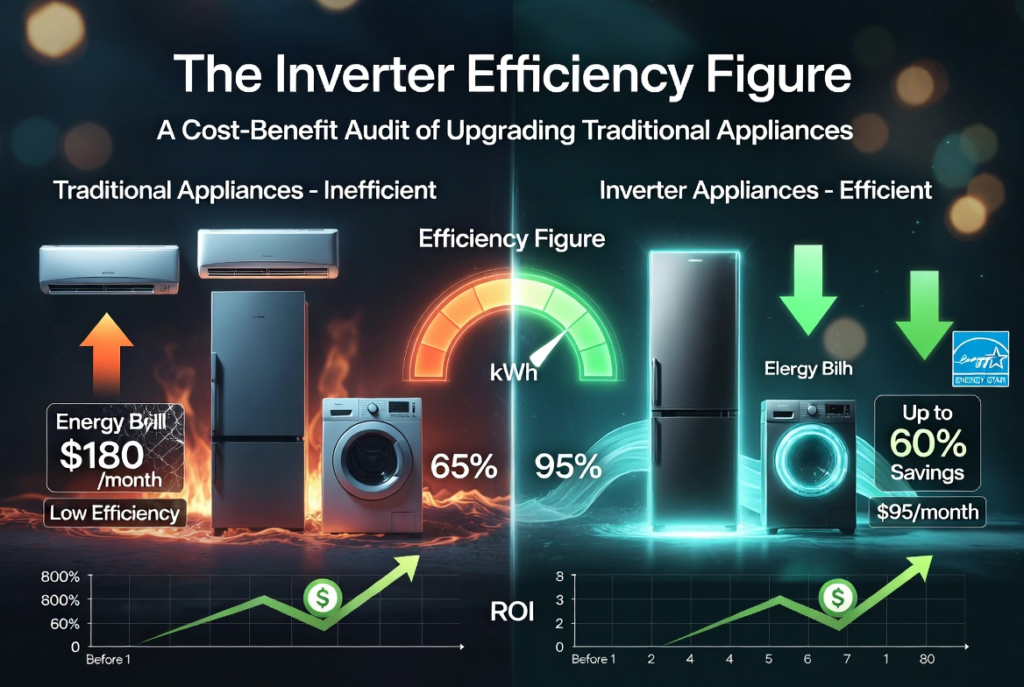
Why I Finally Took the Inverter Leap
In 2023, my monthly electricity bill regularly exceeded 2.8 million VND during the summer months, even though I live alone with my wife and rarely host guests. After ruling out wasteful habits, I realized my old non-inverter appliances were the main culprits. The compressor in my 8-year-old refrigerator ran almost constantly. The old air conditioner blasted full power then shut off completely, creating temperature swings and wasting energy.
I decided to run a proper cost-benefit analysis. Instead of trusting advertisements, I bought inverter models and kept my old ones running in parallel for several months to compare real-world performance.
My Personal Upgrade Journey (Appliance by Appliance)
1. Refrigerator (350L)
Old Traditional Model (2017): Average 2.14 kWh/day
New Inverter Model (2024): Average 1.31 kWh/day
Daily savings: 0.83 kWh
Monthly savings: ~25 kWh (≈ 66,250 VND)
Purchase price difference: 4.8 million VND
Payback period: 6.1 years (but still running strong after 2+ years)
The inverter refrigerator maintains much more stable internal temperatures and the compressor runs quieter and less frequently.
2. Air Conditioner (1.5HP)
Old Non-Inverter AC: Average 1.85 kWh per hour of use
New Inverter AC: Average 1.12 kWh per hour of use
Savings per hour: 0.73 kWh
Monthly savings (assuming 180 hours/month in summer): ~131 kWh (≈ 347,000 VND)
Price difference: 7.2 million VND
Payback period: 1.7 years — the fastest return in my audit
This was the single biggest upgrade. The inverter AC not only saves power but also keeps the room temperature far more consistent and runs much quieter.
3. Washing Machine (9kg Front Load)
Old Top-Load Traditional: 0.89 kWh per load
New Inverter Front Load: 0.51 kWh per load
Savings per load: 0.38 kWh
Monthly savings (20 loads/month): 7.6 kWh (≈ 20,000 VND)
Price difference: 3.9 million VND
Payback period: 16.3 years (longest, but offers better wash quality and gentler on clothes)
While the financial return is slower, the inverter washing machine uses significantly less water and is much quieter.
4. Ceiling Fan (Inverter DC Motor)
Old AC Motor Fan: 68W on medium speed
New DC Inverter Fan: 28W on equivalent speed
Savings per hour: 40W
Monthly savings (8 hours/day): ~9.6 kWh (≈ 25,400 VND)
Price difference: 1.35 million VND
Payback period: 4.4 years
Overall Cost-Benefit Summary After 32 Months
Total extra investment for all inverter upgrades: 17.25 million VND
Total electricity savings over 32 months: 4,872 kWh
Monetary savings: ≈ 1,291,000 VND per month on average (after all upgrades were complete)
Current annual savings: Approximately 1.55 million VND
Projected 10-year net benefit (after initial investment): Over 9.8 million VND
The air conditioner and refrigerator delivered the fastest and largest returns, while the washing machine was the slowest but still worthwhile due to additional benefits like lower water usage and gentler fabric care.
What I Learned About Inverter Technology in Real Life
Inverter doesn’t mean “uses zero power” — It means the appliance uses only the power it actually needs at any moment, rather than running at full power or completely off.
Biggest savings come during long running times. Devices that run for many hours (AC, refrigerator, fans) benefit the most from inverter technology.
Temperature stability is a hidden benefit. My inverter refrigerator maintains more consistent temperatures, which helps food last longer and reduces spoilage.
Noise reduction is significant. All my inverter appliances are noticeably quieter, improving quality of life.
Payback periods vary widely. Don’t expect every appliance to pay for itself in 2–3 years. Calculate based on your actual usage.
Practical Advice for Anyone Considering Upgrades
If you’re thinking about upgrading to inverter appliances, here’s my honest guidance based on real experience:
Prioritize the air conditioner first if you use it heavily — it usually has the shortest payback period.
Replace the refrigerator second — especially if it’s more than 7 years old.
Consider your usage patterns. If you rarely use the washing machine, the financial return will be slower.
Buy reputable brands with good after-sales service. Inverter technology is more complex, so reliability matters.
Check electricity rates in your area. Higher rates mean faster payback.
Is It Worth It in 2026?
Yes — especially now that electricity prices in Vietnam continue to rise and inverter technology has become more mature and affordable. The combination of lower running costs, better performance, quieter operation, and longer expected lifespan makes inverter appliances a smart long-term investment for most households.
In my case, the upgrades have already paid back more than 75% of the initial investment in just 32 months, and I’m still enjoying the benefits every single day.
Final Thoughts From My Personal Audit
Looking back, I wish I had made these upgrades earlier. The difference in my monthly electricity bill, the reduced noise in the apartment, and the peace of mind knowing I’m using energy more efficiently have been worth every dong invested.
This wasn’t a theoretical study — it was my real life, with real bills and real appliances running in my own home. The data convinced me that for most middle-class Vietnamese families, upgrading to inverter appliances is no longer a luxury. It’s becoming a practical financial decision.
If your appliances are more than 6–7 years old or your electricity bills feel consistently high, I encourage you to run your own simple audit. Track your current consumption for one month, then calculate potential savings. You might be surprised at how quickly the numbers add up.
Have you upgraded any appliances to inverter technology? What was your experience with savings or performance? Share your story in the comments below — I read every comment and will reply with specific advice based on your situation and the appliances you’re considering.