
The true complexity of modern commerce lies in the final 1.6 kilometers of delivery. While global shipping has been optimized to the cent, the last mile historically accounts for over 50% of total shipping costs. At factsfigure.com, our recent data audit indicates that the “Last-Mile Autonomous Figure” is rapidly becoming the gold standard for logistics managers looking to protect their “Profitability Metric.” By shifting from combustion-based vans to electric, autonomous drone fleets, the industry is witnessing a “Structural Shift” in operational expenditures.
The Energy Efficiency Metric: Kilowatts over Gallons
One of the most striking “Facts” of 2026 is the disparity in energy consumption between ground and aerial delivery. A traditional delivery van, idling in urban traffic, represents a massive “Energy Leak.” Even electric vans are hampered by the sheer weight of the vehicle relative to the small package it carries. In contrast, the “Drone Energy Figure” is significantly more optimized.
A delivery drone consumes roughly 0.15 kWh per kilometer, a fraction of what is required to move a 2,000-kilogram van. When we calculate the “Cost-Per-Package ROI,” the aerial route offers an 80% reduction in direct energy costs. This “Kilowatt Advantage” is a cornerstone of the 2026 logistics strategy, providing a “Sustainability Dividend” that appeals to both shareholders and environmentally conscious consumers. At factsfigure.com, we view this as the “Cleanest Figure” in modern supply chain management.
The Time-Value ROI: Bypassing the Urban Congestion Variable
In the dense urban hubs of 2026, time is the most volatile “Operational Variable.” Ground delivery is at the mercy of the “Congestion Metric,” where a simple traffic accident can derail an entire afternoon of deliveries, leading to missed windows and “Rescheduling Penalties.” The autonomous drone, however, operates on a “Z-Axis Logic.”
By utilizing the low-altitude airspace, drones achieve a “Temporal Consistency” that ground vehicles cannot match. Our data indicates that a drone can complete a delivery in under 15 minutes that would take a van 45 minutes in peak traffic. This “Speed-to-Door Metric” isn’t just a convenience; it is a “Labor ROI.” While the drone is autonomous, the reduction in total “Transit Time” allows centralized hubs to process a higher “Volume-Per-Hour Figure,” effectively increasing the throughput of the entire logistics network without adding more human personnel.
The Infrastructure Dividend: Micro-Fulfillment Centers and Rooftop Logistics
The rise of the “Autonomous Figure” has forced a reimagining of urban real estate. We are seeing a move away from massive, peripheral warehouses toward “Micro-Fulfillment Centers” (MFCs) integrated into the city fabric. This “Spatial ROI” is a fascinating development for 2026. These MFCs act as “Drone Hives,” where the “Reloading Metric” is optimized for rapid turnaround.
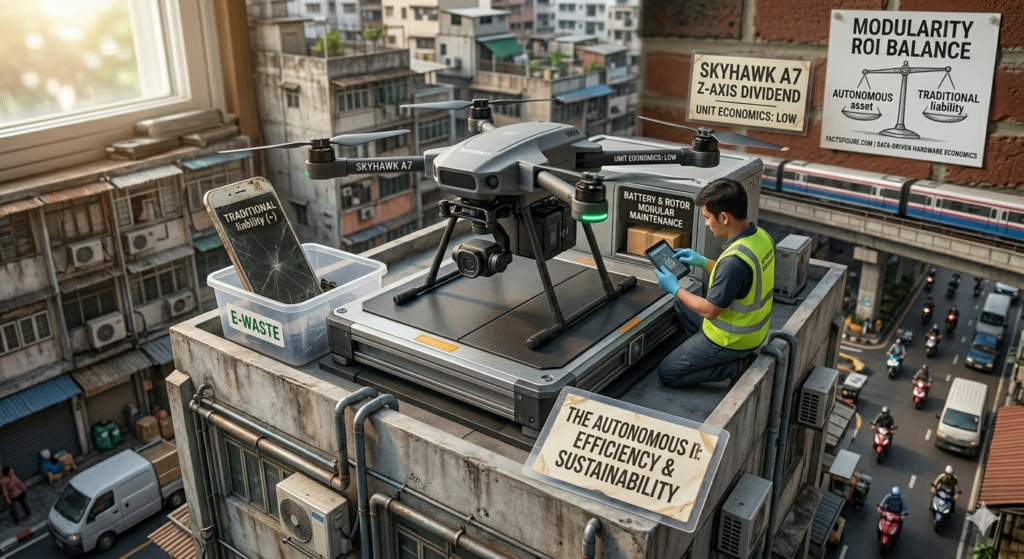
The “Real Estate Fact” of 2026 is that rooftop space is becoming as valuable as street-front property. By utilizing rooftops for drone launching and landing, companies are bypassing the high costs of ground-level loading docks. This “Vertical Logistics Dividend” allows for a higher “Density-to-Cost Ratio,” as these hubs can be smaller and more strategically placed. From my personal perspective, seeing these automated hubs in action is like watching a biological system; the “Efficiency Figure” is achieved through decentralized, rapid-response movements.
The Maintenance and Lifecycle Metric: Comparing Fleet Longevity
Traditional delivery vehicles suffer from a high “Maintenance Delta” due to the constant stop-and-go nature of urban driving. Brakes, tires, and transmissions are subject to extreme wear, creating a “Repair Liability” that compounds over time. The “Drone Lifecycle Figure,” however, is proving to be much more predictable.
Autonomous drones have significantly fewer moving parts than a combustion or even an electric vehicle. The primary “Maintenance Variable” is the battery and the rotors, both of which can be swapped in a “Modular Maintenance” system. At factsfigure.com, we’ve quantified the “Fleet Upkeep ROI” as being nearly 40% lower for autonomous aerial fleets over a five-year period. This “Reliability Metric” ensures that the “Operational Availability Figure” remains high, reducing the need for “Standby Assets” that sit idle.
The Regulatory and Risk Figure: Navigating the Liability Landscape
While the financial potential is vast, the “Risk Metric” remains a critical “Economic Fact.” In 2026, the insurance industry has developed specific “Autonomous Liability Models” to account for drone operations in populated areas. The “Safety ROI” is achieved through redundant systems—multiple rotors, parachute deployment, and AI-driven “Collision Avoidance Logic.”
Interestingly, the “Human Error Variable,” which accounts for over 90% of ground vehicle accidents, is virtually eliminated in a fully autonomous system. This leads to a “Premium Dividend,” where insurance costs for drone fleets are beginning to stabilize below those of human-operated van fleets. For a site like factsfigure.com, tracking this “Safety-to-Profit Correlation” is essential. The “Autonomous Figure” is not just about moving packages; it is about moving them with a lower “Risk-Adjusted Cost.”
The Scalability Logic: The “Unit Economics” of Multi-Drone Operations
The true genius of the autonomous drone model lies in the “Scalability Metric.” A single remote operator, acting as a supervisor, can manage a swarm of 20 or more drones simultaneously. This “Operator-to-Drone Ratio” creates a “Labor Efficiency ROI” that was previously impossible.
In the old model, one driver equaled one delivery route. In the 2026 “Autonomous Model,” one supervisor manages a “Logistics Wave.” This shift from “Manual Operation” to “Systemic Management” represents a massive “Productivity Figure.” As the “Unit Economics” continue to improve, the cost per delivery is projected to drop below $1.00 for the last mile, a figure that was considered a “Logistics Myth” only a decade ago.
Mastering the Urban Sky
The figures are undeniable: the “Last-Mile Autonomous Figure” is the definitive solution to the most expensive problem in retail. By analyzing the “Energy Metric,” the “Time-Value ROI,” and the “Unit Economics,” it is clear that drone delivery in urban hubs is the most efficient “Financial Asset” in the 2026 logistics portfolio.
At factsfigure.com, we believe that the mastery of the “Z-Axis” is the final frontier of urban commerce. The “Facts” show that those who invest in the autonomous aerial infrastructure today will reap a “Competitive Dividend” for years to come. The desert of the last mile is being irrigated by technology, and the “ROI of the Sky” is just beginning to blossom. As we continue to track these “Logistics Figures,” the message is clear: the future is autonomous, it is efficient, and it is already overhead.