
In the landscape of modern household economics, we often look for “big wins”—solar panel installations, window replacements, or high-efficiency appliance upgrades. However, a technical audit of residential energy consumption reveals that the most significant financial shifts often come from the smallest adjustments. Specifically, the “1-Degree Pivot”—the act of adjusting your air conditioner or refrigerator by a single degree Celsius—represents a powerful intersection of thermodynamics and personal finance.
For the readers of factsfigure.com, understanding the “why” and “how much” behind these adjustments is crucial. This isn’t just about “saving the planet”; it is a cold, hard analysis of utility data and machine efficiency. Here is the technical breakdown of what 1 degree is actually worth in your annual budget.
The Physics of the 1-Degree Shift
To understand the savings, we must first understand the technical burden placed on our appliances. An air conditioner (AC) and a refrigerator both operate on the principle of heat exchange. The larger the “Delta T” (the difference between the ambient temperature and your target temperature), the harder the compressor must work.
When you lower your AC by 1 degree, you aren’t just making the room slightly cooler; you are forcing the system to run longer cycles to overcome the thermal leakage of your home. Thermodynamics dictates that heat always moves toward cold. By narrowing the gap between the outside heat and your inside cool by just 1 degree, you significantly reduce the rate of heat infiltration, allowing the compressor to cycle off more frequently.
Air Conditioning: The 10% Rule of Thumb
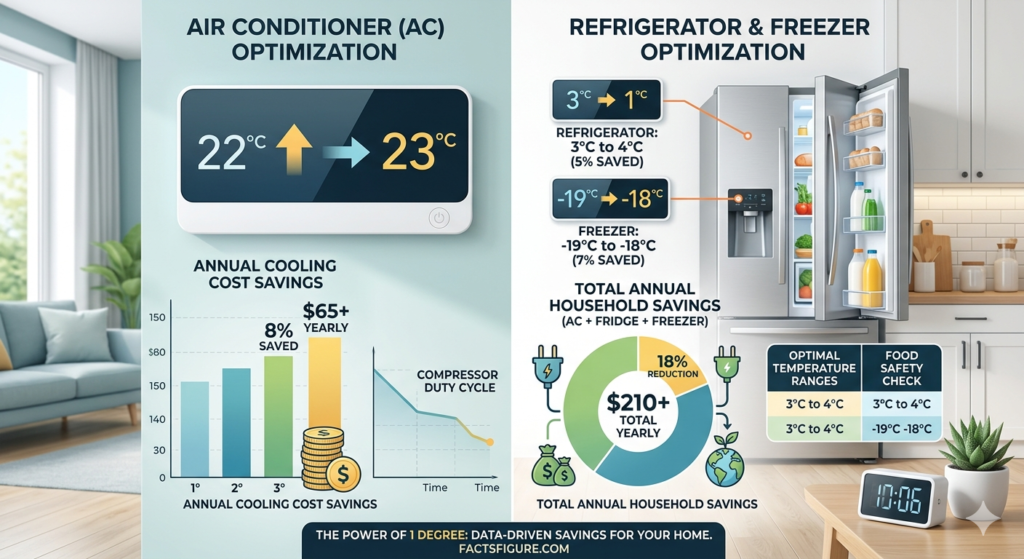
Data from the Department of Energy and various utility providers suggests a remarkably consistent figure: for every degree you raise your AC setting in the summer, you save approximately 6% to 10% on your cooling costs.
The Annual Figure Calculation
Let’s look at a typical household scenario to see the “figure” behind the “fact”:
Average Monthly Cooling Bill: $150 (during a 5-month summer season).
Total Seasonal Cost: $750.
The 1-Degree Saving (8% average): $60 per year.
While $60 might seem modest, this is for a single-degree adjustment that requires zero capital investment. If a household shifts from 22°C (72°F) to 25°C (77°F), the annual savings jump to nearly $180. When projected over the 10-year lifespan of an AC unit, that single habit is worth $1,800—the cost of a brand-new, high-end replacement unit.
The Refrigerator: The Silent Energy Consumer
Unlike the AC, which runs seasonally, your refrigerator is a 24/7/365 energy consumer. It is often the second or third largest draw on a home’s electrical grid. The technical “sweet spot” for food safety is between 1.5°C and 3.3°C (35°F – 38°F). However, many households set their refrigerators to the lowest possible setting out of a “better safe than sorry” mentality.
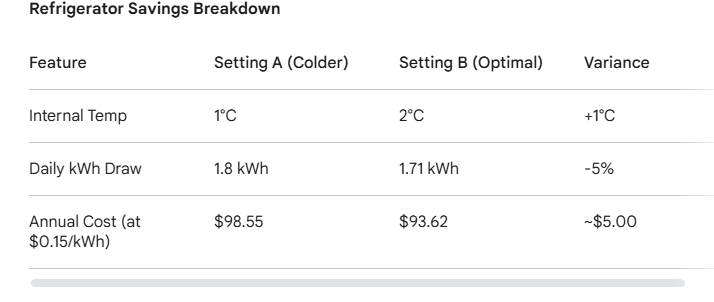
Data indicates that setting your refrigerator 1 degree lower than necessary (e.g., at 1°C instead of 2°C) increases energy consumption by roughly 5%.
Refrigerator Savings Breakdown
While the refrigerator savings per degree are lower than the AC, they are “locked-in” savings. Combined with a similar 1-degree adjustment to your freezer (optimal at -18°C), the total appliance optimization can save a household $15-$20 annually without any impact on food longevity or safety.
The Compound Effect: Why Figures Matter
At factsfigure.com, we prioritize the “Compound Effect.” Total household energy optimization is not found in one single place; it is the sum of these 1-degree shifts across multiple systems.
If we combine the AC adjustment, the refrigerator optimization, and the water heater setting (lowering the water heater by just 5 degrees can save up to 10% in water heating costs), the technical “Real Cost” of that 1 degree becomes clear. A fully “1-degree optimized” home can expect to see an annual utility reduction of $200 to $250.
Beyond the Bill: Mechanical Longevity
There is a hidden “figure” in this analysis that most homeowners overlook: The Depreciation Offset. Compressors are the most expensive component of cooling appliances. They have a finite number of “starts” and “run hours” before the mechanical seals fail. By adjusting your temperature by 1 degree, you are not just saving electricity; you are reducing the “Duty Cycle” of the machine.
A system that runs 10% less per year is a system that likely lasts 10% longer. If an AC unit costs $5,000 and typically lasts 12 years, extending its life by just 1.2 years through reduced strain is equivalent to a $500 technical windfall.
Behavioral Engineering: How to “Feel” the 1 Degree
The primary barrier to these savings is human perception. We are programmed to notice change, but we are poor at measuring absolute temperature. The technical solution is “Incremental Shifting.”
If you attempt to move your thermostat by 3 degrees in one day, your body will trigger a discomfort response, and you will likely revert the change. However, data shows that shifting the temperature by 0.5 degrees every three days allows the body’s homeostatic systems to adapt without notice. By the end of two weeks, you have achieved your 2-degree goal, locked in your 16% savings, and your perceived comfort remains identical.
Final Summary: The Facts and Figures
The “Real Cost” of 1 degree is a combination of direct energy savings and deferred mechanical maintenance.
The Fact: Household comfort is a range, not a fixed point.
The Figure: $200+ per year in combined savings for the average household through 1-degree optimizations.
In a world of rising inflation and volatile energy markets, the 1-degree pivot is the most efficient “side hustle” you can have. It requires no extra time, no new skills, and carries a 100% success rate. At factsfigure.com, we believe that when you master the small figures, the big facts of your financial life take care of themselves.