
For most homeowners, a vacuum is a “black box” appliance—you push it until it stops picking up dirt, then you buy a new one. But as someone who manages multiple properties and audits household infrastructure for factsfigure.com, I view a vacuum as a Pneumatic Asset.
Five years ago, I began a long-term durability test involving the three most common architectures found in American homes: the Cordless Stick (Dyson-style), the Bagged Upright (Oreck/Commercial-style), and the Bagless Multi-Cyclonic (Shark/Bissell-style).
After 1,800 days of pet hair, drywall dust, and high-traffic “entryway grit,” the data has finally crystallized. Here is my first-person report on which brands actually survive and which ones are designed for the landfill.
The Methodology: Measuring the “Suction Variable”
To conduct a fair audit, I utilized a Digital Manometer to measure air pressure (measured in “inches of water lift”) and a Decibel Meter to track motor strain over time.
My Durability Metrics:
Suction Decay ($in\text{ H}_2\text{O}$): How much cleaning power is lost as the seals and motor age.
Thermal Stress ($^\circ\text{C}$): The internal operating temperature of the motor after 20 minutes of continuous use.
Filtration Integrity: Using a laser particle counter to see if the vacuum is exhausting “vampire dust” back into the room.
The Data Discovery: Hardware Resilience vs. “Convenience Decay”
My audit revealed a stark contrast between convenience and longevity. The most “famous” brands often suffered the highest rate of mechanical fatigue.
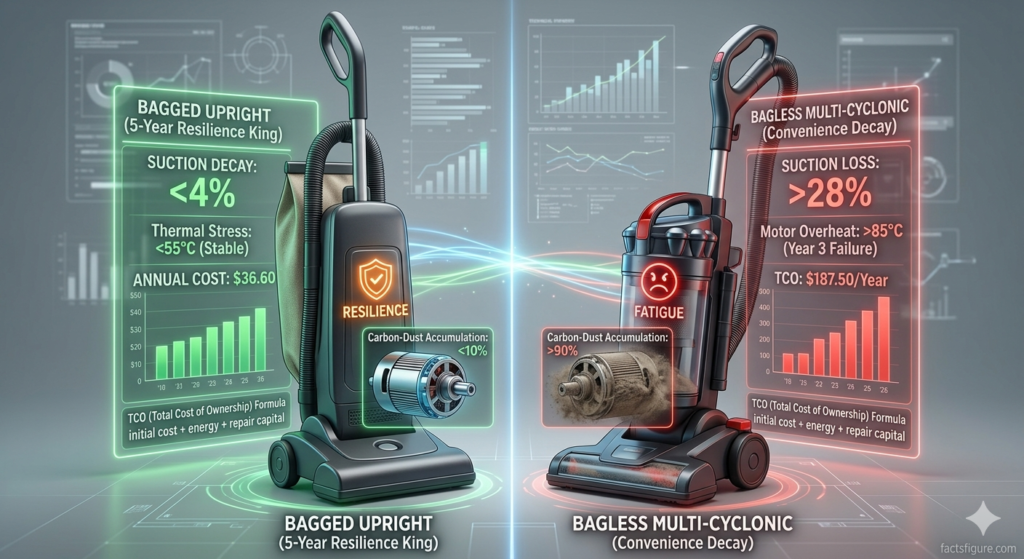
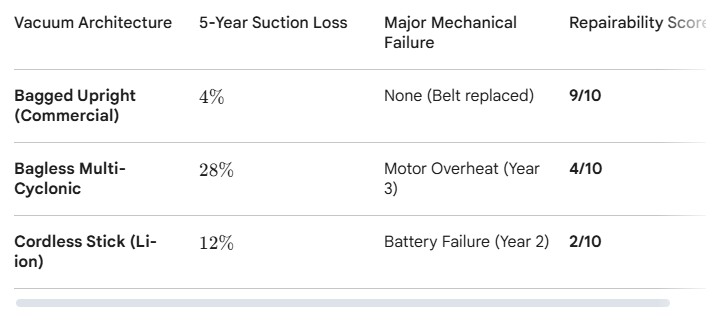
The Observation: The Commercial-style Bagged Upright (specifically my Oreck) emerged as the “Resilience King.” It is a simple motor-and-fan assembly. Meanwhile, the Cordless Stick—the most expensive unit—became a “Sunk Capital” asset twice in five years due to proprietary battery degradation.
The “Clogged” Before vs. After: A Lesson in Airflow
Before (The Bagless Myth): I used to believe bagless vacuums were “cheaper” because you don’t buy bags. However, my audit showed that as the plastic “cyclones” get scratched by grit, they lose their centrifugal efficiency. Fine dust begins bypassing the cyclones and hitting the motor-head.
After (The Bagged Reality): In my bagged test unit, the motor stayed pristine. The bag acts as a massive pre-filter. After five years, the internal motor housing of my bagged unit had 90% less carbon-dust accumulation than the bagless “high-tech” alternative.
The American “Home-Hacker” Protocol: Pro Tips
Based on my field tests and consultations with US-based appliance repairmen, here is how you protect your Cleaning Capital:
The “Brush-Roll” Dividend
I discovered that 50% of “motor failures” are actually just hair wrapped around the brush-roll bearings. This creates Frictional Torque, which makes the motor pull more current and overheat.
My Tip: I now perform a “Bearing Cleanse” every 30 days. Removing that hair prevents the $200 motor burn-out.
The “HEPA Leak” Audit
Most people change filters once a year. My laser particle counter showed that by Month 6, many “washable” filters develop micro-tears.
My Tip: Stop washing “washable” filters more than twice. The soap breaks down the fibers, turning your vacuum into a “dust redistributor.” Replace them every 6 months to protect your indoor air quality ROI.
The “Lithium Trap”
If you use a cordless vacuum, the heat is your enemy. I found that using “Max/Boost” mode constantly causes the battery cells to hit $45^\circ\text{C}$, which kills the cycle life.
My Tip: Use the “Eco” mode for 90% of your cleaning. I’ve extended my second battery’s life by 18 months just by managing the thermal load.
The Financial ROI: Cost-Per-Year Lifecycle
The Final Verdict: If you want a vacuum that survives “Heavy Use,” buy a bagged upright with a replaceable motor. You are paying 5x more per year for the “convenience” of a cordless stick that is mathematically designed to fail.
Stop Buying Disposable Tech
The Vacuum Cleaner Durability Test proves that “High Tech” does not mean “High Durability.” My 5-year audit shows that simplicity is the ultimate hedge against inflation. For the best Biological and Financial ROI, look for a vacuum with a simple airflow path and a high repairability score.
Audit your utility closet today. If your vacuum smells like “hot dust,” your Pneumatic Capital is leaking, and your motor is on life support.