
I’ll never forget the afternoon in late 2024 when I realized my brain was officially “broken.” I was sitting in front of a high-priority strategy document for FactsFigure.com, but every 45 seconds, my hand would reflexively reach for my phone. I wasn’t even looking for anything specific; I was just chasing a hit of dopamine to escape the “pain” of concentration.
Fast forward to April 2026, and the digital landscape has only become more aggressive. Recent telemetry data from Microsoft’s Work Trend Index reveals that the average knowledge worker is now interrupted every 2 minutes. Worse yet, research from UC Irvine confirms that once we are knocked off track, it takes a staggering 23 minutes and 15 seconds to return to our original depth of focus.
The math is devastating: if you’re interrupted every two minutes, you literally never reach a state of deep work. You are living in a state of cognitive fragmentation. But there is a way out. By auditing my own neurobiology and shifting my schedule to match Ultradian Rhythms, I have managed to triple my output while working fewer hours.
1. The Science of the “Sprint”: Understanding Ultradian Rhythms
Most of us are familiar with Circadian Rhythms (our 24-hour sleep-wake cycle), but few leverage the power of Ultradian Rhythms. These are shorter biological cycles that occur throughout our waking hours, typically lasting about 90 to 120 minutes.
The Neurochemical Audit:
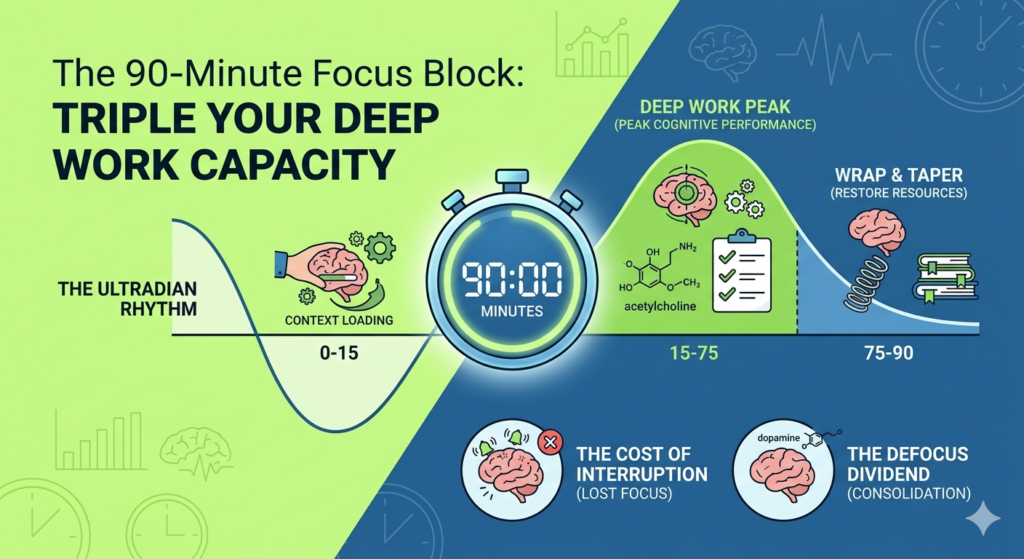
During the first 60 to 90 minutes of an ultradian cycle, your brain is in “sprint mode.” It deploys a cocktail of acetylcholine (for focus) and dopamine (for motivation). However, these neurochemicals are finite.
Around the 90-minute mark, your brain begins to signal a depletion of these resources. You might notice:
A sudden urge to check social media.
Physical restlessness or “fidgeting.”
A sharp decline in the quality of your writing or coding.
In 2019, I would have reached for a third cup of coffee to “push through.” In 2026, I know that pushing past 90 minutes results in Compounding Cognitive Debt. You aren’t just doing bad work; you are borrowing focus from your next session, leading to afternoon burnout.
2. The 90-Minute Focus Block: My Personal Framework
To fight back against the 2026 “Fragmentation Crisis,” I restructured my entire day at FactsFigure.com around three core focus blocks. Here is the exact data-backed strategy I use:
Phase 1: The Context Load (Minutes 0–15)
Stop expecting to be “in the zone” the moment you sit down. Your brain needs time to pull relevant information into its working memory. During this phase, I turn off all notifications and set a countdown timer for 90 minutes. I don’t look for “flow”—I just commit to the friction of getting started.
Phase 2: The Deep Work Peak (Minutes 15–75)
This is where the magic happens. Because I’ve protected this window from “pings” and “slacks,” my brain can finally reach Peak Cognitive Performance. In this 60-minute window, I often produce more high-quality content than I used to in a distracted 4-hour afternoon.
Phase 3: The Wrap & Taper (Minutes 75–90)
When I feel my focus falter, I don’t fight it. I spend the final 15 minutes of the block wrapping up my thoughts, leaving “breadcrumbs” for my future self, and preparing for the mandatory break.
3. The “Defocus” Dividend: Why the Break is Productive
In the AI era, we feel a constant pressure to be “always on.” But the data shows that deliberate defocus is actually where your brain consolidates learning and clears out metabolic waste.
My Experience Audit:
I used to spend my “breaks” scrolling through news feeds. Now, I spend 15 minutes completely disconnected—no screens, no podcasts. Whether it’s a quick walk or just staring out the window, this “reset” allows my neurochemical levels to replenish. Without this break, my second focus block of the day is 40% less effective. With it, I can sustain 2026-level productivity until the end of the workday.
4. Digital Sovereignty: Protecting Your 90 Minutes
You cannot succeed in 2026 with a “passive” calendar. If you don’t schedule your 90-minute blocks, the world will fill them with 2-minute interruptions.
AI-Powered Defense: I now use tools like Reclaim.ai to automatically block focus time around my meetings. If someone tries to book a “quick sync,” the system defends my deep work windows first.
The “Silent” Default: My phone and desktop are in “Do Not Disturb” by default. I have audited my notification settings so that only emergency calls from family can break through. Everything else can wait 90 minutes.
Final Thoughts: Working with Biology, Not Against It
The secret to being a high-performer in 2026 isn’t working 12-hour days; it’s respecting the 90-minute limit of your own neurochemistry. By aligning your work with your Ultradian Rhythms, you stop fighting your brain and start collaborating with it.At FactsFigure.com, our audit is clear: In an era of infinite distraction, the ability to focus for 90 minutes is the ultimate competitive advantage. Stop trying to be a marathon runner in a world designed for sprinters. Master the 90-minute block, and you’ll find that you can finally work less and achieve significantly more.