
For years, the “green lifestyle” has been marketed as a luxury. We’ve been told that saving the planet requires buying expensive organic linens, high-end bamboo toothbrushes, and premium eco-friendly detergents. But standing here in April 2026, amidst some of the highest cost-of-living metrics we’ve seen in a decade, I’ve discovered a different reality.
Lối sống bền vững (Sustainability) isn’t about spending more; it’s about stopping the bleed. At FactsFigure.com, we’ve audited the annual expenses of an average American family of four. By shifting from a “disposable” mindset to a “circular” one, we found a hidden “Zero-Waste Dividend” worth approximately $2,500 per year. That isn’t just “good for the Earth”—that’s a high-yield investment in your family’s financial future.
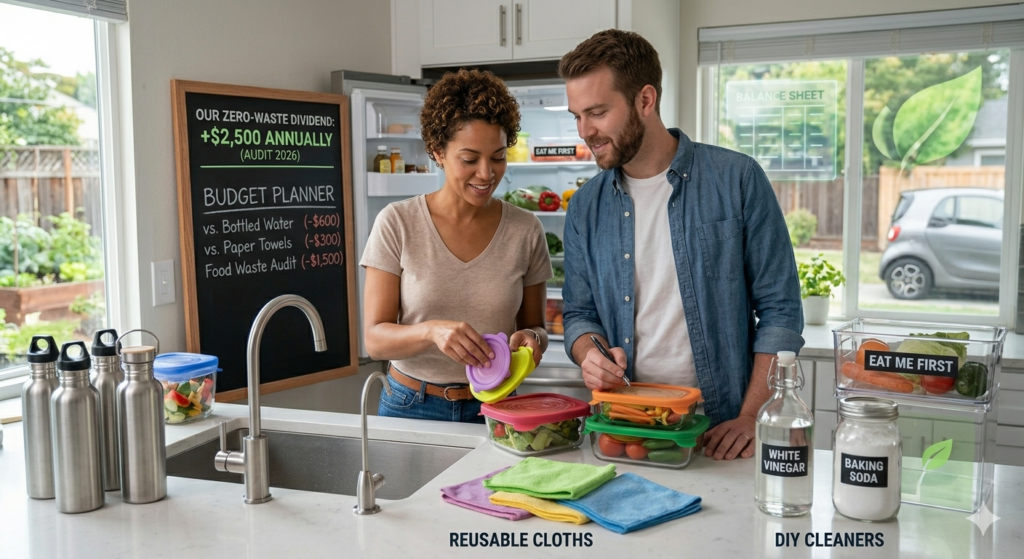
1. The “Single-Use” Tax: Auditing the Small Leaks
Most families don’t realize how much they pay for the privilege of throwing things away. When you buy paper towels, plastic water bottles, and sandwich bags, you are essentially buying trash.
My Experience Audit:
I used to buy a bulk pack of paper towels every month—about $25. Over a year, that’s $300. By switching to a set of 24 microfiber cloths and “un-paper” towels (a one-time $40 investment), I effectively gave myself a $260 raise in year one.
When you apply this logic to other disposables, the numbers explode:
Bottled Water: The average family of four drinking bottled water spends roughly $600 annually. A high-quality under-sink filter and stainless steel bottles cost about $150 upfront. Year 1 Savings: $450.
Plastic Wrap & Baggies: Between lunch boxes and leftovers, the average household burns through $120 of plastic film and bags. Switching to silicone lids and glass containers (one-time $80) saves $40 in the first year and $120 every year after.
2. The Food Waste Audit: Rescuing the “Lost” 30%
The most significant financial drain in the American household isn’t the electric bill—it’s the trash can in the kitchen. According to 2026 USDA metrics, the average family throws away nearly 30% to 40% of the food they buy. On a $250 weekly grocery bill, that is $75 to $100 a week literally rotting in the landfill.
The Strategy for a “Food Dividend”:
By adopting a “Zero-Waste” kitchen mentality, I managed to cut my food waste to nearly zero, saving our family roughly $1,500 annually. Here is the data-backed approach:
Inventory-First Shopping: I spend 10 minutes auditing my fridge before I go to the store. This prevents “double-buying” and ensures I only purchase what we have a plan for.
Proper Storage Metrics: Most people store produce incorrectly. Using “green bags” or proper humidity drawers can extend the life of leafy greens from 3 days to 10 days. That prevents the “Friday Fridge Purge” where $20 of wilted vegetables go to the bin.
The “Eat Me First” Bin: We designated a small bin in the fridge for items nearing their expiration. This simple visual cue rescued dozens of meals last year.
3. The “Low-Tox” Savings: DIY vs. Big Brand Premiums
In 2026, a bottle of “premium” multi-surface cleaner can cost $7.00. But when you look at the ingredients, you’re mostly paying for water and a plastic bottle.
The DIY Dividend:
I transitioned our home to three core cleaning ingredients: White Vinegar, Baking Soda, and Castile Soap.
The Math: I can make a gallon of effective multi-surface cleaner for about $0.45.
The Savings: By replacing specialized cleaners (glass, floor, counter, bathroom) with these staples, our household saved $180 last year. Plus, we eliminated the “hidden cost” of clutter and the environmental impact of 15 plastic bottles.
4. The “Circular” Wardrobe: Fighting Fast Fashion Fatigue
In 2019, the trend was “Fast Fashion”—cheap clothes that fell apart in six months. In 2026, the cost of cotton and logistics has made even “cheap” clothes expensive.
By shifting to a “Quality-First” audit, I stopped buying five $20 shirts every season and started buying one $60 high-quality shirt that lasts three years.
The ROI: While the upfront cost is higher, the “Cost-Per-Wear” (CPW) metric is much lower.
The Dividend: By repairing shoes and mending clothes instead of replacing them, our family’s clothing budget dropped by $450 annually.
Final Thoughts: Sustainability is Sophisticated Economics
At FactsFigure.com, we want to change the narrative. Choosing a sustainable lifestyle isn’t a sacrifice of your comfort; it’s a strategic audit of your waste. Every plastic bottle you don’t buy and every meal you don’t throw away is money that stays in your high-yield savings account.
The $2,500 Zero-Waste Dividend is real, and it is available to any family willing to look at their trash through the lens of a balance sheet. In 2026, being “green” is the ultimate “black” (as in, being in the black). Stop paying the “Disposable Tax” and start collecting your dividend.