
In the “golden age” of home engineering—roughly the 1970s through the early 1990s—purchasing a refrigerator or a washing machine was often a “once-in-a-generation” event. It was not uncommon for a heavy-duty dryer to last 25 years with only minor belt replacements. Today, the landscape has shifted. We are surrounded by sleek, touch-screen appliances that offer unprecedented energy efficiency but seem to fail shortly after their warranties expire.
At factsfigure.com, we look at the figures behind the feelings. Is it true that appliances are made “worse” now, or are we simply asking more of our machines? This technical audit compares the average lifespan of major household appliances between the previous decade and today, exploring the “Planned Obsolescence” vs. “Efficiency” debate, and providing a data-backed maintenance framework to extend your equipment’s life by 20% or more.
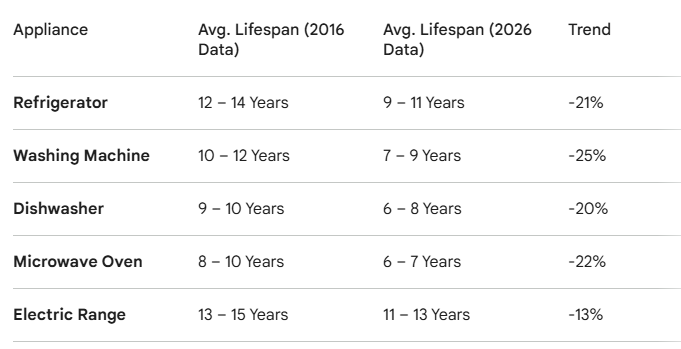
The Lifespan Data: 2016 vs. 2026
The following table highlights the shifting life expectancy of core household appliances. These figures represent “Mean Time to Failure” (MTTF) for standard consumer-grade models (excluding luxury or commercial-grade brands like Miele or Speed Queen).
Why the Decline? The Engineering Trade-off
The decline in longevity is rarely a result of “lazy” engineering. Rather, it is a byproduct of three technical shifts:
Electronic Complexity: Mechanical timers have been replaced by delicate printed circuit boards (PCBs). While PCBs allow for precision cycles, they are highly sensitive to heat and power surges.
Lightweight Materials: To reduce shipping costs and meet environmental standards, heavy steel components have been replaced by high-density plastics and thinner alloys.
Water & Energy Standards: Modern washing machines use 70% less water than 1990s models. To achieve this, pumps and motors must operate at higher pressures and tighter tolerances, leading to faster mechanical wear.
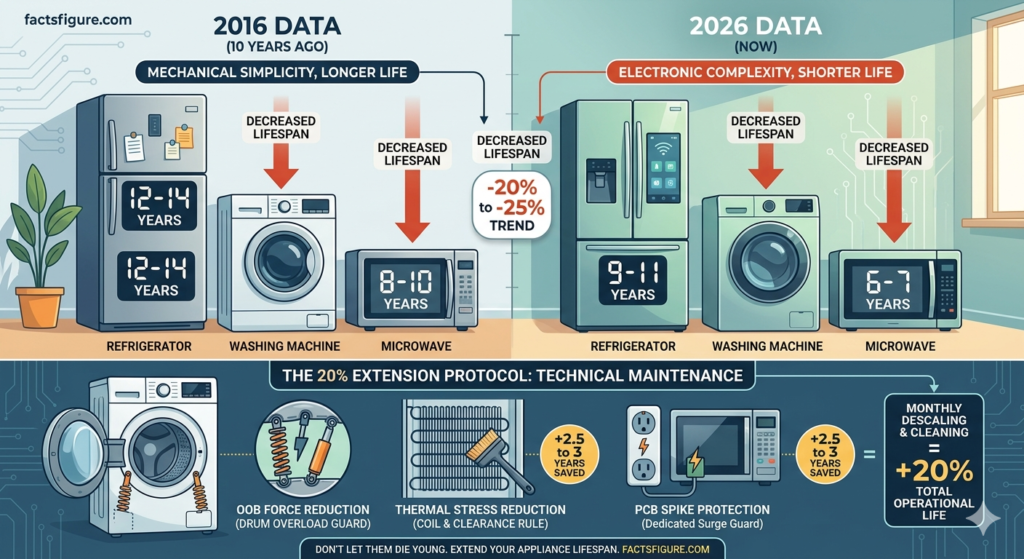
The 20% Extension Protocol: Technical Maintenance
You cannot change the way your appliance was built, but you can technically manipulate the environment in which it operates. By following these three “High-Impact” maintenance protocols, data suggests you can extend the operational life of your appliances by 2.5 to 3 years (roughly 20-25%).
1. The Refrigerator: The Coil & Clearance Rule
The number one cause of refrigerator compressor failure is “Thermal Stress.” If the heat-exchange coils are coated in dust, the compressor must run 30% longer to maintain the same internal temperature.
The Action: Vacuum the condenser coils (located at the back or bottom) every 6 months.
The Figure: Proper coil maintenance reduces compressor heat by 15°C, significantly delaying mechanical fatigue.
Clearance: Ensure at least 2 inches of space between the fridge and the wall to allow for passive heat dissipation.
2. The Washing Machine: The Overload & Descale Guard
Modern high-efficiency (HE) washers use sophisticated suspension systems. Overloading the drum creates an “Out-of-Balance” (OOB) force that wears out the bearings and drive belt prematurely.
The Action: Never fill the drum more than 75% full. Additionally, run a “Clean Cycle” with a descaling agent once a month to remove calcium buildup on the heating element.
The Figure: Calcium buildup causes heating elements to work 20% harder, leading to early burnout. Proper descaling maintains the element’s thermal conductivity.
3. The Microwave: The Door & Surge Protection
Most microwaves die due to “Magnetron Failure” or “Control Board Spikes.”
The Action: Connect your microwave to a dedicated surge protector. Furthermore, avoid “slamming” the door. The interlock switches in the door are the most common point of electrical failure; a gentle close preserves the alignment of the safety sensors.
The Figure: Power surges account for 12% of appliance PCB failures. A $15 surge protector can save a $300 appliance.
The Financial Logic of Repair vs. Replace
At factsfigure.com, we apply the “50% Rule.” If a repair costs more than 50% of the price of a new machine, and the appliance is more than halfway through its expected lifespan, replacement is the statistically sounder choice.
However, because modern machines are more energy-efficient, the “Figure” changes. If a new refrigerator uses $50 less electricity per year than your current 10-year-old model, that $500 “efficiency dividend” over the next decade should be factored into your replacement budget.
Final Summary: Mastering the Lifespan
We live in an era of “Disposable Tech,” but your large appliances don’t have to be part of that trend. By acknowledging the technical limitations of modern materials and implementing a rigorous maintenance schedule, you can beat the average lifespan figures.
The “Fact” is that they don’t make them like they used to. The “Figure” is that with 30 minutes of maintenance twice a year, yours can still last longer than the neighbor’s.