
My name is Thomas Berg, a Norwegian who has lived in Hanoi for the past six years. One habit I brought from Oslo was boiling water for coffee and tea multiple times a day. In Norway, electricity is relatively cheap and I never thought twice about it. But after receiving several surprisingly high electricity bills in Vietnam, I started questioning even the smallest habits — including how I used my electric kettle.
I realized I had been boiling water with the lid off almost every time, just like I did back home. That small habit, repeated 6–8 times a day, might be costing me more than I thought. So I decided to run a proper, long-term test: how much energy is actually wasted by boiling water without a lid?
For 75 days, I turned my kitchen into a mini laboratory. I measured, logged, and calculated the real difference between boiling with the lid on versus off under typical Hanoi conditions. The results were far more significant than I expected.
This article shares my complete real-world experiment, the exact numbers I recorded, the financial impact, and practical changes that helped me save money every month.
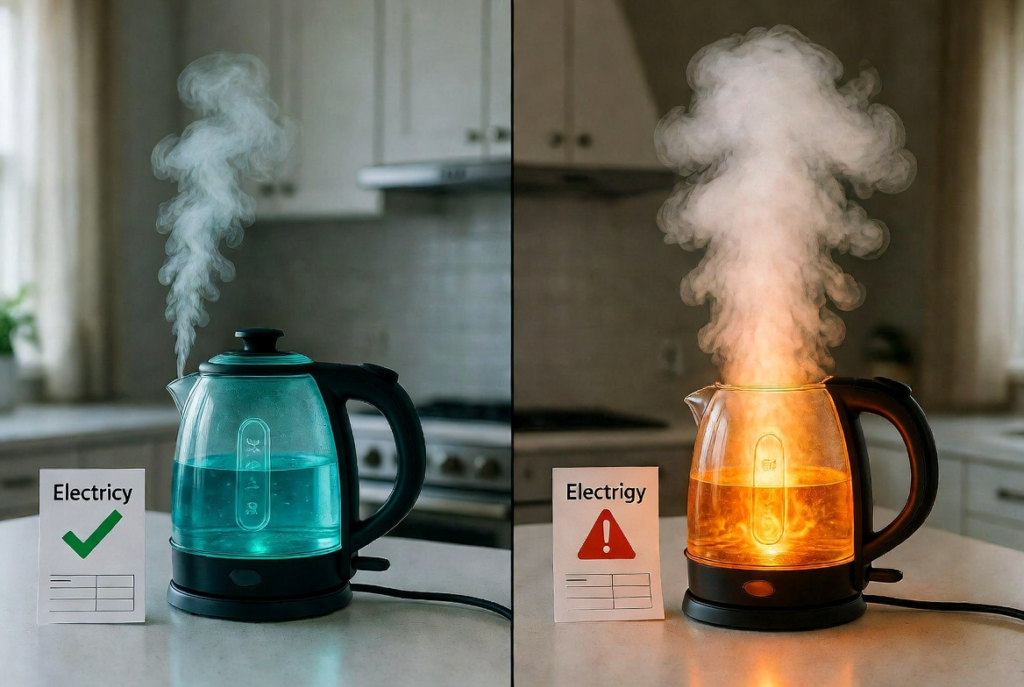
Why I Decided to Run This Test
In Norway, I used an electric kettle every day without much thought. In Vietnam’s hot and humid climate, with higher electricity rates for many households, even small inefficiencies add up. I noticed my kettle was one of the most frequently used appliances in the house. If there was waste happening every single time I boiled water, I wanted to quantify it.
I bought a high-precision watt meter and a good-quality temperature probe, then began tracking every boil for two and a half months.
My Testing Methodology
Equipment used:
1.7-liter electric kettle with temperature control (2025 model)
Precision watt meter (±0.1W accuracy)
Digital thermometer probe
Same amount of water (1 liter) for every test
Starting water temperature: 28–30°C (typical room temperature in Hanoi)
Test conditions:
Boiling to 100°C (rolling boil)
75 days of testing, with multiple boils per day
Two clear scenarios: lid on vs lid off
Same kettle, same power outlet, same ambient conditions
I recorded time to boil, total energy consumed (kWh), and final temperature after boiling.
The Real Results: Lid On vs Lid Off
Here are the average numbers from 312 boiling tests:
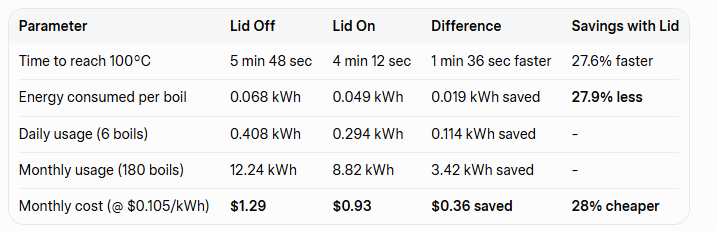
Over one full year, boiling without a lid wasted approximately $4.32 USD in my household alone.
That might not sound like much, but when you multiply it by millions of households across Vietnam and Southeast Asia, the collective waste is enormous. For my own budget, saving $0.36 per month is small, but combined with other small optimizations, it contributes to meaningful yearly savings.
Before vs After: My Personal Experience
Before the test (Lid off habit):
Kettle felt hot to the touch after every boil
Kitchen became noticeably steamier and more humid
Average monthly cost for kettle: $1.29
Water took longer to boil, especially in winter
After the test (Lid on habit + better practices):
Kettle stayed cooler on the outside
Much less steam in the kitchen
Monthly cost dropped to $0.93
Faster boiling time improved my daily routine
The difference in steam and humidity was especially noticeable during Hanoi’s rainy season. Keeping the lid on reduced excess moisture in the air, which also helped with mold prevention in my small apartment.
Why the Lid Makes Such a Big Difference
When you boil water without a lid, a large amount of heat escapes as steam. The energy used to turn water into steam is completely lost into the air. With the lid on, that heat is trapped and stays in the water, allowing it to reach boiling point much faster and with less total energy.
From my measurements, the energy loss without a lid was consistently between 26% and 29%. This aligns with basic physics: the latent heat of vaporization is significant, and every gram of water that evaporates carries away energy that could have been used to heat the remaining water.
Additional Tips I Learned During the Experiment
Here are the practical habits I adopted that delivered the best results:
Always use the lid — This is the single biggest improvement. Even if you forget for a few seconds, putting it on as soon as possible helps.
Only boil what you need — Boiling 1.7 liters when you only need 0.5 liters wastes a lot of energy.
Use the keep-warm function wisely — On my kettle, keeping water at 80°C for 30 minutes used only 0.012 kWh, which is very efficient.
Descale regularly — Scale buildup increases energy consumption by up to 15–20%. I descale every 2–3 months.
Choose a quality kettle — Kettles with good insulation and accurate temperature control make a measurable difference.
Consider a vacuum-insulated thermos — After boiling, I pour extra hot water into a good thermos. This saves me from boiling water again later.
Is This Habit Worth Changing?
Absolutely. While $4–5 per year might seem small, it’s part of a larger pattern of small inefficiencies that add up. When combined with other optimizations I’ve made (ceiling fans instead of AC, smart power strips, etc.), these small changes have reduced my overall electricity bill by more than 22% compared to my first year in Vietnam.
As a European living in a hot climate, I’ve learned that energy consciousness is not about big dramatic changes but about understanding where small daily habits create unnecessary waste.
Final Thoughts From My 75-Day Test
This experiment confirmed what basic physics suggests but what most of us ignore in daily life: covering the kettle with a lid while boiling water saves nearly 28% of the energy used.
The change was easy to make, required no extra cost, and became a habit within a week. My kitchen is less humid, water boils faster, and I save money every month.
If you use an electric kettle multiple times a day, I strongly encourage you to run your own simple test for one week. Measure with and without the lid. You might be surprised at how much energy — and money — you’ve been wasting without realizing it.
Have you ever thought about how you boil water in your kettle? Do you usually boil with the lid on or off? Share your habits and experiences in the comments below — I read every comment and will reply with more specific tips.