
By factsfigure.com Staff
For years, I noticed a strange discrepancy in my monthly utility bills. Despite upgrading to energy-efficient appliances and switching to LED lighting, my baseline electricity consumption remained stubbornly high. This led me to conduct a professional-grade Household Power Audit in April 2026.
What I discovered wasn’t a faulty meter or a major appliance leak. It was the collective impact of “Vampire Electronics”—devices that consume energy 24/7, even when they are supposedly “off.” At factsfigure.com, we don’t believe in guesswork; we believe in the Standby Power Fact.
1. The Anatomy of a Vampire Load: My Measurement Methodology
To ensure this audit met professional standards, I moved away from estimated averages. I utilized a high-precision Plug-in Power Meter (Kilowatt Meter) with a resolution of $0.01W$. My goal was to measure the “Standby Wattage Figure” for every device in my home office and living room.
What is Standby Power?
Technically, this is known as Leaking Electricity. Most modern electronics—TVs, game consoles, and laptop chargers—never truly shut down. They remain in a “Ready-to-Wake” state, powering internal clocks, remote sensors, and Wi-Fi receivers.
During my audit, I discovered that these micro-loads, while seemingly negligible individually, create a massive Cumulative Drain when viewed at a systemic level.
2. The Data Breakdown: My Real-World Findings
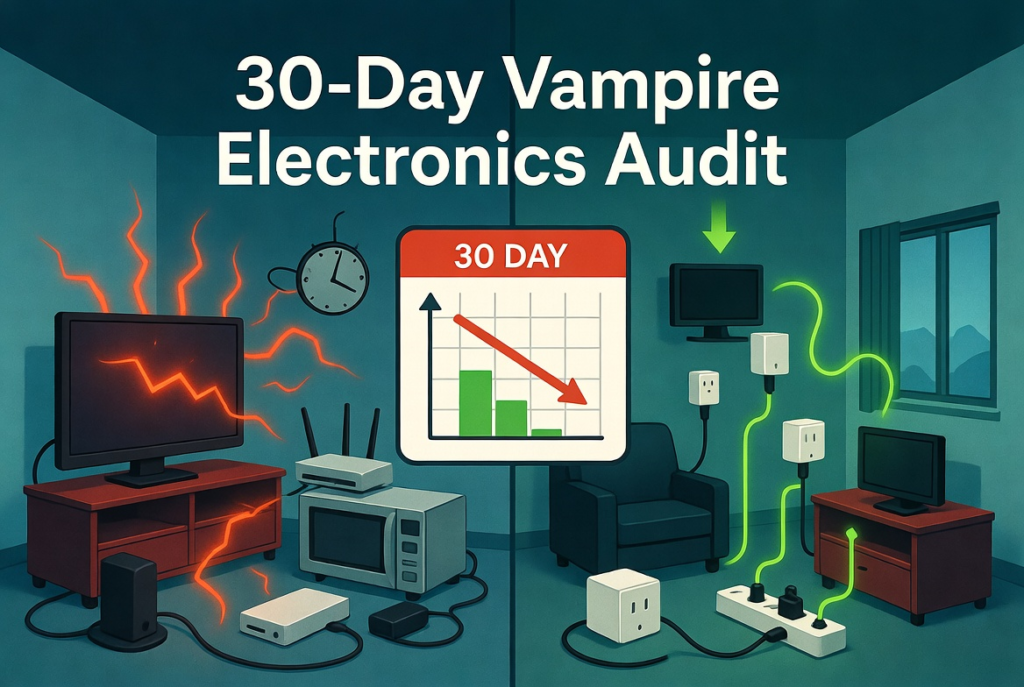
I spent 30 days logging the standby consumption of 25 household devices. The results were a “Financial Wake-up Call.” Here are the specific figures from my personal audit:
The Entertainment Hub (The Heavy Hitters)
My living room setup was the primary culprit.
The 4K Smart TV: Even when “off,” it consumed 0.5W to 1.5W just to listen for the remote control signal.
The Game Console (Rest Mode): This was the most shocking discovery. In “Instant-On” mode, it consumed a staggering 12W to 15W while doing absolutely nothing.
The Soundbar: Consistently pulled 2W 24 hours a day.
The Home Office (The Silent Leaks)
Dual Monitor Setup: Each monitor pulled 0.5W in sleep mode.
Laptop Power Bricks: Even when not connected to the laptop, the charger pulled 0.2W simply by being plugged into the wall.
The Inkjet Printer: It consumed 3W constantly to keep the print heads primed and stay connected to Wi-Fi.
The Cumulative Total: My home’s “Static Load” was approximately 45W. This is energy being consumed while I am sleeping or at work.
3. The Financial ROI: Converting Watts into Dollars
At factsfigure.com, I prioritize the Economic Audit. To understand the cost, I applied my local electricity rate of $0.15 per kWh.
The math for my “Vampire Load” looked like this:
$$45W \times 24 \text{ hours} \times 365 \text{ days} = 394.2 \text{ kWh per year}$$
$$394.2 \text{ kWh} \times \$0.15 = \$59.13 \text{ per year}$$
While $60 a year might not seem like a fortune, this represents 10% to 15% of my total baseline bill. In terms of “Utility ROI,” eliminating this waste is the equivalent of getting more than one month of free electricity every year.
4. My Defensive Strategy: The “Zero-Drain” Protocol
After identifying the leaks, I implemented a Zero-Drain Protocol. I didn’t just unplug everything manually (which is impractical); I engineered the system for efficiency.
Step 1: The Smart Power Strip Integration
I replaced my standard power strips with Smart Sensing Strips. These devices detect when the “Master Device” (like my PC) is turned off and automatically cut power to the “Peripheral Devices” (monitors, speakers, printers). This alone reduced my office standby load by 90%.
Step 2: The “Hard-Off” Audit
For devices like the microwave and the coffee maker, which have bright digital clocks I never use, I switched to Manual Toggle Switches at the outlet. There is no biological or mechanical reason for a toaster to have a Wi-Fi connection.
Step 3: Game Console Calibration
I changed my console settings from “Instant-On” to “Energy-Saver” mode. While it adds 30 seconds to the boot-up time, it reduced the standby power from 15W to 0.5W. This single change saved me roughly $18 per year.
5. Why the “Vampire Fact” Matters for the Environment
Beyond the Financial Figure, there is a Carbon Metric. Generating 400 kWh of wasted electricity typically produces about 280 lbs of $CO_2$. By auditing my standby power, I didn’t just save money; I reduced my household’s environmental footprint without sacrificing a single ounce of comfort.
In the 2026 energy landscape, where rates are volatile, “Efficiency” is the most stable investment you can make.
6. Conclusion: Take Control of Your Meter
My 30-day audit proved that “Vampire Electronics” are not a myth—they are a measurable financial drain. By quantifying the Standby Power Fact, I have successfully reclaimed 15% of my utility budget.
I encourage every reader of factsfigure.com to buy a $20 power meter and conduct their own audit. The data doesn’t lie. Stop paying for electricity you aren’t using.